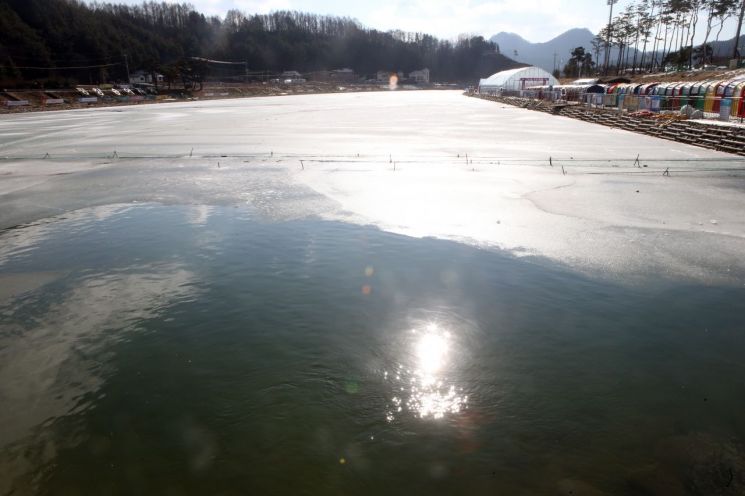
 The winter is so warm that the ice is melting. A scene from the trout festival held on the 18th in Jinbu-myeon, Pyeongchang-gun, Gangwon-do. (Photo by Yonhap News)
[Asia Economy Reporter Moon Chae-seok] It has been revealed that the government has not made any electricity demand reduction requests (dispatch orders) in the past two years. This is because it was judged that electricity demand decreased as the average summer temperature dropped and winter temperatures rose. Demand reduction requests are policies where the Korea Power Exchange issues reduction orders mainly to companies capable of reducing electricity usage among 3,580 firms pre-contracted when energy use concentrates during peak electricity hours.
According to the Korea Power Exchange on the 28th, the government has not made any demand reduction requests for two years since February 7, 2018. The government made five requests to companies in 2017 (twice in July, three times in December) and seven times in 2018 (five times in January, twice in February).
According to the Ministry of Trade, Industry and Energy and academia, climate change and sluggish domestic demand influenced this decision. The easing of winter cold waves and summer heatwaves was cited as the primary reason. The average temperatures in December, January, February, and July?months when the government made demand reduction requests over the past three years?all decreased.
According to the Korea Meteorological Administration, the average December temperatures were -1.9℃ in 2017, -0.6℃ in 2018, and 1.4℃ last year. January temperatures were -4℃ in 2018, -0.9℃ last year, and 1.1℃ up to the 27th of this year. February temperatures were -0.2℃ in 2017, -1.6℃ in 2018, and 1℃ last year. For July, temperatures were 26.9℃ in 2017, 27.8℃ in 2018, and 25.9℃ last year.
Accordingly, the electricity reserve margin remained above a stable level of 10%. The lowest annual electricity reserve margins were 14.2% in 2016, 14.1% in 2017, 14.6% in 2018, and 13.1% last year.
The government manages the situation by considering the deployment of reserve power if the electricity reserve margin falls below 10%. The government has repeatedly stated its intention to manage so that the reserve margin does not fall below 5%, which triggers the first stage of the electricity supply emergency alert (preparation stage), considering the fourth week of this month as the winter electricity peak period.
Professor Sung Poong-hyun, Chair Professor of Nuclear and Quantum Engineering at KAIST, said, "The biggest reason for the reduction in government electricity demand reduction requests is that temperatures neither dropped nor rose excessively, reducing the need for electricity."
The fact that industrial electricity demand decreased due to sluggish domestic demand is also cited as a reason why the government did not make demand reduction requests to companies.
According to the Korea Energy Economics Institute, the electricity consumption decrease rate in the primary metal industry increased from -0.7% in 2018 to -5% in 2019. The growth rate in petrochemicals decreased from 2.8% to 0.5%, and in fabricated metals from 4% to 0.4%.
Professor Sung explained, "The reduction in corporate electricity demand due to sluggish domestic demand and manufacturing likely influenced government policy as well."
Although the government has not made demand reduction requests for two consecutive years, experts emphasize the necessity of the system, warning against complacency.
They particularly urge not to forget that the government's nuclear phase-out policy has lowered nuclear power plant operation rates, making it essential to thoroughly manage electricity demand. Since the number of operable nuclear power plants is decreasing, the government must consider whether to increase nuclear utilization rates during summer and winter electricity peak periods each time.
According to Korea Electric Power Corporation (KEPCO) and Korea Hydro & Nuclear Power, nuclear power plant utilization rates fell from 79.2% in 2016 to 71.2% in 2017 and 65.9% in 2018, then rose again to 72.8% in the fourth quarter of 2018 and surged to 79% by the end of June last year.
The period when nuclear utilization rates sharply increased was after the government restarted Hanul Unit 4 in July 2018 to prepare for the summer electricity peak. In other words, the government is in a position to make demand reduction requests or restart nuclear power plants whenever necessary to prepare for electricity peak periods.
Professor Lee Deok-hwan, Emeritus Professor of Chemistry and Science Communication at Sogang University, said, "The criterion for electricity demand requests is ultimately the electricity reserve margin, not the weather. The point of climate change is not that summers are getting less hot and winters less cold every year, but that 'extreme weather' is occurring more frequently, making climate prediction more difficult. Therefore, even if there was electricity surplus for a year or two, we must not neglect preparations."
© The Asia Business Daily(www.asiae.co.kr). All rights reserved.

















