Customer-Customized Promotions Emerging as Popular Attractions in New Towns
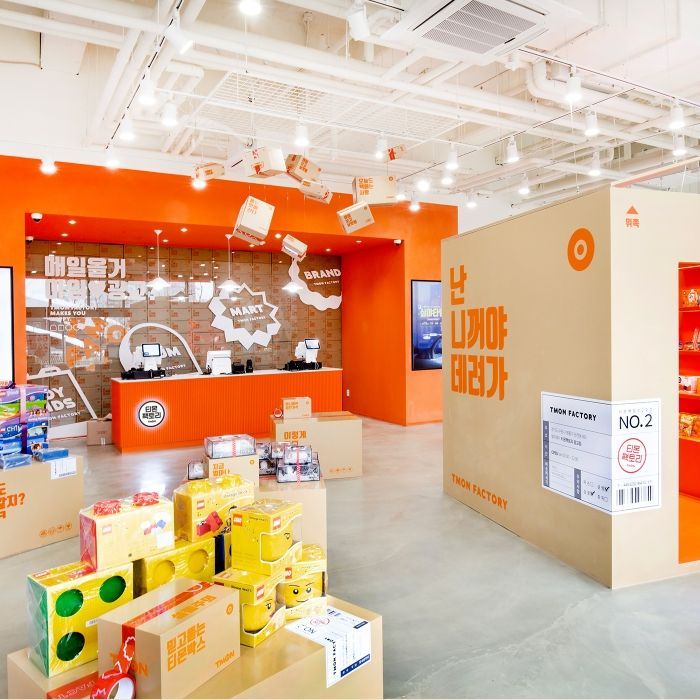
Gwanggyo Hosu Park-ro in Yeongtong-gu, Suwon-si, Gyeonggi-do. In the heart of this new town, where many young parents in their 30s and 40s reside, there is a store unlike any other. Named 'Timon Factory,' it is an offline store operated by the e-commerce company Timon. Although it is a store opened by an online mall, it is not merely a place that transfers products sold online to offline. This location, which conducts various plans linking online and offline experiences and target customer-tailored promotions, has emerged as a local landmark in less than a year.
According to Timon on the 28th, during the operation period of the offline stores?Timon Factory Gwanggyo branch for 9 months and Wirye branch for 24 months?the cumulative number of customers visiting these two locations surpassed 1 million. In the case of the Wirye branch, it received great response from local residents, achieving the highest monthly sales five times greater than the first month of opening in March 2018.
Timon Factory is an experiential store designed to allow customers to experience Timon's online shopping offline. It operates for a certain period at key new town hubs to study consumer patterns through offline sales and analyze data of target customer groups. There are two locations: Wirye and Gwanggyo, which opened in April last year. Although the Wirye branch initially signed a one-year contract, it showed better-than-expected effects in forming the local commercial district, leading to a strong extension request from the operating partner company, resulting in an additional year of operation.
Timon explained that it strategically established offline stores in areas where its core target, 'young moms and dads in their 30s and 40s,' live in large numbers, planning promotions centered on 'child-rearing moms' in Wirye and 'elementary school moms' in Gwanggyo. To provide a special experience to store visitors, it collaborated with large companies such as Ottogi and Hyundai Livart and collected big data on customer purchases. For example, it was able to obtain information on purchase options selected offline as well as products or category items added to the shopping cart, and based on this, it proposed customized products. A Timon representative said, "We collected detailed purchase patterns of offline customers to utilize them online," adding, "There is also a positive function where manufacturers can refer to the development and production based on the actual experiences and reactions of offline customers."
In the global market, e-commerce companies are actively creating offline stores like this. Examples include Amazon's 'Amazon Go' and Alibaba's 'Hema Xiansheng.' This is because e-commerce companies recognize offline stores as spaces and opportunities to demonstrate advanced technology. In particular, there is a trend of transplanting the success formula of e-commerce, which has grown through data analysis, into offline environments.
Both of Timon's offline stores will conclude their respective operation periods of 2 years and 1 year this year and enter a phase of reorganization. However, Timon explained that it plans to continue its offline store challenges through various methods. Lee Jin-won, CEO of Timon, said, "Timon Factory has not only accumulated offline data that online malls find difficult to experience and achieved many meaningful results as a testbed for various services, but also established itself as a symbolic store with unique concepts and branding in each commercial district it entered, attracting love calls from many large malls expecting its effects."
© The Asia Business Daily(www.asiae.co.kr). All rights reserved.
![Clutching a Stolen Dior Bag, Saying "I Hate Being Poor but Real"... The Grotesque Con of a "Human Knockoff" [Slate]](https://cwcontent.asiae.co.kr/asiaresize/183/2026021902243444107_1771435474.jpg)











