First Investigation Results by Chinese Authorities... Strong Evidence of Origin
However, the Specific Animal Source Remains Unknown
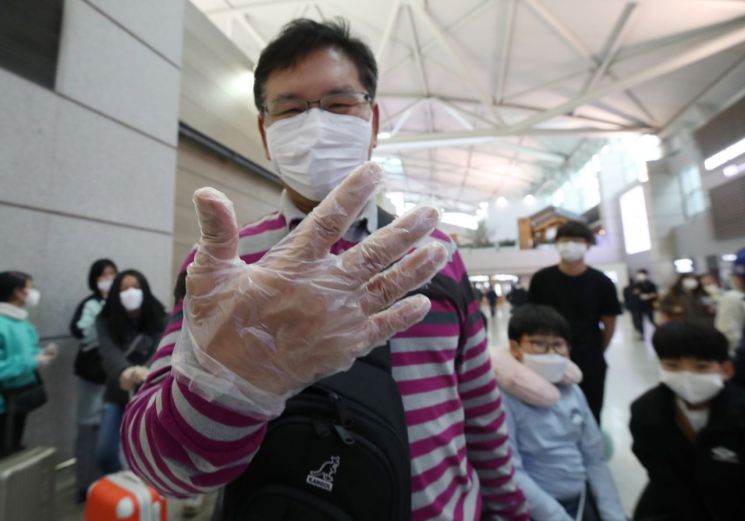 On the afternoon of the 27th, when the fourth confirmed case of the novel coronavirus infection known as 'Wuhan pneumonia' occurred in Korea, a departing passenger at Terminal 1 of Incheon International Airport is seen heading towards the departure inspection desk, showing hands wearing plastic gloves.
 Chinese health authorities have officially announced that a large amount of the novel coronavirus was detected at the Huanan Seafood Wholesale Market in Wuhan, Hubei Province, China. This location has been identified as the starting point of the 'Wuhan pneumonia.' The Huanan Market, where edible wild animals were bred, slaughtered, and sold in large quantities, provides strong circumstantial evidence that it is the origin of the novel coronavirus.
According to the state-run Xinhua News Agency on the 27th, the Chinese Center for Disease Control and Prevention conducted an epidemiological investigation starting from January 1, and out of 585 samples tested, 33 samples were found to contain the novel coronavirus.
Although the Huanan Market outwardly displayed a sign as a 'seafood wholesale market,' it was confirmed that various edible wild animals were illegally traded inside.
Health authorities' investigation revealed that the Huanan Market was actually operated as a comprehensive market, contrary to its name as a seafood wholesale market.
Among the 33 samples that tested positive for the novel coronavirus, 21 were collected from shops within the market.
The Huanan Market is divided into a western and an eastern section by a north-south avenue, and of the 33 positive samples, the vast majority?31?were from the western section.
It was confirmed that several wild animal trading shops were located in the 7th and 8th streets of the western section.
The frequency of novel coronavirus detection was higher in areas where edible wild animal shops were concentrated.
Of the 33 positive samples, 14 samples, accounting for 42.4%, were collected from wild animal shops and their surroundings.
Xinhua News Agency reported, "This investigation result shows that the virus originated from wild animals sold at the Huanan Market."
However, Chinese health authorities have not yet identified the specific wild animal responsible for transmitting the novel coronavirus that causes 'Wuhan pneumonia' in humans.
Various wild animals such as badgers, foxes, masked palm civets, crocodiles, bamboo rats, geese, snakes, and koalas have been traded at the Huanan Market.
According to Chinese scientists' analysis, the novel coronavirus showed the highest similarity to coronaviruses found in bats.
Experts are focusing on the possibility that the coronavirus, originally parasitic in bats, mutated by using other wild animals as intermediate hosts in the unsanitary Huanan Market in Wuhan, eventually infecting humans.
The academic consensus is that the SARS (Severe Acute Respiratory Syndrome) outbreak in 2002-2003 also originated from a virus in bats that mutated and was transmitted to civet cats, which then spread to humans.
© The Asia Business Daily(www.asiae.co.kr). All rights reserved.
![Clutching a Stolen Dior Bag, Saying "I Hate Being Poor but Real"... The Grotesque Con of a "Human Knockoff" [Slate]](https://cwcontent.asiae.co.kr/asiaresize/183/2026021902243444107_1771435474.jpg)
















