Greenhouse Gas 10,000 Times Stronger Than CO2, Record-Level Emissions
China and India Pledged Reductions Under 2015 Montreal Protocol
But Reached All-Time High in 2018
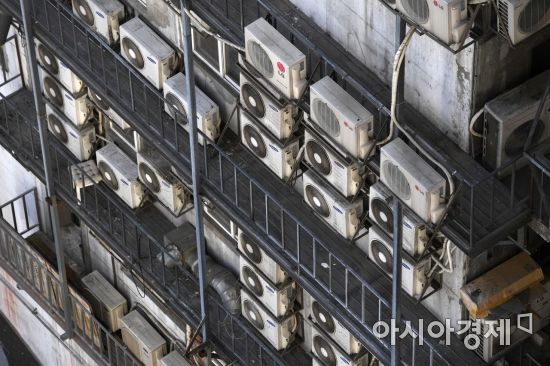 The exterior wall of a building in Jung-gu, Seoul, filled with air conditioner outdoor units. / Photo by Mun Ho-nam munonam@
[Asia Economy Reporter Junho Hwang] Amid growing concerns about global warming following recent wildfires in Australia, a study has revealed that the levels of a greenhouse gas over 12,400 times more potent than carbon dioxide have reached record highs. This research has drawn global attention to China and India, which had pledged under the 2017 Montreal Climate Agreement not to produce this greenhouse gas. Prior to China and India joining the climate agreement, various countries had raised concerns that this greenhouse gas could trigger a 'climate bomb.'
Record Increase in Hydrofluorocarbon Levels
On the 24th, international researchers including those from the University of Bristol in the UK released findings showing a record increase in levels of the greenhouse gas hydrofluorocarbon (HFC-23). Foreign media highlighted that HFC-23 levels should have been close to 'zero,' but in reality, they showed record figures.
HFC-23 is a deadly greenhouse gas. It causes global warming at least 12,400 times more powerfully than carbon dioxide. This substance is emitted during the production of hydrochlorofluorocarbon (HCFC), which is used as a refrigerant in household air conditioners and refrigerators. China and India, the main producers of hydrochlorofluorocarbon (accounting for 75% in 2017), declared in 2015 that they would not emit HFC-23 in response to worldwide criticism over the climate bomb threat.
As researchers expected, HFC-23 levels should have decreased. However, emissions of HFC-23 increased to a record high (15,900 tons in 2018). This amount is comparable to the annual carbon dioxide emissions from about 50 coal-fired power plants.
Eyes on China and India
The researchers believe that China and Japan either failed to fully reduce HFC-23 or emitted HFC-23 while having significant unreported HCFC-22.
Dr. Kieran Stanley, the lead author of the study, stated, "In China's case, it is highly likely that they did not succeed in reducing HFC-23 emissions as reported," and added, "Regarding India, there is no additional measurement data to confirm whether they have taken steps to reduce HFC-23 emissions, so certainty is lacking."
© The Asia Business Daily(www.asiae.co.kr). All rights reserved.

















