"All-Out Offensive for a Direct Breakthrough" Emphasized
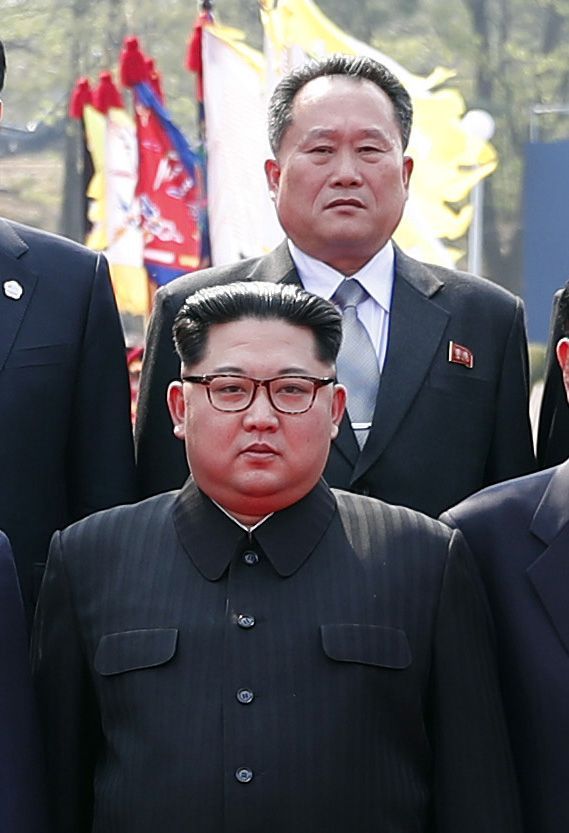 North Korean State Affairs Commission Chairman Kim Jong-un and Ri Son-gwon taking a commemorative photo at the inter-Korean summit held at Panmunjom on April 17, 2018.
 North Korea officially confirmed on the 23rd that Ri Son-gwon, former chairman of the Committee for the Peaceful Reunification of the Fatherland (CPRF), has been appointed as the Minister of Foreign Affairs. The emergence of Ri Son-gwon, a military veteran, draws attention to how it will affect North Korea's future policies toward the United States and South Korea.
Korean Central Broadcasting reported on the same day, "On the occasion of the Lunar New Year, the Ministry of Foreign Affairs held a banquet today for the diplomatic corps stationed in our country," adding, "Minister of Foreign Affairs Ri Son-gwon and other Ministry of Foreign Affairs officials participated."
Earlier, North Korea-related sources revealed that Ri had been appointed as the new Minister of Foreign Affairs, but this is the first time North Korean media officially reported it.
Ri Son-gwon's emergence is first interpreted as revealing North Korea's hardline stance in foreign affairs.
Evans Revere, former Deputy Assistant Secretary of State, said in an interview with Voice of America (VOA) on the 24th, "The replacement of North Korea's foreign minister aligns with the hardline diplomatic policy toward the U.S. announced by Chairman Kim Jong-un at the Workers' Party plenary meeting at the end of last year."
He added, "This personnel change confirms the direction North Korea is aiming for," and predicted, "The United States will face a difficult situation going forward."
In fact, Minister Ri emphasized a "general offensive for a frontal breakthrough." On the 23rd, Korean Central Broadcasting reported that Ri mentioned, "In high regard of the programmatic tasks presented at the 5th plenary meeting of the 7th Central Committee of the Workers' Party, our people have risen in a general offensive to achieve a frontal breakthrough of the difficulties on the path of socialist construction through self-reliance," and "expressed the foreign policy stance of the government of the Republic."
Jung Sung-jang, head of research planning at the Sejong Institute, evaluated, "Ri Son-gwon has no experience negotiating with the United States and is basically an expert in inter-Korean military talks," interpreting this as "reflecting Kim Jong-un's position to halt denuclearization negotiations with the U.S. and to make a frontal breakthrough against international sanctions on North Korea."
He predicted, "It will be difficult to expect meaningful progress in North Korea-U.S. talks going forward," and "North Korea's stance toward the U.S. will become even more hardline."
Ken Gause, director of international relations at the U.S. Naval War College, also told VOA, "The appointment of Ri Son-gwon aligns with Kim Jong-un's hardline policy toward the U.S., expressing dissatisfaction with the lack of progress in diplomacy."
Frank Jannuzi, president of the Mansfield Foundation and former director for East Asia and the Pacific at the U.S. Senate Foreign Relations Committee, focused on Ri Son-gwon's military background. Although he has little diplomatic experience, he likely knows more about North Korea's security policy and nuclear program than officials from the Ministry of Foreign Affairs.
In other words, Ri Son-gwon's appointment signifies a shift from a foreign minister who is a diplomatic expert to one who is a security expert, implying changes in how North Korea will engage in dialogue with neighboring countries and the United States.
Meanwhile, Ri Son-gwon has been Kim Yong-chol's right-hand man since his military days in inter-Korean military talks. When Kim Yong-chol moved to the Workers' Party in 2016 to oversee inter-Korean affairs, Ri immediately left the military and was promoted to chairman of the CPRF.
Ri Son-gwon was also known for making blunt remarks, such as reportedly scolding business leaders visiting Pyongyang during the September 2018 inter-Korean summit by asking, "Can you swallow cold noodles?" which sparked controversy.
© The Asia Business Daily(www.asiae.co.kr). All rights reserved.

















