KIEP Report on "Economic Impact and Implications of Australian Bushfire Damage"
"Climate Change Effects, Potential Shift in Resource Development Policies... Monitoring Required"
Australian Consumer Confidence Index Declines Since September Last Year... Tourism Industry Contraction
[Asia Economy Reporter Kim Bo-kyung] As damage to the agriculture and livestock industry expands due to recent wildfires in Australia, concerns have been raised that disruptions may occur in the import of meat, wool, wine, and other products, highlighting the need for countermeasures.
According to the report "Economic Impact and Implications of the Australian Wildfire Damage" released on the 24th by the Korea Institute for International Economic Policy, the fires are expected to cause disruptions in the production of major agricultural products such as meat, dairy, wool, and wine.
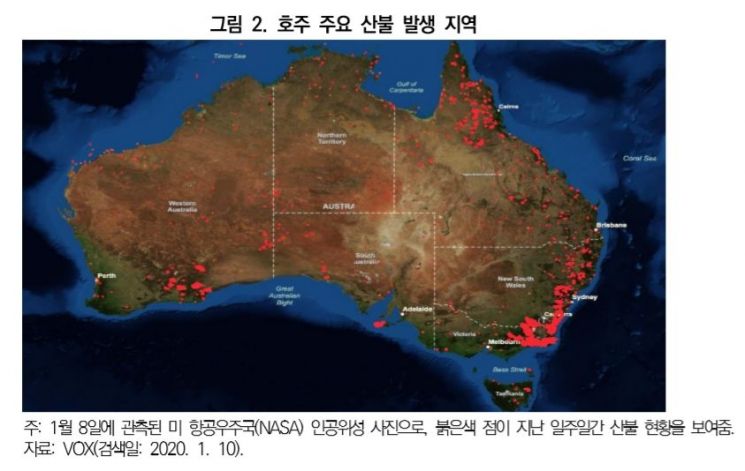
The wildfires, which began in September last year in New South Wales in southeastern Australia, have spread across the country to Victoria, South Australia, and other states, continuing for five months.
The fires have resulted in at least 29 deaths, burned an area of 10 million hectares (100,000 km²) comparable to the size of South Korea, and are estimated to have killed over one billion livestock and wild animals.
The report states that 9% of Australia's total cattle and 13% of sheep are raised in areas severely affected by the wildfires. New South Wales and Victoria, the regions most severely damaged by the fires, are the largest wool-producing areas in Australia.
Adelaide Hills, a representative wine-producing region in Australia, reportedly lost one-third of its wineries to the fires.
If the production of Australian agricultural and livestock products shrinks due to wildfire damage, it is expected to have a significant impact on our imports.
Last year, South Korea's imports of Australian beef (frozen and chilled) totaled $866 million, accounting for about 44% of the country's total beef imports, making Australia the second-largest supplier after the United States ($1.045 billion).
Imports of Australian wool amounted to approximately $68 million, representing 92% of total wool imports, making it an important import item. Additionally, Australia is South Korea's sixth-largest wine (red wine) supplier, accounting for 6% ($10 million) of total wine imports last year.
The Korea Institute for International Economic Policy suggested, "Due to the damage to Australia's agriculture and livestock industry caused by the wildfires, South Korea may face disruptions in imports of meat, wool, and wine, so it is necessary to prepare countermeasures such as diversifying import sources."
The wildfires are analyzed to be influenced by climate change, including global warming, indicating the possibility of future policy changes related to resource development by the Australian government. Last year, thermal coal and iron ore were South Korea's first and second largest import items from Australia.
The institute stated, "There is a possibility that resource development, including coal and iron ore, which are major Australian export items, could also be affected," and added, "The South Korean government, as a major importer of these resources, needs to continuously monitor related policy changes."
Meanwhile, the Australian Consumer Confidence Index has shown an unusual decline due to the wildfires. The index has steadily dropped from 112.8 in September last year, when the fires began, to 106.2 on January 7 of this year.
As the fires have damaged Australia's image as a natural tourist destination, a contraction in the tourism industry is also expected. The Australian tourism industry accounts for 3.1% of the total GDP and 5.2% of total employment, making it one of the major industries.
© The Asia Business Daily(www.asiae.co.kr). All rights reserved.

















