Cafe, Restaurant, Convenience Store Inside Bank
Robot Teller Service... A New Customer Experience
[Asia Economy Reporter Kim Min-young] Major overseas banks have embarked on branch innovation. Branches still serve as the main channels for account opening and act as key factors determining customer satisfaction with banks. By innovating branches, which are spaces for direct interaction with financial consumers, banks aim to enhance customer satisfaction and transform into institutions offering new experiences in the 2020s.
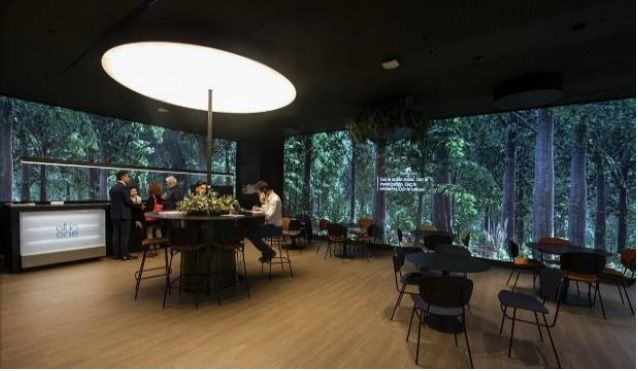
According to the International Financial Center on the 26th, Spain's Caixa bank opened flagship stores called ‘all in one’ in Valencia and Barcelona in July and October last year.
These flagship branches provide innovative banking experiences. They offer all financial and non-financial services and are also designed to be used as cafes and dining spaces. Each branch employs 80 staff members who serve individual, self-employed, and small business customers. The branches offer food prepared by famous chefs and host monthly programs including discussions, lectures, and meetings on various topics.
Hong Kong's HSBC has ‘employed’ robot tellers at its branches. Since introducing SoftBank’s robot ‘Pepper’ to its flagship store in Manhattan, New York in 2018, it has expanded the use to other branches.
Pepper directly interacts with customers, introduces products and services, and provides a new banking experience. By guiding customers on how to open accounts or connecting inquiries to staff to reduce waiting times, bank employees can focus more on personalized services.
The bank encourages customers to upload photos taken with Pepper on social networking services (SNS) to promote the robot teller Pepper.
With Pepper’s introduction, the flagship store’s new business performance increased by more than 60%, and the number of branch visitors grew more than fivefold. Among over one billion SNS posts, 99% were evaluated as positive experiences.
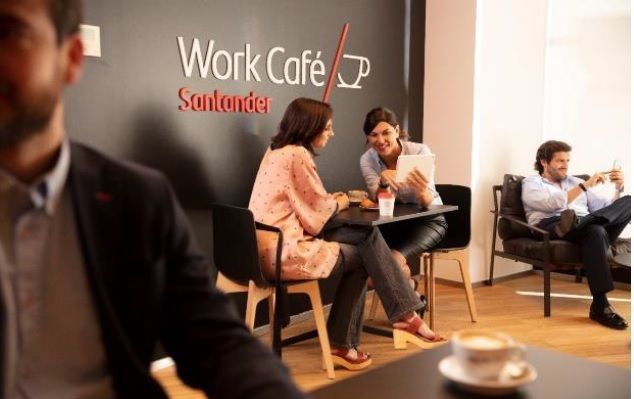
Spain’s Santander bank first introduced caf? branches (Work Caf?) in Chile and then expanded them to six countries in Latin America and Europe. The US’s Wells Fargo is piloting express centers with lounge-style spaces equipped with ATMs and video conferencing facilities.
Domestic banks have also faced waves of change. KEB Hana Bank operates various themed ‘Culture Banks’ at its branches, including crafts, bookstores, gardening, and fashion edit shops. A bookstore is located in the Gwanghwamun Station branch in Seoul, where a minibar sells coffee and beer.
Kookmin Bank’s Seocho-dong Comprehensive Financial Center has decorated its first floor like a stylish caf?. Plants are placed throughout, and coffee and cookies are sold. Five ATMs tucked in a corner of the store remind visitors that it is a bank. It is popular among nearby office workers and housewives.
NH Nonghyup Bank introduced the ‘Hanaro Mini In Branch’ concept, combining a bank and convenience store so customers can use financial services and convenience store amenities simultaneously. Customers can purchase major agricultural products and processed farm foods.
Woori Bank has opened cafes and bakeries in its Jamsil Lotte World Mall and Dongbu Ichon-dong branches, and Shinhan Bank installed an art gallery inside its Hongik University branch.
Yoon Hee-nam, a researcher at the International Financial Center, said, “Domestically, while the number of branches is decreasing due to the strengthening of digital finance, there is a trend of introducing experimental branches combining concepts such as cafes, bookstores, and convenience stores. Going forward, it is necessary to expand the development and introduction of differentiated branch types suitable for the domestic financial environment.”
© The Asia Business Daily(www.asiae.co.kr). All rights reserved.


















