Government Announces 'Regulatory Sandbox Development Plan' on 1st Anniversary of Implementation
Establishment of Private Reception Organization to Improve Accessibility
Dedicated Departments Designated in All Ministries
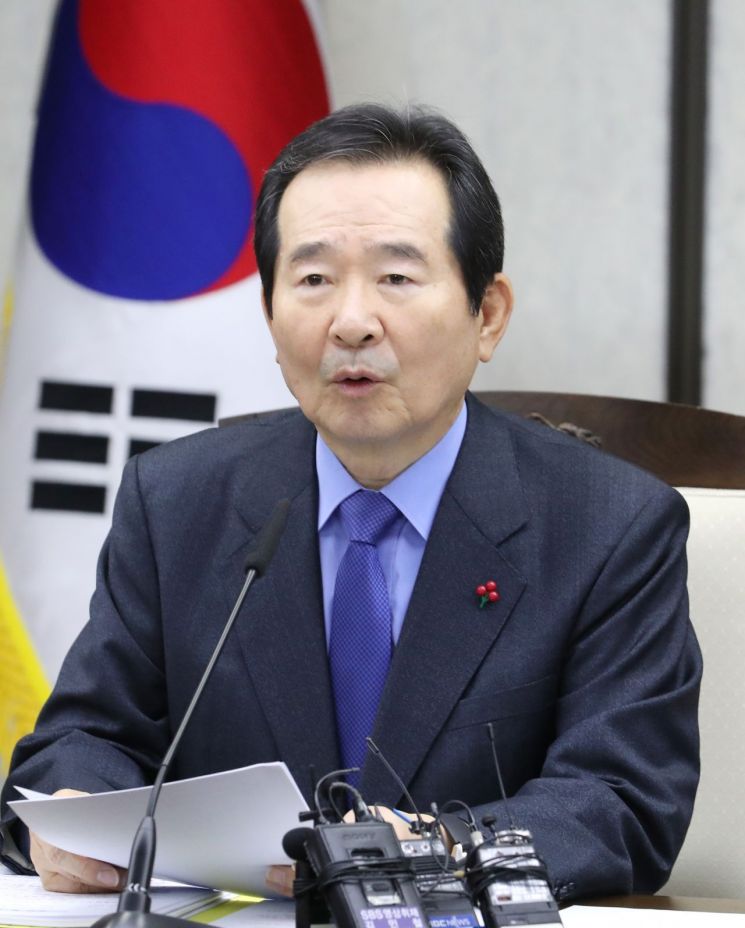 Prime Minister Chung Sye-kyun is speaking at the Government Policy Coordination Meeting held at the Government Complex Sejong in Sejong City on the morning of the 23rd.
[Sejong=Asia Economy Reporter Joo Sang-don] The government has decided to establish a Regulatory Sandbox Support Center at the Korea Chamber of Commerce and Industry to enhance accessibility and convenience for applicant companies. Additionally, dedicated departments for the regulatory sandbox will be designated in all ministries.
On the 23rd, the government held a National Policy Issue Inspection and Coordination Meeting chaired by Prime Minister Chung Sye-kyun at the Government Complex Sejong, where it prepared and announced the 'Regulatory Sandbox Development Plan' containing these measures.
First, the government will create a private reception organization to make it easier for companies to access the regulatory sandbox system during the application and reception stages. Currently, dedicated institutions for ICT and industrial convergence, financial innovation, and other sectors only support applications and receptions related to their respective tasks. In addition, a 'Regulatory Sandbox Support Center' will be established within the Korea Chamber of Commerce and Industry to accept applications from companies regardless of sector, provide legal advice and consulting, and support coordination with ministries. After a three-month pilot operation, it will be expanded into a permanent operating system, and the support functions for applicant companies will be expanded by utilizing the networks of the Korea Chamber of Commerce and Industry and regional chambers.
The government also plans to accelerate the regulatory sandbox by shortening the special review period and the period for proving the stability of demonstration exceptions. The rapid processing system for similar or identical tasks will be reinforced so that if the special project and business model are the same as existing ones, the period from application to approval will be shortened to within one month. Furthermore, the minimum six-month demonstration period will be abolished, allowing immediate commencement of the legislative amendment process once stability is proven.
Dedicated departments for the regulatory sandbox will be designated in all ministries to support the proactive establishment of standards for new technologies and certification criteria required for products approved under the regulatory sandbox before the expiration of the special exception period. Also, when an application project receives temporary approval, prompt legislative adjustments will be pursued under the principle that 'laws are submitted to the National Assembly within six months, and subordinate statutes are amended within three months.'
If legislative adjustments are delayed, the special exception will be extended until the law is amended. Temporary approval will include a provision in the Information and Communications Convergence Act for 'automatic extension of temporary approval validity in case of legislative delay,' and for demonstration exceptions, if safety is proven but legislative adjustments are unavoidably delayed, legal amendments will be pursued to allow conversion to temporary approval or additional extension of the demonstration exception period.
Since the regulatory sandbox began on January 17 last year, 278 cases were received by the end of last year, with a total of 195 projects approved. Due to this, some criticism has arisen that 'the number of approvals is too low,' along with concerns that the government is 'passive regarding socially contentious issues such as Tada.' A National Assembly Coordination Office official stated, "Excluding 50 cases withdrawn due to business changes among the unapproved cases, only 13 were rejected," adding, "Virtual currency-mediated overseas remittance services like Bitcoin were rejected due to a lack of social consensus based on opinions that the harms outweigh the benefits, such as speculative overheating. Going forward, a separate conflict resolution process will be operated to prepare alternatives based on social dialogue."
© The Asia Business Daily(www.asiae.co.kr). All rights reserved.

















