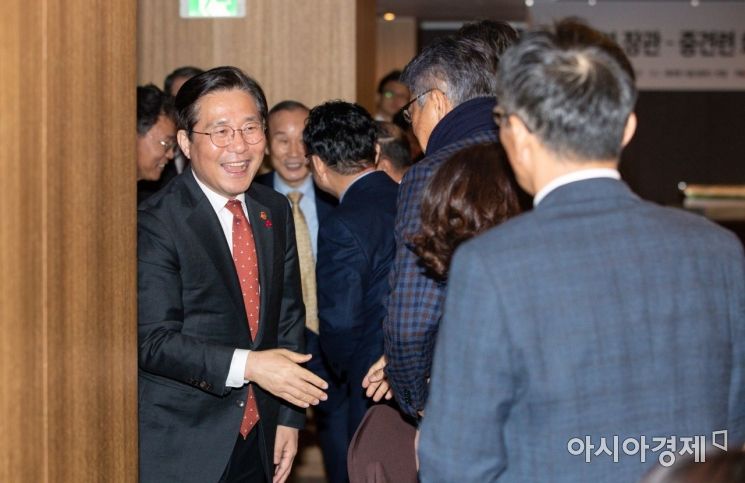
 The smiling person is Seong Yun-mo, Minister of Trade, Industry and Energy./Photo by Jinhyung Kang aymsdream@
[Asia Economy Reporter Moon Chaeseok] Experts have shown mixed reactions to the government's plan to establish departments specializing in materials, parts, and equipment (SoBuJang) at universities starting this March to facilitate the retraining of employees from partner companies, drawing attention.
On the 22nd, the Ministry of Trade, Industry and Energy announced the plan to establish SoBuJang departments at the '3rd SoBuJang Competitiveness Committee' chaired by Deputy Prime Minister and Minister of Economy and Finance Hong Nam-ki.
The ministry stated that it will establish 'SoBuJang Win-Win Contract Departments' at three universities this year. The program will be operated by having large corporations identify the educational needs of partner company (small and medium-sized enterprise) employees and jointly develop curricula with universities.
In the materials and parts sector, Kyung Hee University and Samsung Electronics will collaborate; in the hydrogen vehicle sector, Suwon University and Hyundai Motor Company (Hyundai Motor) will partner; and in the connected car sector, Daegu University and KT will join forces. Each department will have an enrollment capacity of about 15 to 20 students.
Incentives to attract talented personnel have also been prepared. The government plans to support up to 50% of labor costs for up to three years when companies hire research personnel related to SoBuJang, and up to 50% of labor costs for up to six years when specialized personnel from public research institutions are dispatched to companies.
For ten SoBuJang occupations including electronics, chemistry, and telecommunications engineering, overseas experts (E-7 visa holders) will be granted fast-track procedures such as electronic visas when seeking employment in Korea, and income tax deductions of up to 70% for five years.
Those praising the government policy say it is the most rational and effective among the SoBuJang policies implemented so far.
Professor Sung Tae-yoon of Yonsei University's Department of Economics diagnosed, "Given Korea's reality, it is highly likely that systematic education for partner company personnel has not been provided," adding, "On-site personnel training is more urgent than training bachelor's degree holders."
However, some question whether focusing policy efforts on universities will be effective.
Joo Won, head of research at Hyundai Research Institute, said, "SoBuJang policy requires mid- to long-term planning rather than short-term measures, so we need to consider whether linking with universities is the right direction," adding, "Companies may not gain much from universities, and in the long term, nurturing research and development personnel centered on bachelor's degree holders is better."
Experts commonly pointed out that pouring budgets into policies is not necessarily the best approach.
Joo advised, "For short-term measures, why not leave it to companies? What companies want may not necessarily be money. In the long term, cooperation between government and companies to build systems such as research centers is also a method."
Professor Sung also evaluated, "The win-win contract department policy is better than simple budget support."
© The Asia Business Daily(www.asiae.co.kr). All rights reserved.

















