Recovery Before App User Boycott
Sharp Rise in Air Travel and Car Sales
Hosaka Yuji "Impact of Summit Talks"
Abe's Low Profile, Commitment to Irrigation Improvement
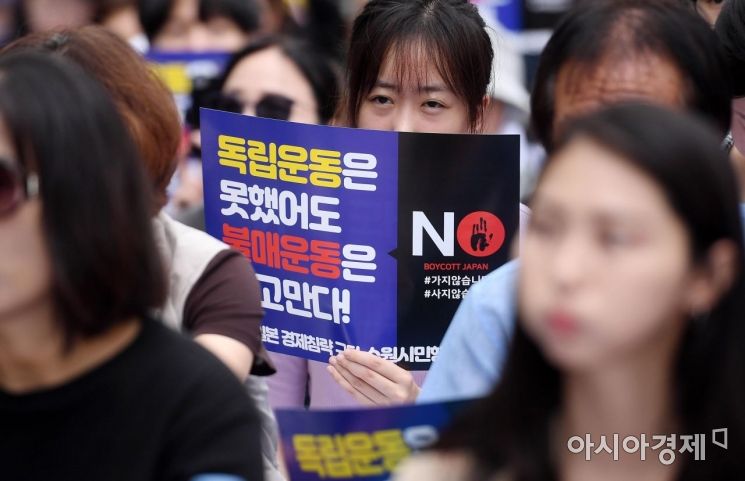 On the 28th, participants are urging the Japanese government to apologize at the "1402nd Regular Wednesday Demonstration for the Resolution of the Japanese Military Sexual Slavery Issue" held in front of the former Japanese Embassy in Jongno-gu, Seoul. Photo by Hyunmin Kim kimhyun81@
[Asia Economy Reporter Yoo Byung-don] "The current Japan boycott movement is divided into two groups."
This is the perspective of Professor Hosaka Yuji of Sejong University, observing the waning No Japan (boycott of Japanese products) movement. He expresses concern over the recent recovery in domestic sales of Japanese products, which had sharply declined since the boycott began in July last year.
The situation of Uniqlo, a representative Japanese brand, is often used as a barometer for the boycott movement. Just one month after the boycott started, the Jongno 3-ga branch in Seoul was forced to close. However, that was the end of the decline. Although exact sales recovery can only be confirmed through the semi-annual report reflecting results up to the end of February, indirect estimates are possible.
According to 'Mobile Index' by IGAWorks, a mobile big data platform company, the monthly active users (MAU) of the Uniqlo mobile app on Android was recorded at 618,684 in December. The number of users, which had dropped to 276,287 in September, sharply rebounded to 506,002 in October and recovered to pre-boycott levels. This suggests an increase in clothing purchases through the Uniqlo mobile app.
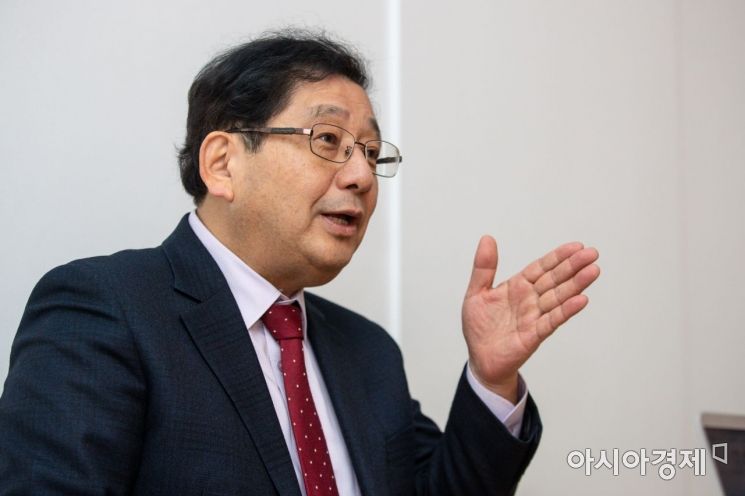 Professor Hosaka Yuji of Sejong University is being interviewed at Chung-Ang University in Dongjak-gu, Seoul on the 27th. Photo by Jinhyung Kang aymsdream@
Professor Hosaka explained, "People who reluctantly participated in the boycott due to social pressure are no longer hesitant to purchase Japanese products," adding, "Those who led the boycott still maintain their stance, but others are returning to Japanese products."
The largest domestic Japanese travel information sharing community, 'Naildong (Naver Japan Travel Club),' also reopened last month. Just four days after resuming operations, it was bustling with about 1,500 new posts. Specific inquiries about Japanese travel, such as currency exchange information, attractions, and transportation in cities popular among Korean travelers like Osaka and Fukuoka, accounted for about 14% (210 posts) of the total.
Previously closed Japanese flight routes have also resumed some operations to coincide with the peak travel seasons of winter vacation and Lunar New Year holidays. Korean Air reopened the Incheon-Komatsu route, Air Busan resumed Busan-Sapporo and Busan-Kagoshima routes, and Eastar Jet reopened the Incheon-Okinawa route. The Incheon-Kagoshima route operated temporarily by Korean Air from November to mid-December last year showed an 83% occupancy rate despite being the off-season for travel.
Sales of Japanese cars have also recovered to the highest levels since the boycott began. This is attributed to major discount sales campaigns launched by Japanese car brands starting in October last year, which were hit hard by the boycott. Compared to just two to three months ago, it is now rare to find 'Shy Japan' consumers who secretly engage in Japanese travel and related spending.
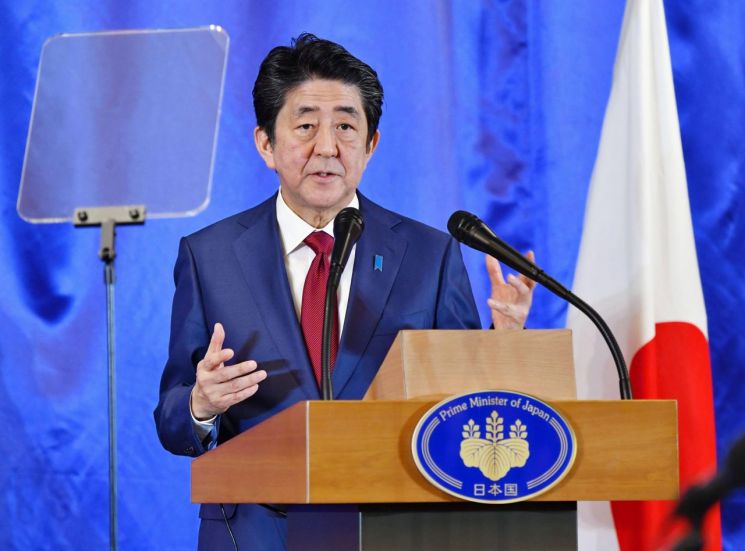
Professor Hosaka believes the subtle shift in relations between the two countries following the Korea-Japan summit has influenced this trend. He said, "Prime Minister Abe used the phrase 'a country sharing fundamental values' about Korea again after six years, taking a step back," adding, "Japan has expressed its willingness to improve relations with Korea first, and the future course of bilateral relations will determine the flow of the Japan boycott movement."
© The Asia Business Daily(www.asiae.co.kr). All rights reserved.
![Clutching a Stolen Dior Bag, Saying "I Hate Being Poor but Real"... The Grotesque Con of a "Human Knockoff" [Slate]](https://cwcontent.asiae.co.kr/asiaresize/183/2026021902243444107_1771435474.jpg)













