KCS Announces Export-Import Status for 1-20 Days
Reduced Working Days Likely Cause 14-Month Decline
Xijinping's Visit to Korea Seen as Positive for US-China Trade Deal
Experts "Closely Monitoring Export Trends to China"
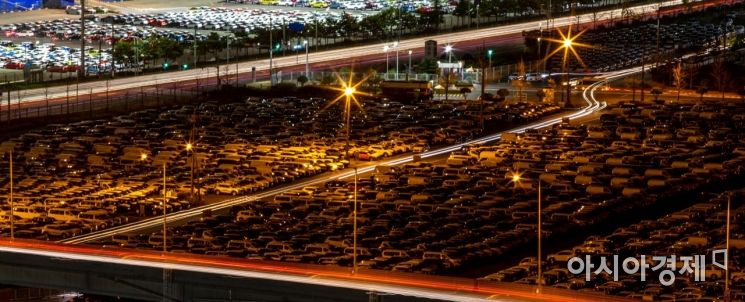
[Asia Economy Reporters Kim Bo-kyung, Moon Chae-seok] South Korea's exports have decreased by 0.2% compared to the same period last year over the past 20 days this year. As a result, the possibility of January export performance recording a negative figure for the 14th consecutive month has increased.
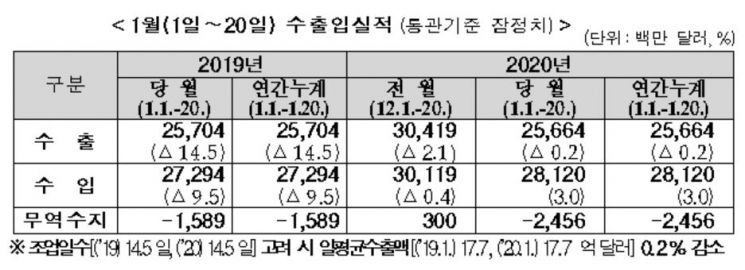
According to the Korea Customs Service on the 21st, the export amount from the 1st to the 20th of this month (provisional clearance basis) was $25.7 billion, down 0.2% ($40 million) compared to the same period last year. Exports from the 1st to the 10th increased by 5.3% year-on-year but turned negative within 10 days. The number of working days from the 1st to the 20th was 14.5 days, the same as last year.
By item, exports of semiconductors (8.7%) and petroleum products (19.3%) increased, while passenger cars (-6.8%), wireless communication devices (-6.2%), and ships (-42.1%) decreased. Cho Ik-no, Director of Export and Import at the Ministry of Trade, Industry and Energy, said regarding the items with decreased exports, "Ships and passenger cars are produced until about the 20th day and then sales (exports) are actively made after the 21st," adding, "We need to watch the indicators until the end of the month." He analyzed that the rise in international oil prices to the $60 per barrel range, up from the high $50s last year, was the cause of the rebound in petroleum products.
By export destination, exports increased to Vietnam (6.7%), Japan (5.6%), Hong Kong (9.9%), and the Middle East (35.0%), but exports to China (-4.7%), the United States (-4.9%), the European Union (EU, -4.3%), and Singapore (-15.8%) decreased. The Ministry of Trade, Industry and Energy expects that the anticipation of the lifting of the 'Hanhanryeong' (Korean ban on cultural exchanges) following Chinese President Xi Jinping's visit to Korea in the first half of this year will have a positive impact on exports to China. The reduction of uncertainty in the global trade market due to the US-China Phase One trade agreement is also seen as a positive factor.
South Korea's exports have been on a negative streak for 13 consecutive months since December 2018. With exports decreasing from the 1st to the 20th of this month and the Lunar New Year holidays causing 2.5 fewer working days than last year, the January export results are likely to record another negative figure. The Ministry of Trade, Industry and Energy expects exports to turn positive in February. Director Cho said, "The so-called 'IT trio'?mobile phones, home appliances, and computers?are expected to post positive results in February," adding, "Especially, the rise in NAND flash prices will have a significant impact."
However, experts caution against overly optimistic forecasts relying on semiconductor price increases. Professor Ahn Deok-geun of Seoul National University Graduate School of International Studies said, "In the case of passenger cars, China has rapidly caught up, weakening our export competitiveness, so the government needs to make efforts such as tariff reductions to support the industry." He also added, "Although the overall situation is stabilizing due to the US-China trade negotiations, if China expands imports of US-made industrial goods, South Korea's exports to China could decrease, so careful monitoring is necessary." The recent downward revision of the global economic growth forecast for this year from 3.4% to 3.3% by the International Monetary Fund (IMF), reflecting poor performance in emerging markets, cannot be overlooked.
Meanwhile, imports from the 1st to the 20th totaled $28.1 billion, up 3.0% ($830 million) compared to the same period last year, resulting in a trade deficit of about $2.5 billion. Among import items, crude oil (14.7%), petroleum products (49.0%), and machinery (1.0%) increased, while gas (-2.7%), coal (-34.7%), and passenger cars (-19.7%) decreased. Imports from China (6.1%), the Middle East (1.7%), the United States (16.9%), and Vietnam (7.7%) increased, while imports from the EU (-2.7%), Japan (-15.2%), and Australia (-2.4%) decreased.
© The Asia Business Daily(www.asiae.co.kr). All rights reserved.
![Clutching a Stolen Dior Bag, Saying "I Hate Being Poor but Real"... The Grotesque Con of a "Human Knockoff" [Slate]](https://cwcontent.asiae.co.kr/asiaresize/183/2026021902243444107_1771435474.jpg)











