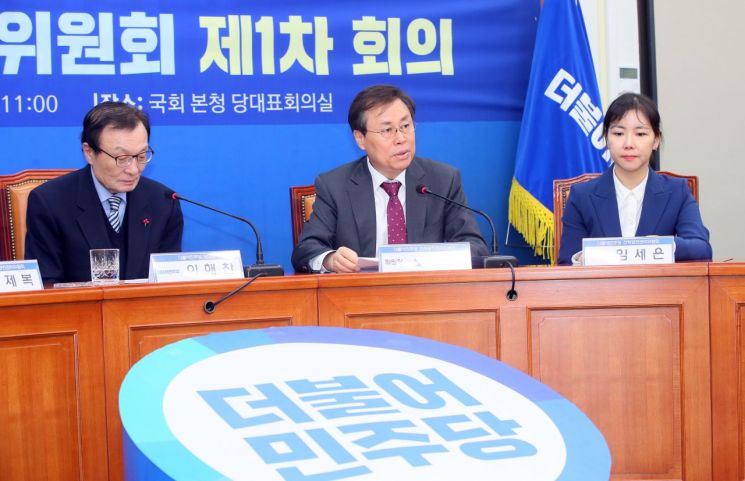
[Asia Economy Reporters Park Cheol-eung and Kang Na-hum] Amid the growing controversy over the nomination of Moon Hee-sang, Speaker of the National Assembly's son, Do Jong-hwan, Chair of the Democratic Party's Strategic Nomination Committee, stated, "Candidates for strategic nomination regions primarily consider recruited personnel, and exceptionally, the nomination may be decided through primaries." He anticipated that the number of recruited talents would reach around 20 to 30.
In a phone interview with Asia Economy on the 21st, Chair Do said, "Only the strategic nomination regions have been decided, but discussions about candidates have not yet taken place," adding, "The public's wish is to replace with new figures. We will continue to recruit individuals with expertise or those representing diverse citizens, and such people will be prioritized in strategic nominations." He further stated, "Only about 10 have been announced so far, but the number of recruited talents will increase two to three times more."
Chair Do emphasized, "We will decide candidates solely based on who and how to present them to gain public support," and firmly said, "Even if certain individuals are mentioned, they are not considered in the actual nomination process." He also mentioned, "Even if a region is designated for strategic nomination, if it is judged more appropriate to hold a primary in consultation with the Nomination Management Committee (NMC), changes can be made. Conversely, regions initially set for primaries may also be shifted to strategic nomination." This appears to be a remark conscious of the controversy over the hereditary nomination involving Speaker Moon.
The Democratic Party is experiencing internal turmoil regarding criticism from opposition parties about the hereditary nomination of Moon's son, Moon Seok-gyun, Standing Vice Chairman of Uijeongbu Gap, Gyeonggi Province. On the 20th, Kim Hae-young, a Supreme Council member of the Democratic Party, sharply criticized, "It is difficult to accept the public sentiment when a child immediately receives the same party's nomination in the next term in a district where the parent is currently a member of the National Assembly." On the 17th, the Democratic Party confirmed 15 strategic nomination target regions, including Speaker Moon's constituency. Although the party began accepting candidate applications from the 20th, strategic nomination regions are exempt.
The number of strategic nomination regions may increase depending on additional decisions regarding withdrawal from candidacy. The main issue is the list of the bottom 20% of incumbent lawmakers' evaluations. As the official notification of the list approaches, the Democratic Party is in a restless atmosphere.
The Democratic Party's Nomination Management Committee held a meeting in the afternoon to make a final decision on whether to disclose the list publicly and the timing for objections from the concerned lawmakers. It is known that there is strong public opinion against disclosing the list due to concerns about internal party conflicts. It is highly likely that the decision will be to notify individuals separately. However, some within the NMC still advocate for transparency and the disclosure of the list, so it is premature to conclude.
Lawmakers included in the bottom 20% receive a 20% deduction in primaries, making this list effectively a 'death note.' A Democratic Party lawmaker said, "If you face young or female candidates who receive a 25% bonus in the primaries while carrying a 20% deduction, it is almost impossible to overturn the outcome," adding, "It practically means they should give up running."
There are concerns about internal party division, such as lawmakers on the list running as independents. Especially, an unofficial bottom 20% list circulated in political circles the previous day, which included veteran lawmakers. The NMC denied the authenticity of that list. A Democratic Party lawmaker's office official expressed concern, saying, "The stronger the backlash will be from veteran lawmakers. Since they have established a base in their regions, if they are not nominated, they might attempt to re-enter the National Assembly by running as independents."
© The Asia Business Daily(www.asiae.co.kr). All rights reserved.

















