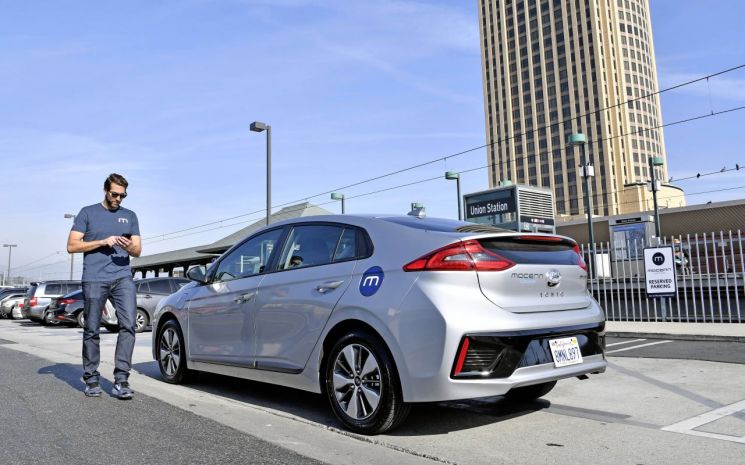
 Dave Gallon, Executive Director of Strategy at Motion Lab, Hyundai Motor Company's mobility service corporation, is demonstrating how to use the car-sharing service at the Union Station parking lot in Los Angeles (LA), USA. Photo by Hyundai Motor Company
[Asia Economy Reporter Kiho Sung] As the Korean automobile industry faces a crisis known as the production cliff, there are calls for a sweeping regulatory innovation to increase domestic production. In particular, it is analyzed that outdated regulations, as seen in Hyundai Motor Group's car-sharing service, could stifle the entire industry.
On the 21st, the Korea Automobile Industry Association held the 7th Automobile Industry Development Forum on the theme of "Development Strategies for Korea's Automobile Industry" in the main conference room of the Korea Automobile Industry Association.
At the forum, Cheol Jo, head of the Korea Institute for Industrial Economics & Trade, Dongbae Kim, professor at Incheon National University, Cheolhwan Kim, managing director at Innosync Consulting, and Hanho Song, professor at Seoul National University, gave keynote presentations. Additionally, Jisoo Yoo, former president of Kookmin University, served as the chair, with panelists including Jimin Lee, professor at Yonsei University, Jinkook Kim, professor at Paichai University, Heungjun Jung, senior researcher at the Korea Labor Institute, and Jaegwan Lee, head of the Korea Automotive Technology Institute, participating in the discussion.
The attendees pointed out that the Korean automobile industry is currently facing a production cliff crisis, which is by no means a short-term issue. To overcome this, they argued that government regulations must be "timely." Missing the timing of regulatory reform could have a detrimental effect by blocking the development of new businesses altogether.
Managing Director Kim Cheolhwan cited Hyundai's car-sharing business as a representative case of regulatory failure. He said, "GM's car-sharing business, Maven, has been operating in 17 cities across the U.S. just one year after its launch, with plans to expand globally. In contrast, Hyundai's carpooling service, which invested 5 billion won in 2017, transferred all its shares within six months due to opposition from the taxi industry and the government's lukewarm attitude."
In fact, Hyundai announced plans this year to establish a mobility corporation, Motion Lab, just before the Consumer Electronics Show (CES), to officially launch a car-sharing business in Los Angeles (LA), USA. Hyundai explained regarding its U.S. entry, "LA is one of the cities with the highest necessity and potential for success in future mobility businesses, including car-sharing services," but the automobile industry views this as Hyundai seeking a new experimental stage outside the domestic market, where persistent regulations remain.
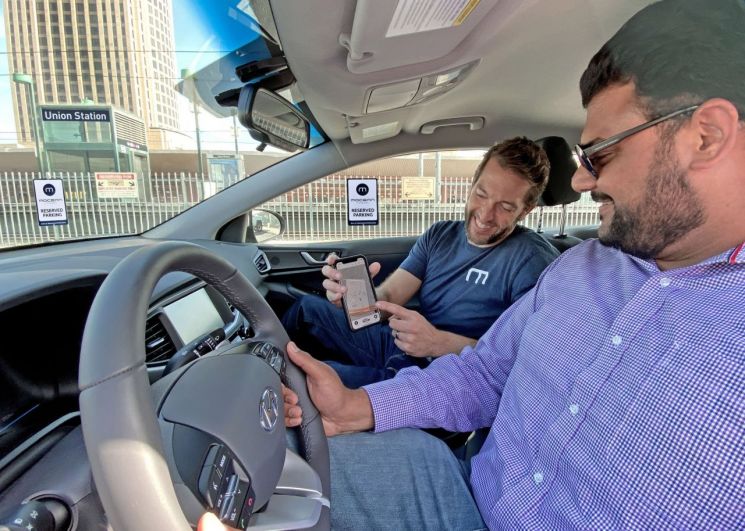 Dave Gallen, Executive Director of Strategy at Motion Lab, Hyundai Motor Company's mobility service corporation (left), is demonstrating how to use the car-sharing service at the Union Station parking lot in Los Angeles (LA), USA. Photo by Hyundai Motor Company
Managing Director Kim said, "Legal and emotional regulations related to investment restrictions, labor regulations (such as minimum wage), application of new technologies (such as autonomous driving), and introduction of new businesses (such as sharing services) tend to shrink domestic production and investment," adding, "Legal and emotional regulations limit corporate management strategies to respond to the automobile industry's transition period."
Concerns were also raised that "excessive eco-friendly regulations" during the transition to eco-friendly vehicles could reduce the competitiveness of the entire industry. Professor Hanho Song stated, "In the current situation where the market maturity of electric vehicles is low and there are limitations in responding to regulations on internal combustion engine-based vehicles, policies and businesses biased toward only one side inevitably have limitations," and argued, "To respond to current greenhouse gas regulations, an appropriate combination of electric vehicles and internal combustion engine-based vehicles is necessary, and balanced government policies to support this are required."
© The Asia Business Daily(www.asiae.co.kr). All rights reserved.













