[Asia Economy Reporter Hwang Junho] Domestic researchers have solved the lifespan degradation problem of lithium-ion batteries used in electric vehicles and ESS by rearranging the oxygen layers.
The National Research Foundation of Korea announced on the 21st that Professor Kang Ki-seok's research team at Seoul National University identified the causes of voltage drop and lifespan degradation in lithium-ion batteries and developed a cathode material to compensate for these issues.
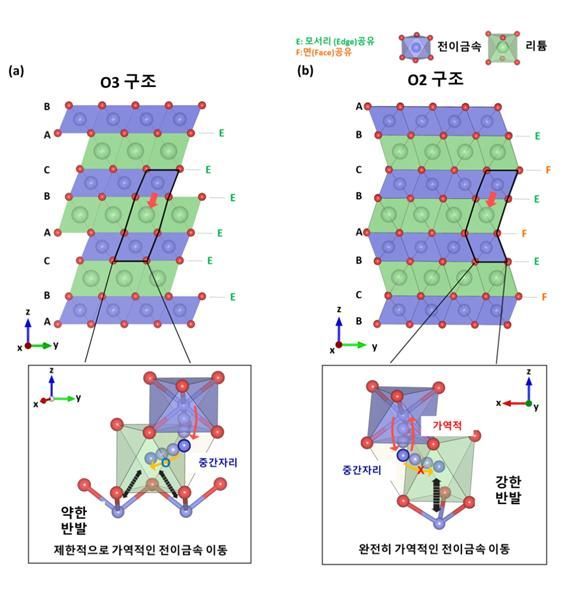
The research team first identified the problems of lithium-ion batteries. Lithium-ion batteries generate electricity as lithium ions move back and forth between the cathode made of lithium oxide and the anode, but they confirmed that the ions producing electricity do not return to their original positions, causing structural collapse. This scientifically clarified the causes of voltage weakening and lifespan degradation in lithium-ion batteries.
Additionally, the team found a solution to this problem. By applying a new cathode material with a rearranged layered structure of the oxygen layers inside the battery, they prevented structural collapse. As a result, the voltage drop range was reduced from the previous 0.15V or more to within 0.05V, mitigating it by more than three times. They also confirmed excellent voltage stability of up to 98.7% even after 40 charge-discharge cycles.
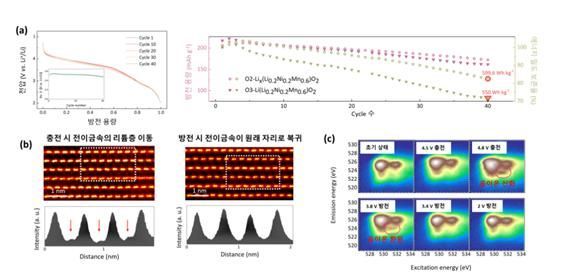
The research team stated, "With the urgent need to develop next-generation lithium-ion electrode materials, cathode materials with high energy density based on the electrochemical activity of oxygen anions are an important alternative," and evaluated, "Solving the biggest technical challenge of a new concept high-energy-density cathode material holds great significance and impact."
The team expects this technology to be applied in electric vehicles, ESS, and other fields requiring high energy density. However, they noted, "Further research is needed on the efficiency of the synthesis process and improvement of tap density for the commercialization of lithium-excess materials." They added, "Enhancing the stability of oxygen at high voltages remains a challenge to achieve excellent lifespan characteristics."
Supported by the Future Materials Discovery Project promoted by the Ministry of Science and ICT and the National Research Foundation of Korea, the results of this study were published in 'Nature Materials' on the 21st.
© The Asia Business Daily(www.asiae.co.kr). All rights reserved.
![Clutching a Stolen Dior Bag, Saying "I Hate Being Poor but Real"... The Grotesque Con of a "Human Knockoff" [Slate]](https://cwcontent.asiae.co.kr/asiaresize/183/2026021902243444107_1771435474.jpg)











