Creating a Collaborative Platform Supporting University-Linked Regional Innovation Activities
Autonomous Discovery of Core Areas Reflecting Regional Characteristics ... Talent Development Included
[Asia Economy Reporter Jo In-kyung] A new university-centered regional innovation support project, planned and executed by local governments and supported by central ministries, will be launched.
On the 20th, the Ministry of Education announced the basic plan for the "Local Government-University Cooperation-Based Regional Innovation Project," which includes these details.
This project is introduced as a "major revitalization project for local universities" to respond to the regional extinction crisis caused by low birth rates, aging population, and population concentration in the metropolitan area. It supports universities to cultivate core local talents through university education innovation and to utilize their resources to carry out tasks needed by the region. The goal is to ensure that "university innovation" leads to "regional innovation."
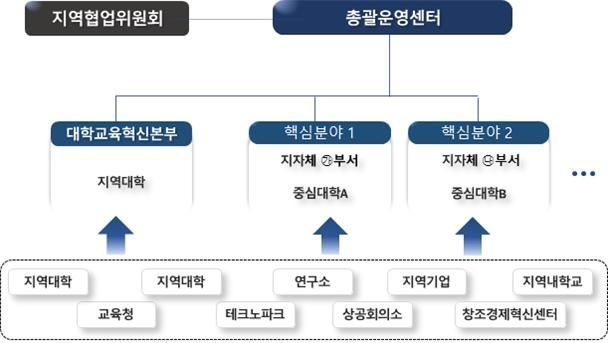
To this end, the Ministry of Education plans to establish regional innovation platforms in three non-metropolitan areas and invest 108 billion KRW from the national treasury along with local government funds (30% matching investment of the total project cost).
The participating local governments are basically one metropolitan city or province (single type), but integration between neighboring metropolitan cities or provinces or between metropolitan cities (multiple type) is also possible. Universities include educational institutions such as autonomous improvement universities and competency enhancement universities under the Higher Education Act, and collaborative institutions can include companies, research institutes, schools, education offices, technoparks, chambers of commerce, and creative economy innovation centers.
The Ministry of Education explains that this project differs from existing university support projects in that it supports the establishment and operation of a "local government-university cooperation-based regional innovation platform," a close collaboration system between local universities and regions in each area.
Unlike existing university financial support projects that focused on enhancing the capabilities of individual universities and expected the effects to spread to the region incidentally, this platform will help local governments discover "core regional innovation fields" that fully reflect local conditions and issues together with universities, companies, and other regional innovation actors, and support universities to take a leading role in carrying out these tasks.
Each region will be able to create synergistic effects through "information sharing" and "linkage between projects." Until now, universities have carried out various support projects from central ministries individually, but these projects were implemented in a top-down and segmented manner, so the effects were not as high as expected. However, in the regional innovation platform, information on various regional innovation projects linked to universities will be shared to minimize overlap and fill gaps between projects, while integrated coordination will be pursued to create synergy effects.
The Ministry of Education is currently consulting in various ways on linkage plans between projects led by the National Balanced Development Committee, the Ministry of Trade, Industry and Energy, the Ministry of SMEs and Startups, and the Ministry of Science and ICT, and plans to expand collaborating ministries to include the Ministry of Employment and Labor in the future. In addition, in February, regional meetings involving the Deputy Prime Minister, heads of local governments, university presidents, and heads of collaborative institutions will be held to increase on-site acceptance, and the basic plan will be finalized and announced by the end of February.
Deputy Prime Minister Yoo Eun-hye emphasized, "This project, which newly establishes the role of universities in relation to the region, will be a groundbreaking turning point in the future direction of higher education policy," and added, "We will continuously support smooth collaboration and linkage among universities, ministries, and regional actors for the region's mutual development together with the Balanced Development Committee."
© The Asia Business Daily(www.asiae.co.kr). All rights reserved.
![Clutching a Stolen Dior Bag, Saying "I Hate Being Poor but Real"... The Grotesque Con of a "Human Knockoff" [Slate]](https://cwcontent.asiae.co.kr/asiaresize/183/2026021902243444107_1771435474.jpg)











