[Asia Economy Reporter Ji-hwan Park] Domestic registered public offering funds that meet requirements such as own capital and asset management will be able to conduct cross-border sales in the Asia region.
On the 20th, the Financial Services Commission announced a legislative notice for amendments to the Enforcement Decree of the Capital Markets Act and Financial Investment Business Regulations, including these details, to implement the 'Asia Fund Passport' domestically in May.
The Asia Fund Passport is a system designed to activate cross-border sales of public offering funds by introducing a standardized and simplified fund registration procedure common to member countries, similar to a passport. In April 2016, five countries including South Korea, Japan, Thailand, Australia, and New Zealand signed a memorandum of understanding and have been preparing for its implementation.
The amendment to the Capital Markets Act to implement the Asia Fund Passport on May 27 this year passed the National Assembly last October, and the Financial Services Commission has been working on detailed subordinate regulations reflecting specific implementation details.
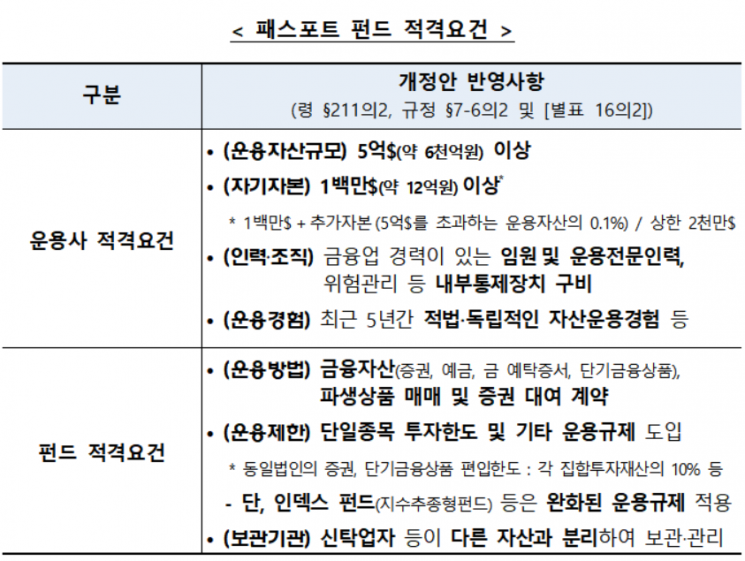
With this amendment, domestic funds can be registered as passport funds overseas if they meet all requirements as public offering funds, including own capital and asset management.
Asset management companies must meet requirements such as managing assets of at least 500 million USD (approximately 600 billion KRW), own capital of at least 1 million USD (approximately 1.2 billion KRW), and have executives with financial industry experience, professional management personnel, risk management, and internal control systems.
For funds, contracts for financial assets, derivatives trading, and securities lending must be in place. Additionally, single stock investments are limited to within 10%, and trustees must separate and manage these assets from others.
Funds from other member countries can be sold domestically through simplified procedures such as submitting securities registration statements. However, qualification reviews within the country are omitted. If a member country violates the memorandum of understanding or unfairly restricts the sale of domestic passport funds, application may be excluded.
Overseas passport funds will also be sold through domestic banks and securities firms, applying the same investor protection measures as domestic public offering funds.
Furthermore, from the perspective of investor protection, accounting audits are mandatory even for small-scale funds. For domestic public offering funds, small-scale funds with total assets under 30 billion KRW are exempt from accounting audits.
Asset management companies and others have reporting obligations to the country of establishment and the country of sale in cases such as fund termination, dissolution, redemption suspension, or legal violations. For illegal acts such as registering by false or fraudulent means, asset management companies and their executives may face sanctions including business suspension, corrective orders, suspension of duties, or dismissal, with legal grounds established accordingly.
A Financial Services Commission official emphasized, "For domestic management companies, opportunities to enter larger overseas markets such as Australia and Japan will expand, enhancing competitiveness," adding, "Investors will also have expanded choices for fund investments."
The Financial Services Commission plans to implement the Asia Fund Passport system on May 27 after the legislative notice and regulatory review period until the 29th of next month.
© The Asia Business Daily(www.asiae.co.kr). All rights reserved.
![Clutching a Stolen Dior Bag, Saying "I Hate Being Poor but Real"... The Grotesque Con of a "Human Knockoff" [Slate]](https://cwcontent.asiae.co.kr/asiaresize/183/2026021902243444107_1771435474.jpg)











