Employment Rate of Major Graduate Students in Nuclear Engineering Drops by 11.3%P
Private Company Hiring Decreases as New Nuclear Power Market Disappears
Popularity of Nuclear Engineering Declines...Industry Competitiveness Worsens
[Asia Economy Reporters Kim Bo-kyung and Moon Chae-seok] "The popularity of nuclear engineering departments is declining, and private companies no longer want to hire nuclear engineering graduates. The job market is completely frozen."
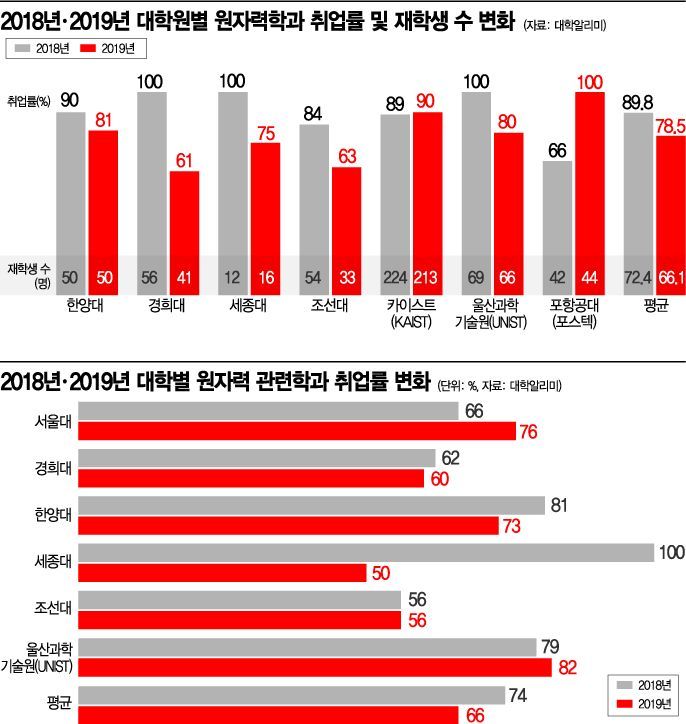
Since the government's announcement of the nuclear phase-out policy in October 2017, a cold wave has hit the job market for nuclear engineering graduates. An analysis of publicly available data on the University Alimi website on the 20th shows that the average employment rate of graduates from nuclear-related departments at seven major graduate schools fell by 11.3 percentage points compared to the previous year. The average employment rate of graduates from nuclear engineering departments at six major universities (undergraduate) also dropped by 8 percentage points, from 74% to 66% during the same period. This is because private companies no longer hire nuclear majors due to the government's nuclear phase-out policy. This leads to a vicious cycle of talented individuals avoiding nuclear engineering departments → deterioration of competitiveness in the nuclear field.
Hanyang University, which established the first nuclear engineering department in Korea in 1958, saw its graduate employment rate drop from 90% in 2018 to 81% last year. Recently, some students admitted through the integrated master's and doctoral program at Hanyang University have expressed their intention to give up their doctoral studies, and the university is accepting withdrawal applications. Kyung Hee University, which opened the third nuclear engineering department in Korea in 1979, experienced a 39 percentage point drop from 100% to 61% during the same period. Only the employment rates of graduate students at Pohang University of Science and Technology (POSTECH) and Korea Advanced Institute of Science and Technology (KAIST) increased by 34 percentage points and 1 percentage point, respectively.
The situation is similar in undergraduate programs. The employment rate of nuclear engineering graduates at Sejong University was halved from 100% to 50%, while Hanyang University and Kyung Hee University saw declines of 8 percentage points and 2 percentage points, respectively.
The main reason is the sharp decline in new hires by private companies related to nuclear power plants. Professor Heo Kyun-young of Kyung Hee University said, "As the popularity of nuclear engineering departments declines, the admission cutoff scores are also falling," adding, "Private companies no longer want to hire nuclear engineering graduates." Professor Heo explained, "In the past, private companies such as ○○ Engineering, ○○ Construction, and ○○ Heavy Industries hired nuclear engineering graduates, but now, with the disappearance of the new nuclear power plant construction market, the workload has decreased, and they hardly hire anyone."
The number of graduate students is also decreasing. This is due to a pessimistic outlook that there will be no further research and development (R&D) since the government declared the cancellation of new nuclear power plant construction. Min Byung-joo, president of the Korean Nuclear Society, said, "Due to the government's nuclear phase-out policy, talented young people are avoiding nuclear engineering, making it difficult to supply manpower to the nuclear sector," adding, "At the same time, due to the structure of manpower in the nuclear sector, many experts in research, industry, and safety regulatory agencies are aging and retiring in large numbers all at once."
© The Asia Business Daily(www.asiae.co.kr). All rights reserved.
![Clutching a Stolen Dior Bag, Saying "I Hate Being Poor but Real"... The Grotesque Con of a "Human Knockoff" [Slate]](https://cwcontent.asiae.co.kr/asiaresize/183/2026021902243444107_1771435474.jpg)
















