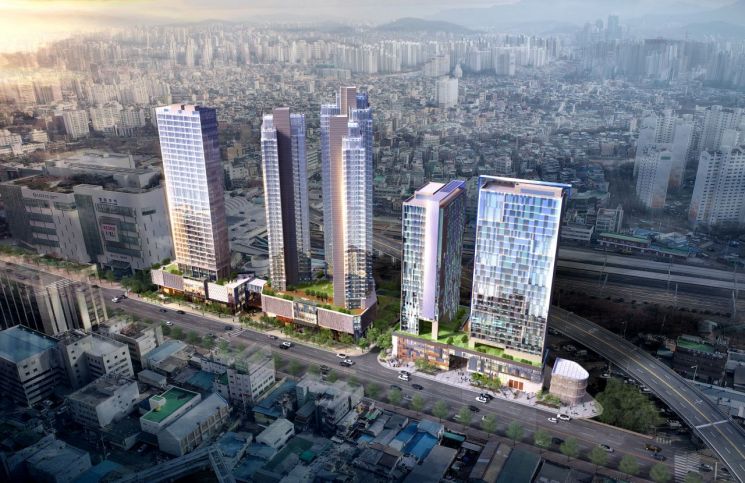
 ▲ Perspective view of the public housing project for improving the residential environment and urban maintenance of Yeongdeungpo jjokbangchon (Provided by the Ministry of Land, Infrastructure and Transport)
[Asia Economy Reporter Lee Chun-hee] The area around Yeongdeungpo Station in Seoul, once an old residential area known as a jjokbangchon (tiny room village), is being reborn as a residential, commercial, and welfare town. The jjokbangchon will be completely demolished, and over 1,200 households, including permanent rental housing for residents and happy housing for young people, will be supplied.
The Ministry of Land, Infrastructure and Transport, Seoul Metropolitan Government, and Yeongdeungpo District announced on the 20th the "Public Housing Project Promotion Plan for Improving the Residential Environment and Urban Renewal of Yeongdeungpo Jjokbangchon." On the same day, Yeongdeungpo District, Korea Land and Housing Corporation (LH), and Seoul Housing and Communities Corporation (SH) ? all participating as project implementers ? also signed a Memorandum of Understanding (MOU) for the "Yeongdeungpo Jjokbangchon Renewal."
The area was already designated as a redevelopment zone in 2015. At that time, an urban environment improvement plan was established for the 41,165㎡ area around Yeongdeungpo Station’s jjokbangchon. However, only housing measures for about 100 residents were prepared, which was criticized as a policy limitation, and the project was eventually halted. Subsequently, Yeongdeungpo District directly proposed the jjokbangchon renewal to the Ministry of Land, Infrastructure and Transport, leading the government and related agencies to form a task force (TF) to promote the current plan.
According to the Ministry of Land, Infrastructure and Transport, the current residential environment for residents of the Yeongdeungpo Station jjokbangchon is extremely poor. Despite the minimum housing standards not being met ? with kitchens and bathrooms within 6.6㎡ not properly equipped ? residents pay rent of 100,000 to 200,000 KRW per 3.3㎡, which is even higher than luxury housing in the Gangnam area.
Although remodeling projects to solve the jjokbang problem have been promoted, the severe aging of the buildings has rendered them ineffective, and improvements to the jjokbangs have led to rent increases, causing a vicious cycle where residents are replaced.
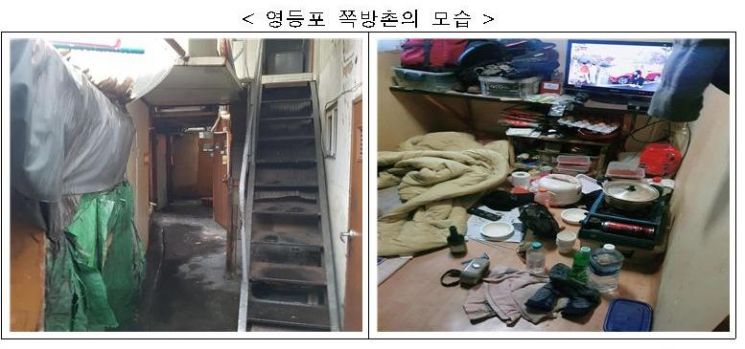 ▲ Current appearance of the aging Yeongdeungpo Station area shantytown (Provided by the Ministry of Land, Infrastructure and Transport)
The current renewal plan significantly increases housing by creating 370 permanent rental housing units for jjokbang residents. This scale can accommodate all 360 or so residents currently living in the jjokbangchon, according to the Ministry of Land. These houses will be about 16㎡ in size, with a deposit of 1.61 million KRW and a monthly rent of approximately 32,000 KRW. A Ministry official stated, "The space will be 2 to 3 times larger and more comfortable than existing jjokbangs, and residents will be able to live at about 20% of the current rent." The deposit will be supported through tenant relocation measures under the public housing project to reduce the burden on tenants.
In addition, 220 happy housing units for young people such as newlyweds, and 600 units of sale housing will be supplied, totaling about 1,200 households.
The Ministry plans to proceed with the project using a "first relocation, virtuous cycle" approach, sequentially providing housing. An initial relocation complex for temporary residence of jjokbang residents will be created on the right side of the district through remodeling of existing buildings. After the construction of public housing is completed, residents will move to permanent rental housing. The initial relocation complex will then be demolished and sold as private development land.
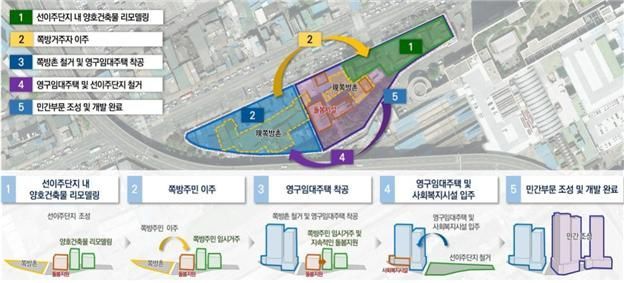 ▲ Conceptual diagram of early relocation and virtuous cycle for public housing projects to improve residential environment and urban maintenance in Yeongdeungpo jjokbangchon (Provided by Ministry of Land, Infrastructure and Transport)
The project will complete district designation in the second half of this year after collecting residents’ opinions and other related procedures, with district planning and compensation scheduled for next year and move-in targeted for 2023. The Ministry of Land will support the project by forming the "Yeongdeungpo Jjokbangchon Public Housing Promotion Public-Private TF," led by the Ministry’s Housing and Land Office Director and the Seoul Housing and Architecture Headquarters Director, with participation from Seoul City, Yeongdeungpo District, LH, SH, and private care facilities. A Ministry official said, "Through last year’s Yeongjung-ro street vendor renewal, this year’s Daeseon Flour complex cultural space creation, next year’s Yeongdeungpo rotary overpass demolition, and the 2024 opening of the Sinansan Line, we expect to revitalize Yeongdeungpo District and contribute to housing stability for young people by supplying housing near the station area."
The permanent rental complex will include a comprehensive welfare center to support jjokbang residents’ self-sufficiency and employment, and will support the resettlement of care facilities that have provided free meals and medical care to residents. Currently, private organizations such as Gwangya Church, Joseph Clinic, and Thomas House provide free meals and medical care to jjokbang residents in the area. Additionally, the happy housing complex will have convenience facilities such as a national and public kindergarten, library, and community caf? available to both residents and local citizens.
Minister of Land Kim Hyun-mi said, "The Yeongdeungpo jjokbang renewal project is not forced demolition or displacement development but a warm development with an inclusive and virtuous cycle structure where everyone prospers together. We will continue to strive to prepare more detailed housing welfare policies." Seoul Mayor Park Won-soon said, "The Yeongdeungpo jjokbang renewal plan announced today is a fundamental solution jointly proposed by the central government and local governments to stabilize housing for vulnerable groups and improve the urban environment, revitalizing the area. We will also cooperate with the central government, local governments, and residents to gradually renew the other four jjokbangchons."
Seoul City plans to gradually renew four other jjokbangchons in Seoul besides Yeongdeungpo. Currently, the Donui-dong jjokbangchon is undergoing an urban regeneration project (Saetteul Village Project), and the other three will be gradually renewed through urban environment improvement projects. The Ministry of Land, Infrastructure and Transport also plans to gradually renew 10 jjokbangchons nationwide (5 in Seoul, 2 in Busan, and 1 each in Incheon, Daejeon, and Daegu) with project methods suited to local conditions.
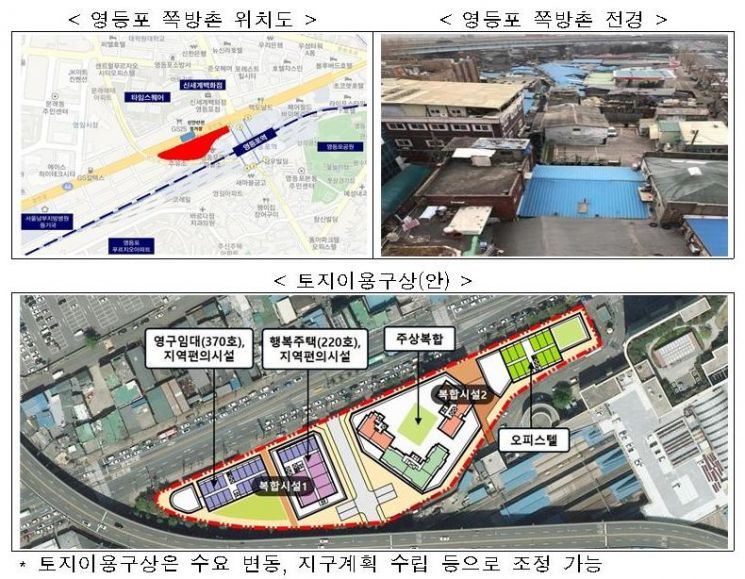 ▲ Location map and land use plan (draft) for public housing projects to improve the residential environment and urban maintenance of Yeongdeungpo jjokbangchon (Provided by the Ministry of Land, Infrastructure and Transport)
© The Asia Business Daily(www.asiae.co.kr). All rights reserved.
![Clutching a Stolen Dior Bag, Saying "I Hate Being Poor but Real"... The Grotesque Con of a "Human Knockoff" [Slate]](https://cwcontent.asiae.co.kr/asiaresize/183/2026021902243444107_1771435474.jpg)


















