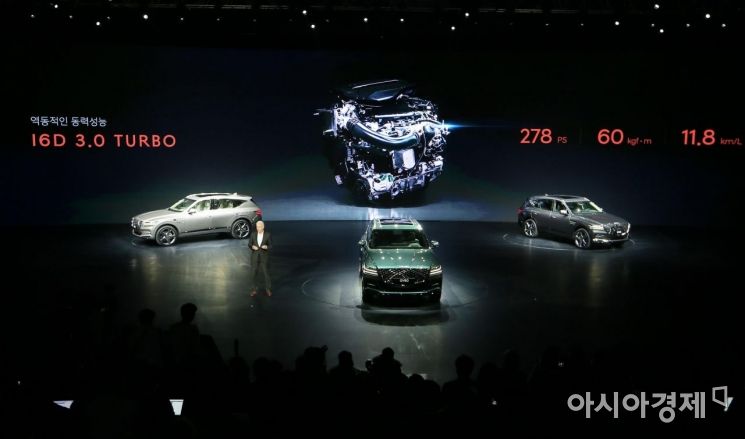
 Hyundai Motor Group's luxury brand Genesis has officially launched its first SUV (Sport Utility Vehicle), the 'GV80'. On the 15th, Hyundai Motor Group held a new car launch event at KINTEX in Goyang, Gyeonggi Province, and began official sales. The GV80 is Genesis's first rear-wheel-drive based large SUV.
 Goyang ? Photo by Kim Hyun-min kimhyun81@
[Asia Economy Reporter Kiho Sung] Demand for large luxury sport utility vehicles (SUVs), monopolized by imported cars, has exploded. Although prices exceed hundreds of millions of won, consumer choices continue to increase steadily. Recently, with Genesis launching the GV80, expectations are rising for changes in the large SUV market, which has been completely dominated by imported cars.
According to statistics from the Korea Imported Automobile Association on the 19th, last year, imported luxury SUVs sold domestically reached 19,644 units, a 15.5% increase compared to 17,006 units the previous year. Considering that total imported car sales last year were 244,780 units, a 6.1% decrease, the luxury SUV market is showing a high growth rate.
The best-selling models last year were the Land Rover Discovery (4,345 units) and Audi Q7 (4,155 units). These two models accounted for 22% and 21% market share respectively, totaling 43%. Following were the BMW X5 with 2,205 units, Mercedes-Benz GLE with 2,003 units, Volvo XC90 with 1,416 units, and Lexus RX with 1,305 units.
While domestic brands have not introduced significantly different models, the offensive by imported cars has intensified.
Meanwhile, Hyundai Motor Group’s Genesis GV80 has thrown down the gauntlet. The start is smooth. With a sales target of 24,000 units this year, 15,000 contracts were made on the first day of launch.
The GV80 3.3 diesel model starts at 65.8 million won, but with many added options, the price rises to the 80 million won range. It is cheaper than the Mercedes-Benz GLE (90.3 million won) and BMW X5 (100.2 million won), but there is little difference compared to the Audi Q7 and Volvo XC90, which are around 80 million won.
The automotive industry views the advantage as the convenience of purchase and maintenance due to the dense Hyundai sales and service network in Korea.
The GV80 is planned to be produced at an annual volume of 50,000 units at the Ulsan Plant 2. Having recorded 15,000 units on the first day domestically, there is a possibility of supply shortages when it launches in the North American market this summer.
The key point to watch is the relationship with the labor union. In the case of the previously launched Palisade, attempts to increase production capacity due to surging orders were met with union opposition, resulting in contract cancellations.
Last year, Hyundai was evaluated to have eliminated the labor union risk that had hindered performance improvement by reaching a no-strike wage agreement for the first time in eight years. Therefore, for the success of the GV80, timely production, perfect quality, and stabilization of labor-management relations are essential conditions.
© The Asia Business Daily(www.asiae.co.kr). All rights reserved.
![User Who Sold Erroneously Deposited Bitcoins to Repay Debt and Fund Entertainment... What Did the Supreme Court Decide in 2021? [Legal Issue Check]](https://cwcontent.asiae.co.kr/asiaresize/183/2026020910431234020_1770601391.png)
















