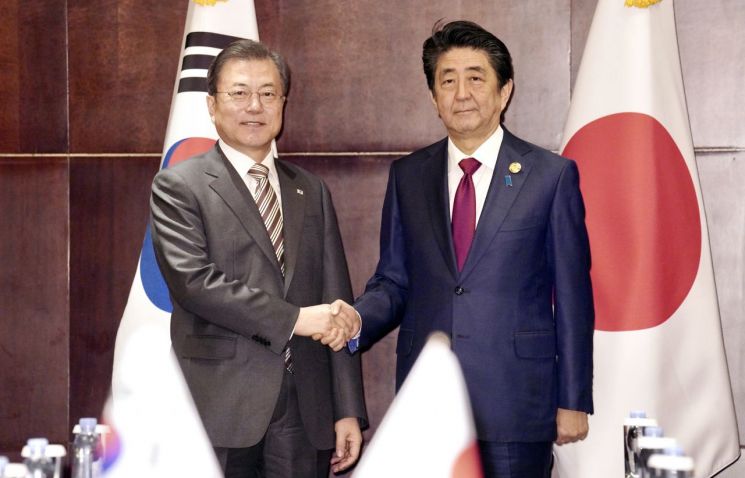
 President Moon Jae-in and Japanese Prime Minister Shinzo Abe are shaking hands on December 24 last year (local time) at the Century City Shangri-La Hotel in Chengdu, Sichuan Province, China.
 [Image source=Yonhap News]
[Sejong=Asia Economy Reporter Joo Sang-don] South Korea and Japan have yet to resume dialogue to resolve their trade dispute. On December 12 last year, the two countries held the "7th Korea-Japan Export Control Policy Dialogue" with government delegations in attendance. At that meeting, they agreed to hold the 8th Export Control Dialogue in Seoul as soon as possible, but even after a month, they have not agreed on a schedule.
On the 19th, a senior official from the Ministry of Trade, Industry and Energy described the current Korea-Japan situation as a "complete lull," stating, "There is no special momentum, so we have not been able to set a date for the 8th Export Control Policy Dialogue."
However, the dialogue channels are being maintained. The official explained, "The dialogue channel between the Ministry of Trade, Industry and Energy and Japan's Ministry of Economy, Trade and Industry is being maintained, but there has been no significant progress regarding the 8th policy dialogue," adding, "This is because there has been no progress in the situation since last year's Korea-Japan summit."
The official predicted that this lull would continue for the time being. He said, "Last year, there were events such as the Emperor's enthronement ceremony and the summit that had the potential to improve relations, but currently, there is no such momentum for the time being," and added, "The turning point in the Korea-Japan dispute is expected to be whether Japanese companies such as Nippon Steel and Mitsubishi Heavy Industries will liquidate their assets around March."
Earlier, President Moon Jae-in emphasized at the New Year's press conference on the 14th, "Since there is not much time before the forced execution procedures lead to forced sales and liquidation of Japanese companies' assets, I hope that dialogue between Korea and Japan will be accelerated with a sense of urgency."
Japanese Prime Minister Shinzo Abe holds the position that liquidating Japanese companies' assets in Korea violates the Korea-Japan Claims Agreement. Prime Minister Abe has repeatedly stated that the issue of forced labor was completely resolved by the Claims Agreement. He argues that the liquidation, i.e., forced sale, of Japanese companies' assets in Korea constitutes a violation of the agreement. If the liquidation of Japanese companies' assets actually proceeds, further deterioration of Korea-Japan relations is inevitable.
© The Asia Business Daily(www.asiae.co.kr). All rights reserved.
![User Who Sold Erroneously Deposited Bitcoins to Repay Debt and Fund Entertainment... What Did the Supreme Court Decide in 2021? [Legal Issue Check]](https://cwcontent.asiae.co.kr/asiaresize/183/2026020910431234020_1770601391.png)















