[Asia Economy Reporter Naju-seok] Since Vladimir Putin, the President of Russia, won the 2018 presidential election, one question has consistently arisen in Russian political circles: Who is President Putin's successor? Foreign media reported that following the sudden announcement of Russia's constitutional amendments and the resignation of the entire cabinet, the outline of President Putin's successor has emerged. The successor to President Putin, whose term ends in 2024, is said to be President Putin himself.
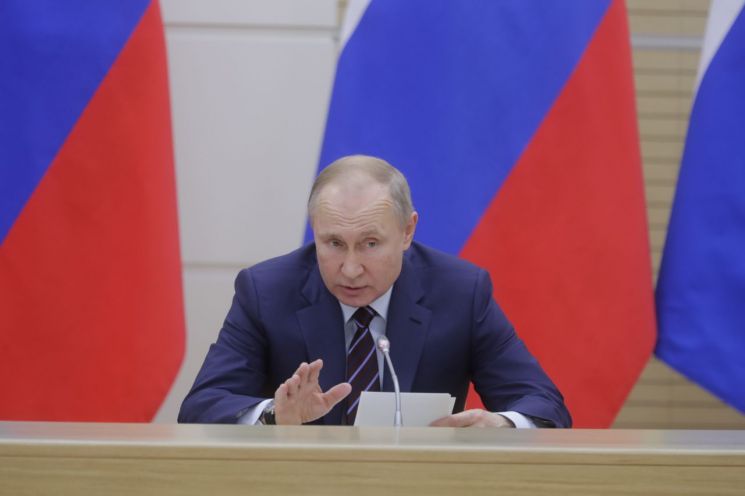
President Putin proposed constitutional amendments that weaken the powers concentrated in the presidency, grant the parliament the authority to appoint the cabinet, and significantly increase the powers of the prime minister. Although these amendments appear to strengthen democracy to some extent in terms of checks and balances, experts inside and outside Russia believe that President Putin's true intentions lie elsewhere.
Some speculate that President Putin may take on the role of prime minister again after his term ends. In 2008, barred by the three-term limit, Putin nominated Dmitry Medvedev, who had been his prime minister, as the presidential candidate and secured his election, while Putin himself served as the influential prime minister. Later, after winning the next presidential election, Putin reappointed former President Medvedev as prime minister, setting a precedent.
There are also predictions that Putin might become the chairman of the Federation Council, which has decisive influence over government policy direction. Some speculate that even after officially stepping down, he might maintain his position as the leader of the ruling party and influence politics through the parliament. Since there is still time until his term ends in 2024, the general expectation is that various options remain available.
Why do such predictions arise despite President Putin's insistence that he has no plans for permanent rule?
On the 18th, during a meeting with veterans, after receiving a proposal to abolish the three-term limit (allowing President Putin to run for president again), he remarked, "It is concerning to return to the 1980s situation where national leaders held onto power until the end of their lives without creating the necessary conditions for power transfer."
However, it is difficult to take this explanation at face value. If President Putin had a successor in mind, he would have appointed a potential successor as the next prime minister. Instead, the prime minister he appointed was Mikhail Mishustin, a technocrat who had served as head of the Federal Tax Service. This suggests that Putin did not designate a successor. Ultimately, appointing Prime Minister Mishustin is interpreted as meaning that President Putin has not presented a successor.
Nonetheless, some view these moves as a strategy to regain public support weakened by pension reforms and other issues. As the ruling United Russia party suffered defeats in local elections and the situation worsened, it is believed that a reshuffle was attempted.
© The Asia Business Daily(www.asiae.co.kr). All rights reserved.
![User Who Sold Erroneously Deposited Bitcoins to Repay Debt and Fund Entertainment... What Did the Supreme Court Decide in 2021? [Legal Issue Check]](https://cwcontent.asiae.co.kr/asiaresize/183/2026020910431234020_1770601391.png)















