
[Asia Economy Reporter Junho Hwang] A 'two-dimensional magnet,' gaining attention as a next-generation electronic device, has been developed. This magnet can be used as a material responsible for information generation in spin semiconductors to be developed in the future, and it is expected to contribute to advancing South Korea's semiconductor industry to the next level.
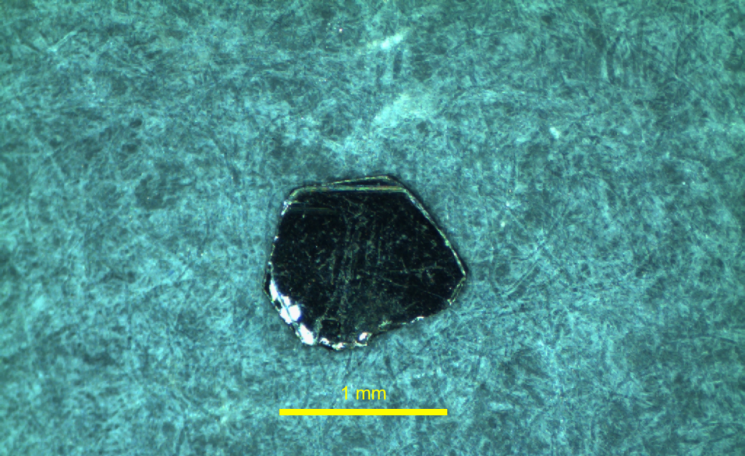
The Institute for Basic Science announced on the 18th that a domestic and international joint research team designed and synthesized iron-germanium-ditelluride (Fe4GeTe2), which exhibits magnetism at room temperature. The researchers also succeeded in exfoliating the synthesized material into thin layers only a few nanometers thick, creating a two-dimensional magnet. This is the world's first actual creation of a 'two-dimensional magnet.'
Two-dimensional magnet at nanometer thickness level
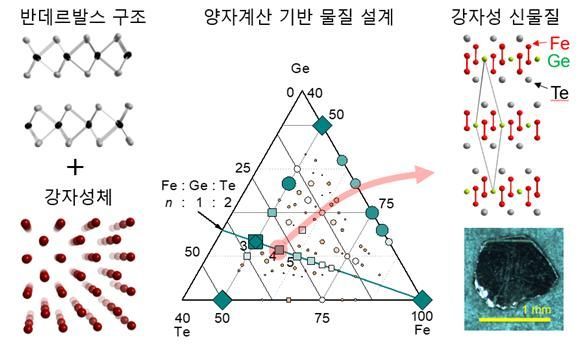
The research team synthesized three materials to create the two-dimensional magnet. First, they focused on the properties of iron (Fe), which exhibits magnetism and conducts electricity, to design a new material that could be used as a spin information device. They also considered the need for tellurium (Te) atoms, which weaken the interlayer atomic bonding. Then, through electronic structure calculations, they predicted the stability and magnetism of 11,000 iron-based candidate materials. Among these, they succeeded in synthesizing three candidates that could be exfoliated into two dimensions, including one combined with germanium.
The Fe4GeTe2 developed by the research team is a stable and highly utilizable material. This material exhibited ferromagnetism between 0 and 10°C. Existing two-dimensional magnets show magnetism around ?200 to -50°C. Notably, this material is not easily affected by heat. Furthermore, when exfoliated into layers only a few nanometers thick, the ferromagnetism was maintained. It also has properties that allow easy bonding with other two-dimensional materials.
Potential core function in spin semiconductors
 Senior Researcher Kim Deok-young of the China High Pressure Research Center (co-first author, from the left), Research Fellow Kim Joon-sung of the IBS Center for Atomic Control of Low Dimensional Electronic Systems (co-corresponding author), Associate Professor Shim Ji-hoon of the Department of Chemistry at POSTECH, Associate Professor Choi Si-young of the Department of Materials Science and Engineering at POSTECH.
The research team expects this material to be used as a two-dimensional magnet with core functions in spin information devices. Typically, semiconductors process information by controlling the flow of charge, one of the properties of electrons. Electrons also have a property called spin, and devices that use spin as the basic unit for information storage and processing are called spin information devices. Spin has lower power loss and faster response speed than charge. It especially has the advantage of being able to store and process information simultaneously.
Currently, the scientific community is researching two-dimensional materials that can generate, transmit, and control spin information. However, two-dimensional materials exhibiting ferromagnetism necessary for spin information 'generation' are very rarely found. Moreover, those that do exist either do not conduct electricity or exhibit magnetism only at extremely low temperatures, making practical semiconductor implementation difficult.
Challenging human limits... Designing and developing new materials
Co-first author Researcher Deokyoung Kim (Senior Researcher at the China High Pressure Research Center) stated, "We succeeded in designing and synthesizing magnetic materials that are difficult to calculate. Especially, the successful design of ternary compounds composed of three elements is rare worldwide." Typically, new material synthesis succeeds by chance, meaning countless attempts are made before synthesizing a new material. It is not easy to design a material and create a corresponding substance to reach the application stage, as in this study.
Co-corresponding author Research Fellow Junsung Kim said, "This research, encompassing material design, synthesis, device fabrication, and measurement, was made possible through collaboration among researchers from various fields domestically and internationally," adding, "Based on this achievement, we expect to discover two-dimensional materials with even stronger magnetism."
This research was conducted with support from the Institute for Basic Science and the Korea Research Foundation's Leading Research Center program. The research results were published online at 4 a.m. (Korean time) on the 18th in the international journal Science Advances.
© The Asia Business Daily(www.asiae.co.kr). All rights reserved.



















