Short Selling Transactions Last Year 103 Trillion Won
Accounting for 4.5% of Total Stock Trading
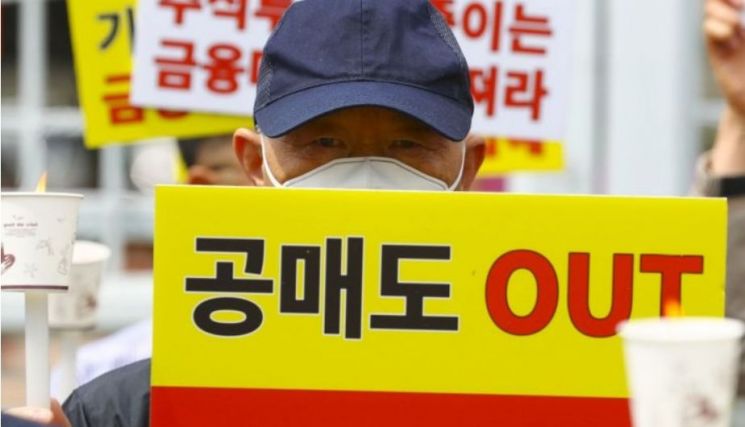
[Asia Economy Reporter Koh Hyung-kwang] Last year, the short-selling transaction amount in the domestic stock market exceeded 100 trillion won. Although the short-selling transaction amount decreased by nearly 20% compared to the previous year due to the sluggish stock market, its share in the stock market did not fall behind. The proportion of foreigners and institutional investors in short-selling transactions reached 99%, raising growing dissatisfaction that individual investors are being excluded from these trades.
According to the Korea Exchange on the 18th, the total short-selling transaction amount traded on the KOSPI and KOSDAQ last year was 103.49 trillion won. This accounts for 4.52% of the total stock transaction amount of 2,287 trillion won last year. Compared to 2018, when the short-selling transaction amount was at its highest at 128 trillion won, it decreased by about 25 trillion won (19.5%), but the transaction ratio is similar to 2018’s 4.57%.
Short selling is an investment technique where investors borrow stocks expecting the price to fall, sell them, and then repurchase the stocks at a lower price to return them, thereby earning a profit from the price difference.
In 2009, short selling accounted for less than 1% of the total transaction amount. However, after entering the 1% range in 2010, it increased annually, surpassing 2% in 2012, 3% in 2014, and 4% in 2016. Notably, in 2018, when it reached 4.57%, stocks worth 128 trillion won were traded via short selling, marking the first time the short-selling amount exceeded 100 trillion won in a year.
Last year, due to the sluggish stock market, the short-selling transaction amount was around 103 trillion won, less than the previous year, but its share in the stock market was similar to the record high in 2018.
The short-selling ratio was higher in KOSPI than in KOSDAQ. The short-selling amount traded on KOSPI was 78.23 trillion won, accounting for 6.37% of the total transaction amount of 1,227 trillion won. In contrast, on KOSDAQ, short selling accounted for 2.38%, or 25.26 trillion won, out of the total transaction amount of 1,060 trillion won.
The main investors using short selling are foreigners and institutional investors. Last year, foreigners accounted for 62.77% (64.9621 trillion won) of the total short-selling transaction amount, and institutions accounted for 36.09% (37.3468 trillion won). Combined, foreigners and institutions made up 98.86%, meaning that almost all short-selling transactions are conducted by these two major players. Individual short selling accounted for only 1.14% (1.1761 trillion won).
However, compared to 2018 (66.95%), the proportion of foreigners in short selling decreased by 4.18 percentage points, while institutions increased from 32.18% to 36.09%, a rise of 3.91 percentage points. Individuals also saw a slight increase from 0.85%.
Meanwhile, individual investors continue to express opposition to short selling, claiming it fuels stock price declines and creates a vicious cycle. They have repeatedly submitted petitions to the Blue House’s civil petition board requesting a ban on short selling. This is because foreigners and institutional investors hold a high proportion of short-selling transactions.
Individuals can also borrow stocks from securities firms to short sell, but this is limited to stocks approved by the brokerage firms. Additionally, due to lower credit compared to institutions, individuals face relatively higher collateral and interest costs, reducing the utility of short selling. It is like playing on a "tilted playing field." Short-selling bans were temporarily implemented as an extreme measure during the 2008 global financial crisis and the 2011 European financial crisis.
Kwon Oh-in, director of the Citizens’ Coalition for Economic Justice, emphasized, "The short-selling system is designed to be absolutely advantageous to foreign and institutional investors, which violates fairness. The short-selling system must be effectively redesigned, including the level of penalties for illegal naked short selling and related regulations."
© The Asia Business Daily(www.asiae.co.kr). All rights reserved.
![User Who Sold Erroneously Deposited Bitcoins to Repay Debt and Fund Entertainment... What Did the Supreme Court Decide in 2021? [Legal Issue Check]](https://cwcontent.asiae.co.kr/asiaresize/183/2026020910431234020_1770601391.png)















