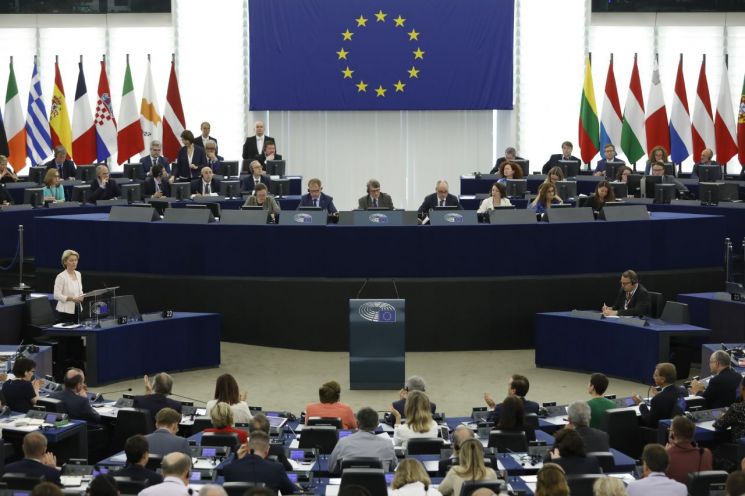
[Asia Economy reporters Hyunwoo Lee and Jaehee Kwon] Europe has admitted that there was a threat from the United States to impose automobile tariffs in connection with the initiation of dispute procedures under the Iran nuclear deal (JCPOA - Joint Comprehensive Plan of Action). This is expected to deepen the rift between the two sides, which is already strained due to issues such as the imposition of digital taxes and tariffs.
According to the British daily The Guardian, on the 16th (local time), Annegret Kramp-Karrenbauer, German Minister of Defense, who was visiting London, UK, responded during a press conference to a question asking whether the report that the US threatened to raise automobile tariffs if the JCPOA dispute procedures were not initiated was true, by saying, "The threat did indeed happen." Earlier, the US Washington Post (WP) reported that the Trump administration warned Germany, France, and the UK that it would impose a 25% tariff on European cars while mentioning the initiation of JCPOA dispute procedures.
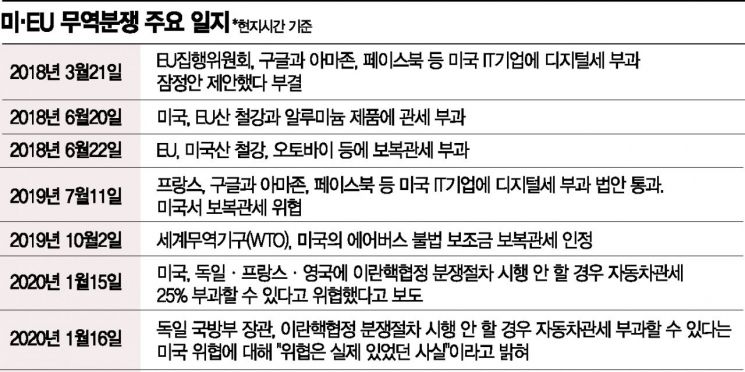
Concerns are growing that the Atlantic trade dispute between the US and Europe, which had been overshadowed by the US-China trade conflict, will intensify as a result. The trade dispute between the US and the EU has continued since the Trump administration took office in 2017. From the outset, the Trump administration began raising issues such as trade imbalances with Europe and NATO defense spending. In June 2018, citing national security, it imposed tariffs of 25% and 10% on EU steel and aluminum products, respectively, opening the door to a trade dispute. The EU immediately retaliated by imposing counter-tariffs on US steel, motorcycles, and other products. If the Trump administration's pressure and the EU's retaliatory tariff war continue, global economic uncertainty is expected to increase further.
Since March 2018, Europe has begun considering imposing digital taxes on major US IT companies such as Google, Amazon, and Facebook as part of its retaliatory tariffs. In July last year, France unilaterally passed a digital tax bill. In October, after the US won a World Trade Organization (WTO) lawsuit against the EU regarding Airbus subsidies, it imposed a 25% tariff on European wine, escalating the cycle of retaliation.
As the bilateral trade dispute continues, skepticism is emerging within the EU that its relationship with the US has deteriorated from an alliance to a mere commercial target. With Brexit expected to lead the UK to sign an independent free trade agreement (FTA) with the US, and the EU's fragmentation due to Brexit, the importance of the US to the EU is gradually diminishing. German Chancellor Angela Merkel recently said in an interview with a media outlet, "In recent years, Europe has been excluded from the US's priorities," adding, "This will be the case under any US president." French President Emmanuel Macron also pointed out last year that "the US is quickly turning its back on Europe regarding strategic issues."
Cracks in the Atlantic alliance have already appeared in various places. Last year, the US unilaterally decided to withdraw troops from Syria without consulting its allies, and earlier in May 2018, it unilaterally withdrew from the JCPOA and the Paris Climate Agreement after long negotiations. Experts also sympathize with the perceptions of EU leaders. Tom Wright, senior fellow at the Brookings Institution, analyzed, "The Trump administration has completely excluded European allies by showing that it does not consider how their actions affect allies."
The EU, which seeks to restore relations with the US, is expected to face difficulties. Phil Hogan, EU Commissioner for Trade, visited Washington DC from the 14th to the 16th to discuss easing trade tensions between the EU and the US for the first time since taking office, but most expect him to return empty-handed. Regarding the JCPOA, Germany, France, and the UK have maintained that the agreement remains valid despite the US withdrawal in May 2018 and that the US should return, but the US has instead urged these countries to withdraw, suggesting that political and military discord will worsen.
There are also concerns that President Trump, buoyed by confidence that his trade order is gaining real influence in the global economy based on the US-China trade agreement and the United States-Mexico-Canada Agreement (USMCA), will pressure the EU more strongly. After the US-China trade agreement, President Trump's focus shifted to the USMCA. On the 16th, the day after signing the US-China Phase One trade deal, President Trump tweeted, "One of the greatest trade deals in history and good for the long-term relationship between China and the US," adding, "We are in a strong position to start Phase Two. Next is USMCA!"
© The Asia Business Daily(www.asiae.co.kr). All rights reserved.
![Clutching a Stolen Dior Bag, Saying "I Hate Being Poor but Real"... The Grotesque Con of a "Human Knockoff" [Slate]](https://cwcontent.asiae.co.kr/asiaresize/183/2026021902243444107_1771435474.jpg)

















