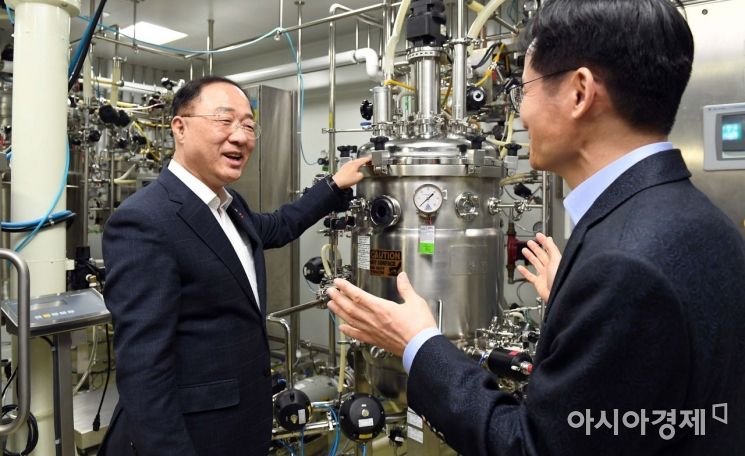
 Hong Nam-ki (left), Deputy Prime Minister and Minister of Economy and Finance, visited Aprogen in Jungwon-gu, Seongnam-si, Gyeonggi-do on the afternoon of the 16th, touring the research center including cell culture fluid manufacturing facilities with Kim Jae-seop, CEO of Aprogen. On the same day, Deputy Prime Minister Hong held a meeting with industry officials from the Korea Bio Association and the Korea Pharmaceutical and Bio-Pharma Association to listen to their suggestions.
 /Seongnam=Photo by Kang Jin-hyung aymsdream@
[Asia Economy Reporter Kang Nahum] Hong Nam-ki, Deputy Prime Minister and Minister of Economy and Finance, said on the 16th that the signing of the US-China Phase 1 trade agreement would have "overall positive effects" on the Korean economy.
After visiting the bio unicorn 'Aprogen' located in Jungwon-gu, Seongnam City, Hong told reporters, "We need to examine whether there are positive and negative impacts on the Korean economy," adding this assessment.
The agreement includes China’s commitment to purchase an additional $200 billion (231.7 trillion KRW) worth of US goods and services over the next two years.
The US decided not to impose tariffs on $160 billion worth of Chinese products that were originally scheduled to be taxed starting December 15 last year. Additionally, the 15% tariff on another $120 billion worth of Chinese goods will be reduced to 7.5%.
Hong said, "The biggest positive aspect is that the Phase 1 agreement was successfully reached, resolving a significant portion of uncertainty."
He added, "The US tariff reduction for China opens the way for China to export more, and the fact that the US must fully import $200 billion worth of goods will also affect the Korean economy. The smooth and increased Chinese exports to the US will have a positive impact on Korean exports."
He further noted, "It is necessary to analyze the competitiveness between items China will import from the US worth $200 billion over two years and those it might import from Korea. Agricultural products likely have very low competitiveness, but a detailed item-by-item analysis is needed for manufactured goods."
Hong said, "Two points to watch are whether the Phase 1 agreement will be properly implemented and how Phase 2 negotiations will proceed. Especially, the progress of Phase 2 agreement seems to be an important variable for us this year."
Regarding the housing transaction permit system, which became controversial following remarks by Kang Ki-jung, Senior Secretary for Political Affairs at the Blue House, Hong drew a clear line, saying, "There has been no internal government review on this."
He explained, "After the December 16 measures were announced, the government has been strictly monitoring the situation and said it could consider additional measures if there are any instability factors or abnormal signs in the market, but the housing transaction permit system has never been reviewed."
On whether additional strengthening of holding taxes, such as subdividing the comprehensive real estate tax base, will be introduced, Hong said, "The December 16 measures already announced strengthening of the comprehensive real estate tax, and there has been no review of further strengthening."
Regarding plans to prepare measures to reduce transaction taxes, he said, "Acquisition and registration taxes are not central government revenues, so decisions are not easy to make. Immediate reduction of acquisition and registration taxes must be approached cautiously."
© The Asia Business Daily(www.asiae.co.kr). All rights reserved.
!["The Woman Who Threw Herself into the Water Clutching a Stolen Dior Bag"...A Grotesque Success Story That Shakes the Korean Psyche [Slate]](https://cwcontent.asiae.co.kr/asiaresize/183/2026021902243444107_1771435474.jpg)
















