[Asia Economy Reporter Lee Ji-eun] "President Moon Jae-in praised himself in his New Year's address, saying 'Among the 3050 Club, we have the second highest growth rate after the United States.' However, among the 3050 Club (Japan, United States, United Kingdom, Germany, France, Italy, South Korea), the years when South Korea's growth rate was not first, excluding economic crises (1980, 1998), were only 2003, 2015, and 2018. South Korea's GDP was $1.38 trillion as of 2018, while the United States was $17.85 trillion, so comparing their GDP growth rates itself is nonsense." (Kang Sung-jin, Professor of Economics at Korea University)
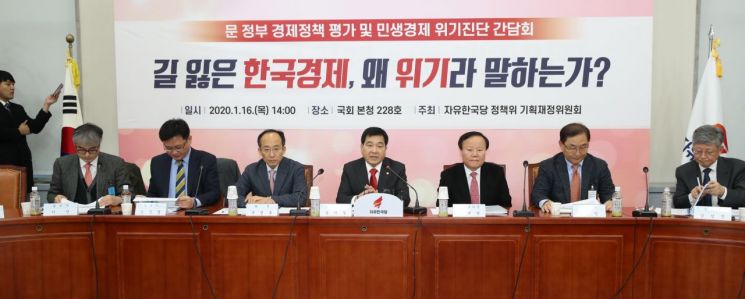
On the 16th, the Liberty Korea Party held an 'Expert Meeting on Evaluation of Moon Administration's Economic Policy and Diagnosis of the Livelihood Economy Crisis' at the National Assembly main building to discuss the evaluation and solutions for the Moon administration's economic policies. Participants sharply criticized the Moon administration's economic failures and demanded the suspension of income-led growth policies, deregulation, market-friendly policies, and fiscal soundness.
Cho Kyung-yeop, Head of Economic Research at the Korea Economic Research Institute, said, "President Moon claimed in his New Year's address that 'the framework of an innovative inclusive nation has been established,' but I don't know if he understands the concept properly," adding, "According to the World Economic Forum's definition, an inclusive nation is one where the income and employment of the low-income class increase. Under the Moon administration, the income of the low-income class increased by only 170,000 won, while the top quintile increased by 1 million won, further widening the rich-poor gap."
Cho also pointed out, "Japan injected a massive 339 trillion yen in fiscal spending after the Plaza Accord but experienced long-term low growth due to inefficient capital investment and delayed restructuring of marginal companies," adding, "We are following that pattern. By expanding fiscal spending and providing financial support to prevent the exit of marginal companies, we are missing opportunities to move toward the Fourth Industrial Revolution."
Choi In, Professor of Economics at Sogang University, said, "The Moon administration claims to have achieved the highest employment rate ever with the largest budget in history, but this is a deception to the public," pointing out, "The employment rate has been steadily increasing over the past decade, and the highest employment rates were actually achieved annually during the Park Geun-hye administration." He compared the seasonally adjusted employment rate of those aged 15-64, setting the first month of each administration to 100, and found that after 30 months in office, the Park administration increased to 102.8, while the Moon administration only increased to 100.6, showing a smaller increase.
Private investment also recorded negative growth rates in 5 out of the last 9 quarters under the Moon administration, and the income gap, which was the goal of income-led growth, has actually widened. Comparing the first quarter of each administration as 100, the Park administration's quintile ratio of equivalized disposable income decreased from 100 in Q2 2013 to 89.5 in Q2 2015, while the Moon administration's ratio increased from 100 in Q3 2017 to 103.7 in Q3 last year. The quintile ratio divides the income of the highest quintile by that of the lowest quintile; the smaller the ratio, the less the income disparity.
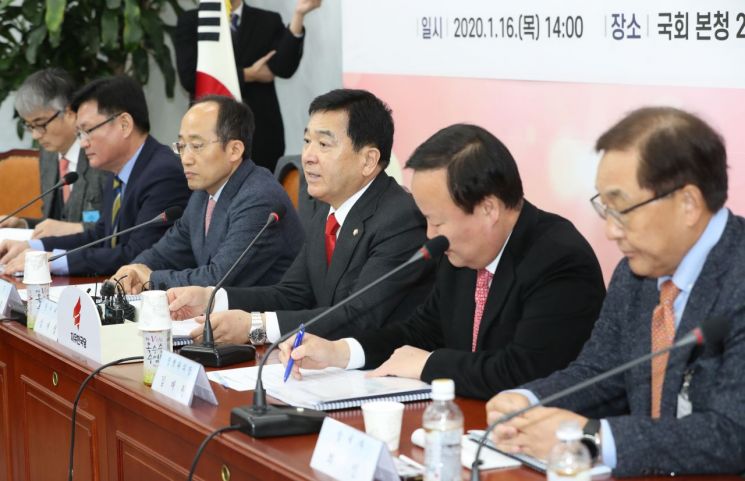
Kang Sung-jin, Professor of Economics at Korea University, said, "In the 1980s, when university students protested, their main argument was the conflict between socialism and capitalism, and their claim was that the government is superior to the market," criticizing, "There is no logic of supply and demand, and they view the economic paradigm completely oppositely." This was aimed at the current mainstream group in the Blue House, the 386 generation (people in their 30s, who entered university in the 1980s, born in the 1960s).
He said, "The problem with the current government is that it tries to create jobs and achieve economic growth through government fiscal spending," adding, "However, job creation must be sustained by the private market, not government fiscal spending." Since job increases are driven by expanded fiscal spending, private-sector economic growth is weakened, and the capacity for job creation declines. He said, "South Korea belongs to the group with relatively low per capita GDP among OECD countries, so it must have a higher growth rate than them to catch up," adding, "Since the current economic growth rate is below the potential growth rate, current policies are disconnected from policies to improve economic growth."
Professor Lee Young of Hanyang University pointed out, "This year's budget is 512 trillion won, a 9.1% increase from the previous year, which is even higher than the 7.6% increase during the global financial crisis response period," adding, "The managed fiscal balance deficit also reached -3.5%, exceeding the EU fiscal deficit limit of -3.0%, which was considered an unwritten rule, and the national debt rapidly increased to 39.8%."
Professor Lee said, "Expansionary fiscal policy is necessary and effective when investment and consumption sentiment are excessively low compared to the potential growth rate, but the current scale of fiscal expansion exceeds what is needed to respond to these factors," adding, "It is desirable to maintain government fiscal spending growth at 5-6%, which is 2-3 percentage points higher than the usual nominal growth rate, and only respond with large deficits during economic crises."
© The Asia Business Daily(www.asiae.co.kr). All rights reserved.


















