"Expected Economic Growth Rate in Early 2% Range This Year"
"Consumer Price Inflation Generally Aligns with Forecast Path... Expected to Rise Around 1% This Year"
Government Analysis Also Emphasizes 'War on Real Estate Speculation'
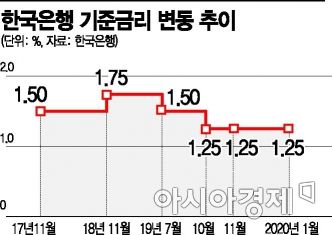
[Asia Economy Reporter Kim Eunbyeol] The Bank of Korea decided on the 17th at the first Monetary Policy Committee meeting of the new year to keep the base interest rate unchanged at the current 1.25%. This decision reflects expectations that South Korea's export situation will improve and economic growth will bottom out, following the reduction of external uncertainties compared to last year due to the Phase One agreement in the US-China trade negotiations the day before. The Bank of Korea has maintained the base rate at 1.25% for three consecutive months after cutting it twice in July and October last year due to economic sluggishness.
Immediately after the meeting, the Bank of Korea stated in its monetary policy direction statement that "the domestic economy showed signs of some easing in sluggishness," adding, "although construction investment and exports continued to decline, facility investment slightly increased and consumption growth also expanded." It further forecasted, "This year, the gross domestic product (GDP) growth rate is expected to be in the low 2% range, generally in line with the forecast path from last November," and "while adjustments in construction investment will continue, the sluggishness in exports and facility investment will gradually ease, and the consumption growth trend will moderately expand."
The 'Recent Economic Trends January Issue (Green Book)' released by the government on the same day also supported the bottoming-out theory of the economy. Experts interpret the interest rate freeze as also signaling support for the government's declared 'war on real estate speculation.' Market attention is focused on the timing of the next interest rate cut.
◆This Year's Economy Better Than Last Year...Support for Government Real Estate Measures= Recent economic indicators are sending signals that the economy has bottomed out. In particular, economic experts are hopeful that the semiconductor sector, which accounts for more than 17% of South Korea's exports, will show signs of improvement. Actual attention has been drawn to the rebound in semiconductor export prices, which had been declining for a long period. In December last year, export prices rebounded for the first time in four months, with DRAM export prices rising by 0.6%. The Leading Economic Index (Statistics Korea) also rose for three consecutive months. The Economic Sentiment Index (ESI) cyclical component has also been on the rise for four consecutive months. Improved economic sentiment expands demand across the economy, and increased demand exerts upward pressure on prices that had been low. If sentiment improvement drives prices upward, the Bank of Korea can ease its burden in monetary policy management. In the monetary policy direction statement issued immediately after the Monetary Policy Committee meeting, the Bank of Korea said, "The consumer price inflation rate is generally in line with the forecast path from last November," and expects it to rise to around 1% during this year.
The Bank of Korea also showed support for real estate policies. Despite two interest rate cuts last year, private investment did not revive but rather funds flowed into the real estate market, inflating household loans, according to analyses. The Bank of Korea stated, "The scale of household loan increases expanded, and housing prices showed a strong upward trend centered on the Seoul metropolitan area." As of the end of December last year, the outstanding balance of bank mortgage loans (including Korea Housing Finance Corporation mortgage loans) was recorded at 653.6 trillion won. This was an increase of 5.6 trillion won from the previous month, marking the largest increase since November 2016. In such a situation, lowering interest rates could lead to criticism that the Bank of Korea only fueled housing price increases.
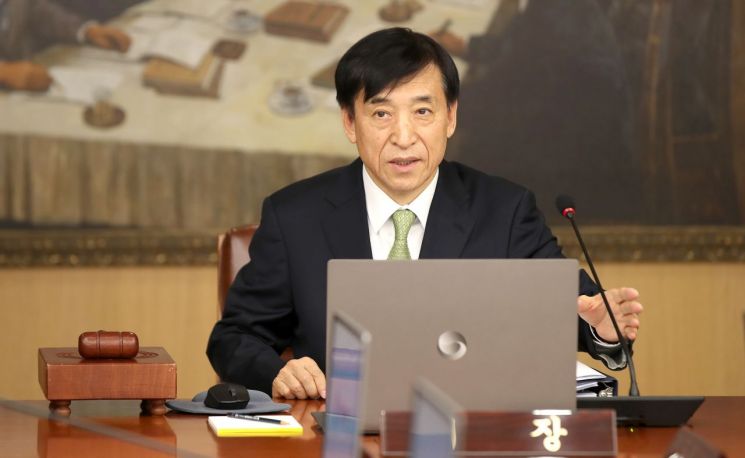
◆Weight on "Interest Rate Freeze This Year"= Experts believe that unless a significant event occurs that worsens the growth outlook path, the Bank of Korea's trend of keeping the base interest rate unchanged will continue. The Bank of Korea had projected an economic growth rate of 2.3% this year, reflecting a scenario where the US-China trade war does not worsen further and the semiconductor sector improves around mid-year.
However, there are still claims that one rate cut may be necessary this year. The reason is that, after removing base effects and exchange rate effects, it is difficult to say that exports have revived. Professor Kim Soyoung of Seoul National University’s Department of Economics said, "Indicators show that the economy has improved, but fundamentally nothing has improved," adding, "Inflation is still far below the target level, and if real estate regulations continue, the debt scale is expected to decrease, so there is more room for interest rate cuts." The timing of the rate cut is divided. Some expect a rate cut before April, when four Monetary Policy Committee members will be replaced, while others suggest that a cut may be considered after reviewing the effects of government fiscal spending in the first quarter.
© The Asia Business Daily(www.asiae.co.kr). All rights reserved.













