Moon Jae-in Government's 'Real Estate Policy' Abolished
'Seoul Reconstruction Regulation Easing and Mortgage Loan Standard Relaxation'... Completely Opposite to Current Government
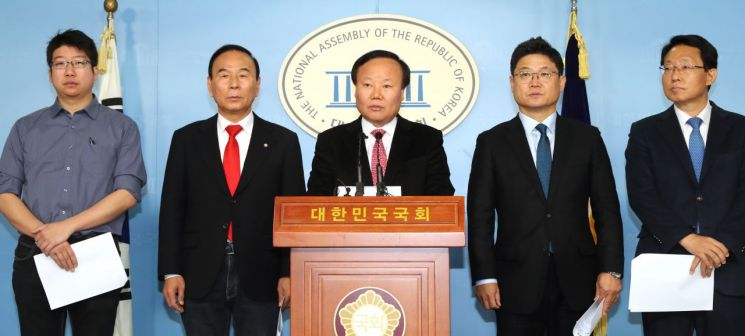
[Asia Economy Reporter Kim Hyemin] The Liberty Korea Party announced its 'Housing Pledge' for the April 15 general election on the 16th, focusing on deregulation of real estate and easing of loans.
The Liberty Korea Party's '2020 Hope Pledge Development Team with the People,' led by Policy Committee Chairman Kim Jae-won as the general head, stated at the National Assembly Press Hall on the same day, "We will stabilize the real estate market through a market-centered autonomous economy."
The core of the Liberty Korea Party's housing pledge is to abolish the Moon Jae-in administration's real estate policies and stand in direct opposition to the current government's policy direction. Specifically, they announced six pledges: ▲ easing regulations on redevelopment and reconstruction of aging apartment complexes in downtown Seoul and first-phase new towns ▲ easing mortgage loan standards ▲ abolishing the price ceiling system for pre-sale apartments ▲ adjusting the criteria for high-priced housing ▲ expanding housing supply for youth and newlyweds ▲ and a full review of the third-phase new town plan.
Chairman Kim said, "Since President Moon Jae-in took office, the government has introduced 18 rounds of real estate regulatory policies, but real estate prices in Seoul have skyrocketed, causing polarization. Coupled with the economic downturn, the local real estate market is on the brink of collapse."
First, the Liberty Korea Party promised to supply many homes in desirable areas by easing redevelopment and reconstruction regulations on aging public housing in downtown Seoul and first-phase new towns.
The party stated, "We will introduce positive policies that provide incentives such as simplified permits if designs open facilities like parks, green spaces, and roads within complexes to the surrounding community, instead of negative policies that impose disadvantages such as increasing public rental housing ratios or various charges during reconstruction and redevelopment." They also said, "We will strengthen the self-sufficiency functions of aging new towns and promote the enactment of special laws containing comprehensive regeneration support measures."
They pledged to significantly ease mortgage loan standards as long as repayment ability is verified. The Liberty Korea Party said, "We will ease loan regulations for first-time homebuyers and temporarily owning two homes for actual residence purposes, focusing loan regulations strictly on speculative multi-home loans. We will also drastically reduce acquisition and registration taxes for first-time homebuyers and provide tailored support through tax reductions on capital gains and acquisition taxes for multi-child families when moving residences."
Along with this, the Liberty Korea Party pledged to abolish the price ceiling system for pre-sale apartments and block increases in official property prices, effectively scrapping the current government's real estate policies. They announced plans to adjust the criteria for high-priced housing from market price over 900 million KRW to official assessed value over 1.2 billion KRW to significantly reduce housing holding taxes. They also said they would review the third-phase new town construction policy and prevent the side effects of excessive housing supply caused by indiscriminate development of suburban new towns, which leads to the creation of 'concrete ghost towns.'
Additionally, the Liberty Korea Party pledged to secure budgets to expand youth housing by providing dedicated support and free consulting services for youth and newlywed housing issues. They promised to strengthen support to provide various types of youth residential spaces according to preferences, including dormitory-style, studio-type, apartment-type, and detached house-type accommodations.
© The Asia Business Daily(www.asiae.co.kr). All rights reserved.

















