2019 Employment Trends... 160,000 Employed in Their 40s, 53,000 Decrease in Their 30s
Private Sector Growth Rate 'Q1 1.0% → Q2 0.4% → Q3 0.5%'
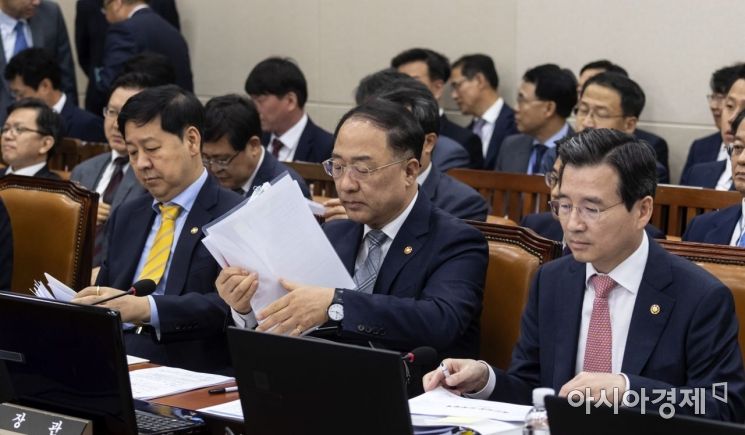 Deputy Prime Minister for Economy Hong Nam-ki is organizing documents while attending the comprehensive audit of the Ministry of Economy and Finance at the Planning and Finance Committee held at the National Assembly on the 23rd. Photo by Yoon Dong-ju doso7@
[Asia Economy Reporter Jang Sehee] On the 16th, the deadline for public officials to resign, Deputy Prime Minister and Minister of Strategy and Finance Hong Nam-ki and Second Vice Minister of Strategy and Finance Koo Yoon-chul have settled on not running in the April 15 general election. Lee Ho-seung, the Blue House Chief Economic Secretary, is also understood to remain unchanged. As a result, the second-term economic team of the Moon Jae-in administration, which was once rumored to run, will all stay in place. This is interpreted as reflecting the Blue House and government's determination to revive the sluggish economy by maintaining the economic control tower as it is. It is also analyzed that the burden of confirmation hearings played a role in the decision not to replace the Deputy Prime Minister.
Deputy Prime Minister Hong plans to hold a Ministry of Strategy and Finance executive workshop on the 18th. This event was organized to diagnose the current economic situation and seek ways to achieve actual results in the year marking the Moon administration's turning point. It also appears to aim at stabilizing the previously unsettled organizational atmosphere. The detailed program includes in-depth discussions on ▲reviving the economy ▲creating a highly satisfactory organizational culture.
The reason Deputy Prime Minister Hong and Vice Minister Koo did not resign is based on the judgment that actual economic results must be achieved this year amid challenging domestic and international conditions. The government has set this year's economic growth target at 2.4%. This is higher than the 2.3% forecast by the Korea Development Institute (KDI) and the Bank of Korea. Some private research institutions have lowered their forecasts to the 1% range.
Although the US-China trade conflict has somewhat eased, new risks in the Middle East have emerged, increasing volatility in the domestic financial and foreign exchange markets. The government's risk management has become even more important. In his year-end address last year, Deputy Prime Minister Hong emphasized, "2020 is a very important year," adding, "It is the year we pass the midpoint of the national administration and enter the latter half, so we must produce national achievements and ensure that these results are tangibly felt by the people."
Initially, there were rumors that Deputy Prime Minister Hong would run in Chuncheon, Gangwon Province, and Vice Minister Koo in Seongju, Gyeongbuk Province. In particular, there was a sentiment that Deputy Prime Minister Hong might resign to run in the general election, as secret opinion polls were conducted against incumbent lawmaker Kim Jin-tae in the region until recently.
However, after President Moon emphasized to Deputy Prime Minister Hong that "it is important to continuously demonstrate leadership over the Korean economy," the draft for their candidacy disappeared. The change in the atmosphere regarding ministerial candidacy is attributed to concerns over the burden of confirmation hearings and potential political setbacks. The Blue House also appears to have considered that changing the economic chief during an economic downturn would increase uncertainty. Currently, Chief Economic Secretary Lee Ho-seung has also settled on not running. President Moon has assigned Prime Minister Chung Sye-kyun, an economic expert, to lead the cabinet.
Public officials and experts unanimously advise focusing all efforts on improving employment indicators and private sector economic growth rates. A Ministry of Strategy and Finance official said, "Although employment has generally improved, it is true that employment among those in their 40s remains difficult," adding, "Both quantity and quality need to recover." According to the '2019 Employment Trends' announced by the government on the 15th, the number of employed persons last year was 27,123,000, an increase of 301,000 from the previous year, but employment among those in their 40s decreased by 162,000 and among those in their 30s by 53,000.
Professor Kim Tae-gi of Dankook University's Department of Economics emphasized, "Household debt and uncertainties in the financial and foreign exchange markets are increasing too much," adding, "As we move into the latter half of the term, the government's risk management capabilities will become even more important."
There are also calls to boost the private sector growth rate. According to an analysis by Hyundai Research Institute, the government sector growth rate surged to 4.2% in the first quarter, 7.9% in the second quarter, and 9.0% in the third quarter last year, while the private sector growth rate was 1.0% in the first quarter, 0.4% in the second quarter, and 0.5% in the third quarter. Professor Kim So-young of Seoul National University said, "Ultimately, the economic team will be evaluated based on the growth rate," adding, "The overall economic growth rate is in the 2% range, but the private sector growth rate is only 0.5%, less than 1%." She emphasized, "Fundamentally, an environment must be created where companies can invest so that private investment can revive."
© The Asia Business Daily(www.asiae.co.kr). All rights reserved.

















