Devoting Life to Dance... Presenting Salpuri Dance in Mokpo
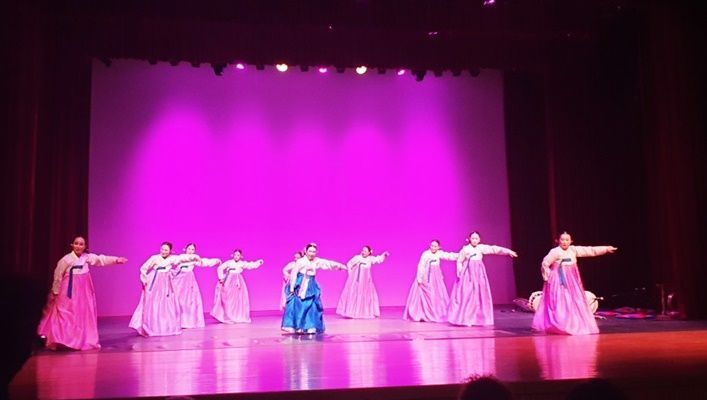 The performance began with a traditional Korean entrance dance amid the audience's cheers. (Photo by Sudang Jeong Myeongsuk Dance Preservation Society)
[Asia Economy Honam Reporting Headquarters Reporter Park Ki-dong] The Sudang Jeong Myeong-sook Dance Preservation Society announced on the 15th that Sudang Jeong Myeong-sook (84), holder of Important Intangible Cultural Property No. 97, Salpuri Dance, held a commemorative performance for her recognition as a Living Human Treasure on the evening of the 14th at 7 PM at the Mokpo Culture and Arts Center Grand Theater.
From a young age, Sudang was full of spirit. At the age of twenty, she moved to Seoul and began formally learning dance from modern Korean dancers Choi Hyun, Kim Jin-geol, and Han Seong-jun. Around the age of thirty, she studied under the late master Woo Bong Lee Mae-bang from Mokpo (honorary holder of Important Intangible Cultural Property No. 97 Salpuri and No. 27 Seungmu) and was active as a member of the National Dance Company (1st generation). In 1993, she was designated as a candidate holder to succeed Master Woo Bong for the Salpuri dance.
After being a candidate for over 20 years, she was officially designated as Important Intangible Cultural Property No. 97 for Salpuri Dance in November last year, filling the long-vacant position of Living Human Treasure for Salpuri Dance, which led to this commemorative performance.
On that day, the performance proceeded in the order of Ipchum (entrance dance), Hallyangmu, Gayageum Sanjo, Gyobangmu, Daegeum Sanjo, Pansori, and Salpuri Dance, amid the audience's cheers.
Additionally, many traditional dance and music successors participated as guests to celebrate Sudang’s registration as a Living Human Treasure.
In particular, master Lee Saeng-gang’s Daegeum Sanjo and Namdo Pansori holder Lee Eun-ha’s singing received great applause and cheers. The finale, Sudang’s Han Poom, showcased a fantastic dance style that vividly demonstrated her deep affection for Salpuri Dance, which she vowed to continue performing on stage until the end of her life.
The Lee Mae-bang style Salpuri Dance, derived from Namdo shamanism, is a dance composed of mysterious and fantastic movements characterized by elegant stillness and motion. Set to the Salpuri melody, it sublimates sorrow into a fantasy world, expressing human emotions of joy, anger, sorrow, and pleasure through beautiful dance movements, making it a dance of high artistic value.
© The Asia Business Daily(www.asiae.co.kr). All rights reserved.












