Degoride Resumes Business After 4 Years
5,000 Drivers Compete at a Ratio of 10 to 1
Ride-Sharing Company Grab Also Joins the Service
Affordable Fares Gain Popularity as a Transportation Option for the Working Class
Indonesian Companies to Enter Soon, Market Expansion Expected
Growth Rate 16%... $1 Billion Market Size in 2023
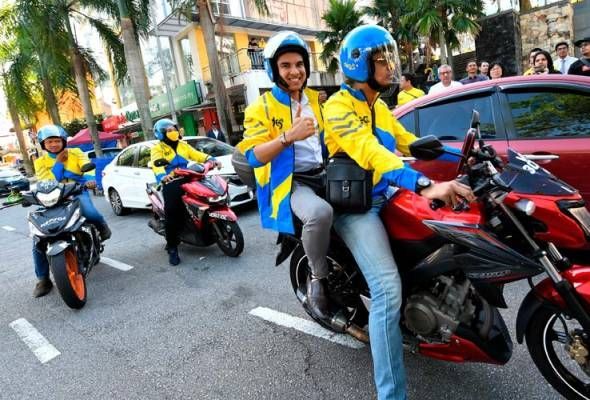
[Asia Economy Kuala Lumpur Correspondent Hong Seong-a] Motorcycle taxi services have reappeared in Kuala Lumpur, the capital of Malaysia.
According to local Malaysian media on the 14th, the Malaysian Ministry of Transport announced that it will conduct a six-month pilot motorcycle sharing project starting from January this year. The company that began the pilot operation is Degoride, a Malaysian motorcycle sharing service company, which started its first operation on the 1st in Kuala Lumpur as well as Putrajaya and Shah Alam.
Degoride, established in 2015, was Malaysia's first motorcycle taxi company and launched its service in November 2016. However, due to concerns over passenger safety, the business was shut down after just three months.
The reappearance of motorcycle sharing services in Malaysia began last August when the parliament approved related businesses and moved to amend relevant laws.
Interest among Malaysians in the service is high. Upon news of the business resumption, about 5,000 drivers applied to Degoride. It is reported that 500 of them started as drivers. The competition ratio reached 10 to 1.
Following Degoride, Grab, the largest ride-sharing service provider in the ASEAN region, launched GrabBike service on the 3rd. Grab operates motorcycle taxi services in Indonesia, Vietnam, and Thailand. In Malaysia, it started operations focusing on busy areas within the metropolitan area such as KLCC, Bukit Bintang, Pudu, and Chow Kit.
During the pilot operation period, both companies plan to focus on safety issues to review the business. To ensure passenger safety, drivers will be hired based on factors such as motorcycle age, drivers' traffic accident history, and driving experience. Helmets meeting SIRIM (Malaysian Standards Association) standards will be provided to both drivers and passengers. Additionally, the maximum travel distance will be limited to 10 km, and insurance coverage will be applied to both drivers and passengers.
During the pilot period, measures will also be put in place for female passengers and drivers. In Malaysia, an Islamic country, Muslim women are prohibited from close physical contact with men who are not their spouses. Due to issues such as sexual harassment arising from unavoidable physical contact, female drivers will only carry female customers, and male drivers will only serve male customers.
The motorcycle sharing service, resumed this year, is expected to grow into an important transportation means in Malaysia. Motorcycle taxi services charge affordable fares ranging from 3 ringgit to 11 ringgit (approximately 850 won to 3,100 won) depending on distance, and they can serve short-distance routes that are difficult to access by public transportation, making them a key transportation option for the working class.
Given the large population using motorcycles, an increase in economically active population is also expected. According to local media such as Free Malaysia Today, Youth and Sports Minister Syed Saddiq stated, "It is expected that the number of employed people in the bottom 40% income bracket will increase by more than 5,000 due to the motorcycle taxi service."
As motorcycle sharing services become more active, this is expected to lead to increased revenue in the sharing economy. Currently, Indonesia's motorcycle sharing service Gojek is also preparing to enter Malaysia. In the future, it is expected to expand beyond motorcycle taxi services to areas such as delivery and parcel services.
According to Statista, a German statistics agency, Malaysia's ride-sharing service revenue reached $558 million in 2019, with an annual growth rate of 16%. It is projected to reach $1 billion by 2023. Malaysia's ride-sharing service penetration rate is 12.7%, ranking third highest in Southeast Asia.
© The Asia Business Daily(www.asiae.co.kr). All rights reserved.

















