South Korea's Current Account Surplus and Trade Surplus with the U.S. Lead to Its Retention as a Monitoring Country
Exclusion of China from Currency Manipulator List is a Positive Factor for South Korean Economy
Won Strengthens and KOSPI Rises on the 14th... Investment Sentiment Expected to Revive
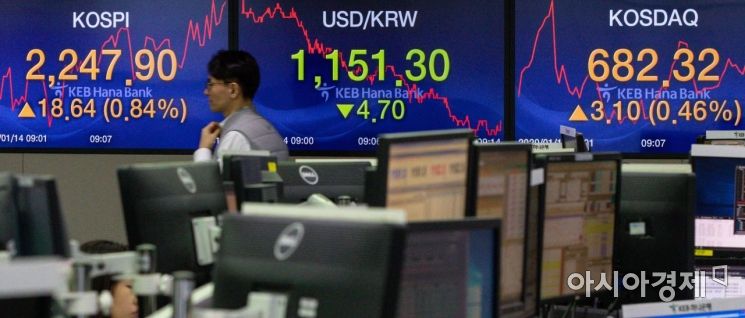 On the 14th, the KOSPI index opened at 2243.06, up 13.80 points (0.62%) from the previous trading day, amid expectations for the signing of the first phase trade agreement between the US and China. Dealers are working in the dealing room of KEB Hana Bank in Jung-gu, Seoul. In the Seoul foreign exchange market, the won-dollar exchange rate started at 1153.7 won, down 2.3 won from the previous trading day. Photo by Jinhyung Kang aymsdream@
[Asia Economy Reporters Sim Nayoung and Kim Minyoung] The reason South Korea was not removed from the U.S. Treasury Department's monitoring list is due to the size of its current account surplus and trade surplus with the U.S. Being removed from the currency monitoring list would enhance South Korea's external credibility and reduce the risk perceived by foreign investors in the Korean financial market, making this a regrettable outcome. However, with China being removed from the currency manipulator list, expectations are rising that South Korea's investment sentiment will revive and that there will be a positive impact on the financial market.
According to the "Report on Major Trading Partners' Exchange Rate Policies" released by the U.S. Treasury Department on the 13th (local time), South Korea maintained its status as a monitoring country by meeting two of the three criteria set by the U.S.: a trade surplus with the U.S. of $20.3 billion and a current account surplus equivalent to 4.0% of GDP.
Last year, South Korea was listed as a monitoring country in the first half's exchange rate report by meeting one criterion: a current account surplus ratio of 4.4% relative to GDP. The U.S. Treasury classifies countries as monitoring countries if they meet two of the following three criteria: ▲trade surplus with the U.S. exceeding $20 billion ▲current account surplus exceeding 2% of GDP ▲foreign exchange market intervention (net purchases) exceeding 2% of GDP. This classification is a step before being designated as a currency manipulator.
A senior official from the Ministry of Economy and Finance stated, "Since the current account surplus ratio and trade surplus with the U.S. are already publicly known statistics, it was expected that South Korea would maintain its monitoring country status, and even if this status is maintained, it will not have any particularly adverse effects."
Economic experts emphasize that China's removal from the currency manipulator list will have a positive impact on the South Korean economy. As the U.S.-China trade conflict, which had been a major external risk, shows signs of resolution, global uncertainties are expected to ease, leading to a revival in exports and a recovery in investment sentiment. Joo Won, Director at Hyundai Research Institute, assessed, "The U.S. removing China from the currency manipulator list indicates a high likelihood that the trade war will be resolved as expected."
The Bank of Korea forecasted that with rising expectations for easing U.S.-China trade tensions and gradual recovery in global trade, South Korea's total merchandise exports this year will increase by 2.2% compared to the same period last year (2.3% in the first half, 2.1% in the second half). In particular, the IT sector is expected to turn to growth, supported by a recovery in the semiconductor market.
On the 14th, the won-dollar exchange rate opened at 1,153.7 won, down 2.3 won from the previous day in the Seoul foreign exchange market. The foreign exchange market expects the won to continue strengthening as risk-on sentiment is ignited. The KOSPI also started on an upward trend, rising 14.51 points (0.65%) to 2,244.52 as of 9:02 a.m. A senior official from the Bank of Korea explained, "Recently, the yuan has strengthened, causing the yuan-dollar exchange rate to decline, and this positive factor has been partially priced in. The U.S. decision this time will further restore investment sentiment."
© The Asia Business Daily(www.asiae.co.kr). All rights reserved.
![Clutching a Stolen Dior Bag, Saying "I Hate Being Poor but Real"... The Grotesque Con of a "Human Knockoff" [Slate]](https://cwcontent.asiae.co.kr/asiaresize/183/2026021902243444107_1771435474.jpg)
















