Bank of Korea Overseas Economic Focus... Assessing Global Economic Risks
Identifying Geopolitical Risks, Trade Conflicts, Political Issues, and Global Debt Expansion
[Asia Economy Reporter Kim Eunbyeol] It has been pointed out that the increasing debt driven by accommodative macroeconomic policies worldwide could become a risk that determines the new direction of the global economy. This is considered an element that could increase uncertainty alongside geopolitical risks, trade conflicts, and major countries' political issues.
On the 12th, the Bank of Korea stated in its 'Overseas Economic Focus' report, "Although the global economic growth is expected to improve moderately this year, structural growth constraints persist, and recently, various risk factors have emerged, such as escalating tensions in the Middle East."
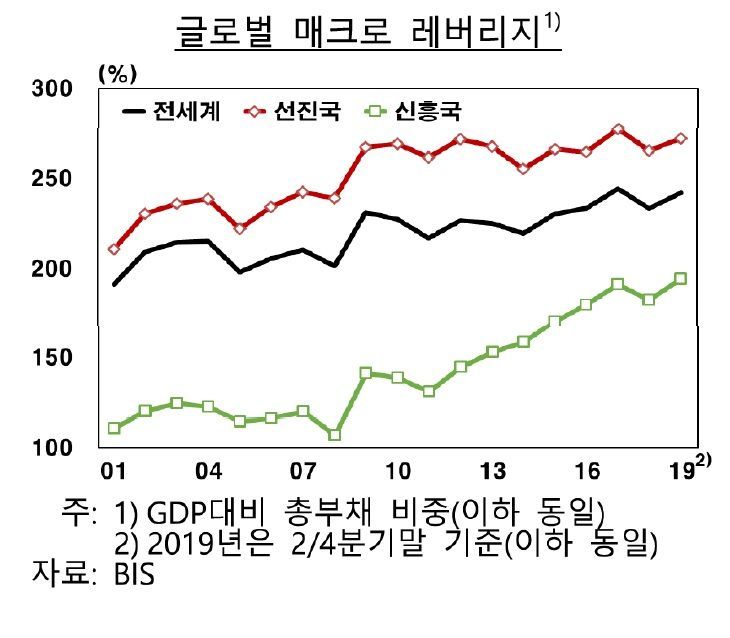
The Bank of Korea pointed out that global macro leverage, which had been on the rise since the financial crisis, decreased in 2018 but rebounded last year due to the influence of accommodative macroeconomic policies in various countries.
Global debt, which was around 200% of Gross Domestic Product (GDP) before the financial crisis, has continuously increased, focusing on government debt in advanced countries and corporate debt in emerging countries, expanding to the low 240% range by the first half of last year.
The Bank of Korea explained, "In the case of advanced countries, as debt levels rise, the policy response capacity may be limited during economic slowdowns," and added, "Emerging countries are experiencing rapid increases in total debt and a significant rise in external debt, raising concerns that financial instability could recur if external uncertainties expand in countries with weak fundamental economic conditions, and corporate debt could deteriorate."
According to the World Bank (WB), the weighted external debt of major emerging countries was $5.5 trillion in 2018, a 146% increase compared to $2.3 trillion ten years ago.
Regarding the conflict between the United States and Iran, the possibility of escalation into a full-scale war is low, but it is assessed that instability in the Middle East region will not be resolved in the short term. The Bank of Korea stated, "Considering the U.S. presidential election, Iran's domestic situation, and the dynamics in the Middle East, it is highly likely to lead to localized armed conflicts." It also anticipated that the positions of pro-Western countries, Shiite countries, and countries such as Turkey, Russia, and China, which are negative toward escalation, will significantly influence the military tension situation in the region.
Regarding Brexit (the United Kingdom's withdrawal from the European Union (EU)), the possibility of a so-called No Deal Brexit, where the UK leaves the EU without an agreement, has almost disappeared, but it is expected that trade negotiations between the EU and the UK may not proceed smoothly. The Hong Kong situation is also expected to see continued gatherings and protests around the September Legislative Council elections.
Trade conflicts are expected to reemerge. Although uncertainty was temporarily eased by the Phase 1 agreement in the U.S.-China trade negotiations, existing tariffs remain in place, and future negotiation agendas are related to China's institutional and economic structural aspects, making it difficult for conflicts to be resolved in the short term. It is also anticipated that trade relations between the U.S. and the EU, which began with the Airbus subsidy issue, could deteriorate.
Political issues in major countries are also factors that increase uncertainty. These include the difficulty in predicting the results of the U.S. presidential and congressional elections in November, the possibility of heightened tensions between Taiwan and China following the re-election of Taiwan's pro-independence President Tsai Ing-wen, the potential spread of anti-government protests by Muslims due to amendments to India's citizenship law, and the intensification of conflicts between the government and labor groups caused by the French government's enforcement of pension reforms.
© The Asia Business Daily(www.asiae.co.kr). All rights reserved.

















