40.2 Million Lost Workdays... 27.2% Decrease YoY
Similar Level to Europe... 5.2% Increase in Labor Disputes
Continuous Decline Since Moon Administration... "Impact of Changing Labor-Management Awareness"
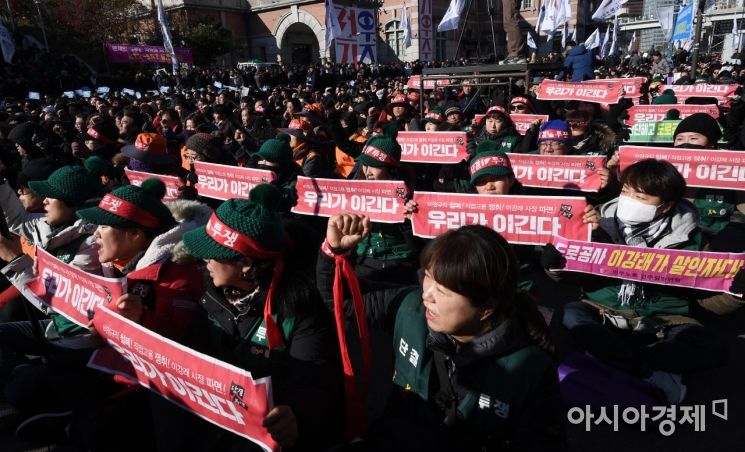
[Asia Economy Reporter Kim Bo-kyung] While the number of labor disputes such as strikes at workplaces increased last year, the number of lost workdays was 402,000, the lowest in the past 20 years.
The Ministry of Employment and Labor disclosed the '2019 Labor-Management Relations Statistical Analysis Results' on the 9th. The number of labor disputes last year was 141, up 5.2% from 134 cases the previous year, but the number of lost workdays decreased by 27.2% from 552,000 days in the previous year to 402,000 days.
The number of lost workdays is calculated for workplaces where labor disputes caused work stoppages of 8 hours or more per day, and is calculated as 'number of strike participants × strike hours ÷ daily working hours (8 hours)'.
The number of lost workdays has continuously decreased since the inauguration of the Moon Jae-in administration, recording 862,000 days (2017) → 552,000 days (2018) → 402,000 days (2019).
In particular, last year, due to factors such as Hyundai Motor Company's strike-free wage and collective bargaining agreement, the number of lost workdays significantly decreased, marking the lowest figure recorded in the past 20 years.
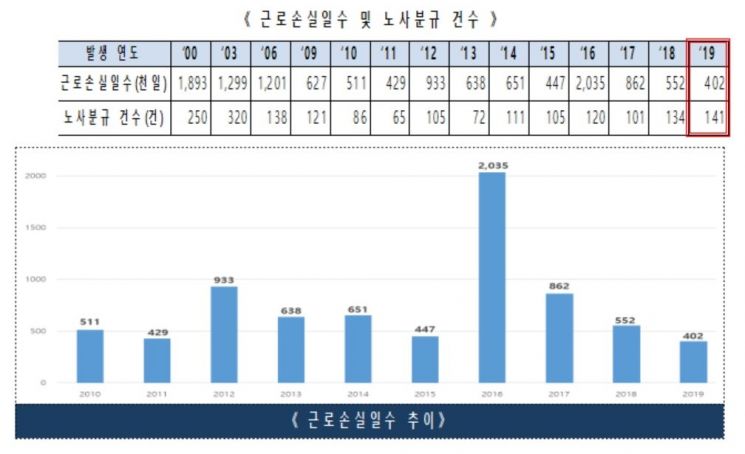
Among the total 141 labor disputes last year, 46 cases were at workplaces with 1,000 or more employees, a 76.9% increase compared to 26 cases in 2018.
However, the average number of dispute days per workplace with 1,000 or more employees decreased by 41.4%, from 16.8 days in 2018 to 9.9 days in 2019, which was one of the main reasons for the reduction in lost workdays.
Im Seo-jung, Vice Minister of Employment and Labor, explained, "In large companies, labor disputes in the automobile industry account for 40% of lost workdays," adding, "It is understood that Hyundai Motor Company's strike-free wage and collective bargaining agreement for the first time in eight years had the greatest impact."
According to the International Labour Organization (ILO), the average number of lost workdays per 1,000 wage workers in major countries over the past 10 years is 107.8 days in Denmark, 48.5 days in Italy (2007-2008), 56.6 days in Spain, 23.4 days in the UK, 6.0 days in the US, and 0.2 days in Japan.
Korea's 10-year average is 42.33 days, similar to many European countries.
The Ministry of Employment and Labor analyzed that the decrease in lost workdays was influenced by ▲ a change in labor and management's perception that long-term strikes are disadvantageous to both sides ▲ the spread of labor-management agreement practices considering difficult economic conditions and public sentiment ▲ government mediation and support systems for smooth negotiations between parties.
Vice Minister Im Seo-jung said, "We will continue to monitor vulnerable and key workplaces regularly to minimize labor disputes," adding, "We plan to prevent disputes in advance through labor-management relations issue review meetings and support early resolution of conflicts by visiting workplaces."
He also stated, "We will actively strive to reduce labor conflicts through various forms of social dialogue and communication with labor and management organizations on major policy issues."
© The Asia Business Daily(www.asiae.co.kr). All rights reserved.


















