Low Credit and Low Income Borrowers Increase Amid Recession
1.1654 Trillion KRW More Than Same Period Last Year
Expansion for Credit Card Companies' Profitability
Rising Delinquency Rates Raise Default Concerns
[Asia Economy Reporter Ki Ha-young] Last year, amid employment instability due to the economic downturn and a slump in self-employment, the use of card loans, which are high-interest long-term loans, increased. With financial authorities announcing regulations on card loans, it is interpreted that low-credit, low-income individuals and small-scale self-employed people who could not pass the threshold of the primary financial sector in urgent need of funds flocked to card loans. As the economy becomes increasingly difficult, delinquency rates are also rising among these groups, raising concerns about defaults.
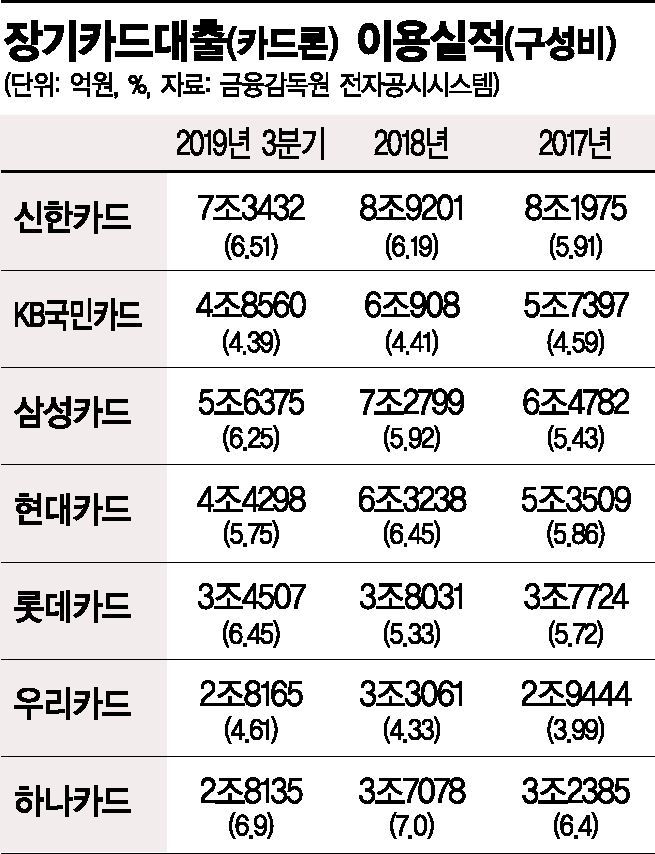
According to the Financial Supervisory Service's Financial Statistics Information System on the 8th, the amount of card loan usage by seven card companies (Shinhan, KB Kookmin, Lotte, Woori, Samsung, Hana, Hyundai Card) reached 31.3471 trillion KRW by the third quarter of last year. This is an increase of 1.1654 trillion KRW (3.86%) compared to the same period the previous year.
The reason for the increase in card loan usage is that major domestic card companies expanded card loans to compensate for the revenue loss caused by the reduction in merchant fees. In fact, the proportion of card loans in the total credit card usage amount (lump sum + installment + cash service + card loan) of card companies mostly increased by the third quarter of last year. The company with the largest increase in the proportion of card loans was Lotte Card. In the third quarter of last year, Lotte Card's card loan ratio was 6.45%, up 1.11 percentage points from 5.34% for the entire previous year. Industry leader Shinhan Card also increased from 6.19% to 6.51% during the same period, a rise of 0.32 percentage points, and Samsung Card rose from 5.92% to 6.25%, an increase of 0.33 percentage points. Woori Card also slightly increased from 4.33% to 4.61% during this period. Hana Card showed a similar level at 6.94% compared to the end of the previous year. Hyundai Card and KB Kookmin Card slightly decreased.
The problem is that the main users of card loans are low-credit, low-income individuals urgently needing funds. Card loans allow borrowing up to 100 million KRW for up to 36 months depending on creditworthiness. Although card loan interest rates vary by card company, most are between 15% and 20%. Compared to bank credit loans, borrowers must bear interest rates three to four times higher.
The increase in card loans leads to a rise in delinquency rates. In fact, Shinhan Card recorded a delinquent loan ratio (including refinancing loans) of 1.65% for loans overdue by more than one month in the third quarter of last year. This is an upward trend following 1.49% in 2017 and 1.53% in 2018. Lotte Card and Woori Card also saw delinquency rates rise to 1.65% and 1.84%, respectively, in the third quarter of last year, up from 1.37% and 1.78% the previous year.
The rise in card company delinquency rates is related to the economic recession. When card company delinquency rates increase, it means that the repayment ability of vulnerable borrowers such as low-credit and low-income individuals is rapidly deteriorating as the economy freezes further. Financial companies with many non-performing loans will inevitably reduce loans to low-income groups to manage soundness in the future. In such cases, the number of ordinary people pushed into the private loan market will increase.
A financial industry official said, "The expansion of card loans is a short-term measure for card companies to maintain profitability," adding, "Since financial authorities also manage and supervise card loans, further expansion will be difficult."
In fact, from April, card companies will face stricter marketing restrictions, such as prohibiting the sale of products that reverse interest rates between credit grades on card loans. This reflects the financial authorities' policy direction to eliminate the structure where card companies easily earn profits through card loans.
© The Asia Business Daily(www.asiae.co.kr). All rights reserved.

















