Low Possibility of Full-Scale War, Likely to Only Increase Short-Term Volatility
Weak Dollar Trend Expected to Continue Amid Signs of US Economic Slowdown
[Asia Economy Reporter Eunmo Koo] As tensions between the United States and Iran escalate, interest in safe-haven assets is rising, but the weak dollar trend appears to be continuing. This is interpreted as being influenced by the outlook that the U.S. economy is showing signs of slowing down and the possibility of Middle East risks escalating into a full-scale war is low.
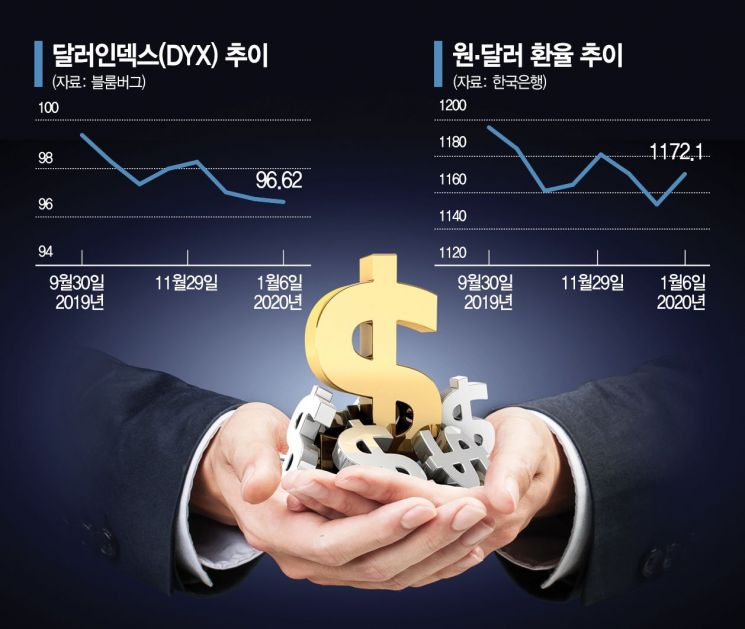
According to the Bank of Korea on the 7th, the won-dollar exchange rate closed at 1,172.1 won, up 5.0 won from the previous trading day (1,167.1 won) in the foreign exchange market the day before. This marks the third consecutive day of gains since the 2nd. The recent rise has temporarily halted the dollar's weakness (won strength) trend, which had fallen to 1,156.4 won on the 30th of last month after peaking at 1,206.0 won on October 2nd last year.
The geopolitical risk in the Middle East, which began with the U.S. military airstrike on Iran, influenced the rise in the won-dollar exchange rate. As tensions between the two countries intensified, the preference for safe-haven assets in the global financial market also strengthened. Representative safe-haven assets such as gold and the Japanese yen showed strength, accompanied by declines in the stock market and gains in the bond market.
Although geopolitical uncertainty in the Middle East is expanding and the preference for safe-haven assets is strengthening, the prevailing view is that the recent dollar weakness (won strength) trend will continue. This is because the conflict between the two countries is currently expected to have a low likelihood of escalating into a full-scale war, meaning it will likely only increase short-term volatility. Despite the conflict, the dollar index has continued its downward trend since peaking at 99.38 points on September 30th last year. According to Bloomberg, the dollar index (DYX) closed at 96.62 points, down 0.22% from the previous day, continuing its weak trend.
Jongnak Gong, a researcher at Daishin Securities, said, "If the situation intensifies into a war in the future, the outlook for the dollar will inevitably change," but added, "Considering the economic and military burdens, it seems unlikely that the two countries will engage in a full-scale war, so the dollar weakness is likely to continue based on economic fundamentals." Youngjin Ahn, a researcher at SK Securities, also said, "It is difficult to predict the outcome of the geopolitical crisis, but assuming the situation does not escalate to extremes, the possibility of a sharp rise in the won-dollar exchange rate is not very high."
Above all, the signs of a slowing U.S. economy and the narrowing fundamental gap with countries outside the U.S. support the sustainability of the weak dollar. The dollar index reflects the economic gap between the U.S. and other regions, and the dollar began to weaken after the ISM manufacturing index fell last October. The U.S. ISM manufacturing index for September, released on October 1st last year, recorded 47.8 points, falling below the baseline of 50 points for two consecutive months following August's 49.1 points.
In contrast to the signs of a slowing U.S. economy, economic indicators in the Eurozone and emerging markets improved in the first half of this year, expected to reduce the growth momentum gap with the U.S. Heejin Kwon, a researcher at Korea Investment & Securities, said, "Economic indicators of major countries excluding the U.S. have passed the bottom and are showing improvement mainly in leading and sentiment indicators, and this is expected to gradually spread to real indicators, so the dollar is likely to decline further for the time being."
Additionally, the Federal Reserve's (Fed) accommodative stance is also a factor preventing the dollar from strengthening. Fed Chair Jerome Powell stated at last month's Federal Open Market Committee (FOMC) meeting that the Fed has no intention of raising the federal funds rate until the U.S. inflation rate significantly exceeds the target level. Researcher Kwon explained, "The inflation forecast announced at the December FOMC is only 2% until 2022," indicating that the Fed is effectively ruling out the possibility of a rate hike at present.
© The Asia Business Daily(www.asiae.co.kr). All rights reserved.

![Clutching a Stolen Dior Bag, Saying "I Hate Being Poor but Real"... The Grotesque Con of a "Human Knockoff" [Slate]](https://cwcontent.asiae.co.kr/asiaresize/183/2026021902243444107_1771435474.jpg)















