[2020 New Year Project - Generational Coexistence, Building Society Together]
<2> Family or Stranger, Two Perspectives on the 'Workplace'
40s and 50s Sharing Life Like a Family at Work
Communication Through Social Gatherings Outside Work
Good Intimacy and Teamwork Boost Work Efficiency
Millennials Who Faced Fierce Entrance Exams and Job Hunting
"No More Enduring or Being Exploited"
Value 'Boundaries to Be Respected' Such as Power Harassment and Prejudice
Average Tenure at First Job for Youth is 1 Year and 5.3 Months
Experts Say "Trendsetting Consumers"
Failing to Understand Millennials Means Falling Behind in the Market
Organizational Innovation with Rewards Based on Ability
[Asia Economy Reporter Jeong Dong-hoon] "I think I won’t be able to make it to this company dinner because of a prior engagement." (Early 30s, Employee A)
"What do you mean prior engagement when the dinner was announced ages ago... You don’t even drink and leave right after the first round, you jerk." (Late 40s, Deputy Manager B)
"I’m not a jerk." (Employee A)
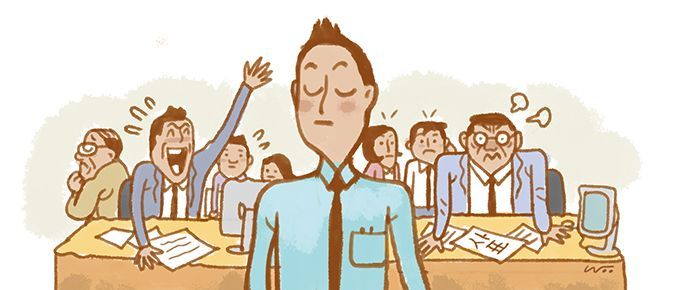
The quarrel between Deputy Manager born in 1974 and Employee born in 1988 was settled by the mediation of the Manager born in 1970. A cold atmosphere enveloped the entire department. Deputy Manager B, storming out of the meeting room, muttered to himself as if for someone to hear, "It’s not like we have these dinners every week, it’s just the year-end party once a year. If personal plans are that important, go run your own business or whatever, these kids nowadays..." Employee A left behind in the meeting room blushed deeply. The two had already clashed several times over the direction of proposal drafts. This is a typical conflict case between seniors who equate organizational and personal development and juniors who see the organization and the individual as separate entities. Employee A said, "I just gave my opinion when asked, but I get called a 'kkondae' (old-fashioned boss)." The phrases "I must not become like that senior" and "There’s no senior I want to emulate" are the most common complaints in Employee A’s peer group chat on KakaoTalk.
For the millennial generation, the workplace is 'the other.' My completion, my time, and my leisure all exist outside the workplace. On the other hand, those in their 40s and 50s value intimacy and organizational cohesion within the workplace. Since most of the day is spent at work anyway, they believe that leisure, happiness, and achievement must be felt there. In other words, the equation that the organization’s development equals my development holds true.
"Millennials Want a Culture Everyone Agrees On"
How can this difficult-to-reconcile difference be overcome? Should everyone adjust to the millennials’ demands? Or is it wiser to follow the words of seniors who hold power (experience)? Apologies to the older generation, but experts generally say that the reality is to ask for 'understanding (or concession)' from seniors. Professor Cho Young-tae of Seoul National University’s Graduate School of Public Health said, "Millennials face tremendous 'population pressure.'" Population pressure refers to the number of older people one must compete with at work. Professor Cho said, "Millennials cannot expect that working hard will naturally lead to higher positions and salaries," and added, "To bring out their performance, companies must break seniority systems and create structures that recognize and reward ability."
Summarizing and interpreting experts’ views, one conclusion is possible. The idea that the organization must develop for me to develop is a value of the older generation. Only organizations where the new generation agrees with the direction and willingly follows can develop. If a company insists on organizational cultures that the millennials cannot accept, it will inevitably be left behind. Professor Lee Eun-hyung of Kookmin University’s Department of Business Administration said, "Millennials are employees within companies but trendsetting consumers in the market. How can companies that do not understand this generation and fail to lead their changes survive in the market?"
"Where Does Company Loyalty Come From?
Unity or Rewards?"
The older generation asks, how can an organization without intimacy and unity develop? Isn’t teamwork that overcomes individualism a supreme value? Millennials counter, "If a company has proper rewards and a flexible organizational culture, tenure will naturally be longer, and organizational strength and loyalty will naturally arise. Without that, how can anyone believe and follow the promise that loyalty will eventually be rewarded?" This is the protest of 'Kingdom' (30, pseudonym), a third-year employee.
As often mentioned, this value stems from the abandonment of the lifetime employment theory. The promise that "your efforts will be rewarded someday" was mostly kept. That was employment stability. But the premise has changed. For millennials, there is no longer a 'family-like workplace where we share life forever.' 'Incheon Senior Sister' (33), who has been working for seven years, said, "Why should I form family-like relationships with coworkers when the company could fire me anytime?" and added, "It doesn’t make sense to expect us to go hiking on weekends and attend mandatory dinners on weeknights when that’s the reality."

"Following Rules Everyone Agrees On
Is Keeping the Boundary"
Ultimately, the core comes down to where the 'boundary to be respected' lies. The older generation does not blindly demand sacrificing personal life. Family is important to them, and personal life is a value not to be compromised. For millennials, the boundary to be respected means fairly adhering to 'rules and contracts made by mutual agreement.' There is a clause in company regulations (or employment contracts) that says 'work until 6 p.m.' However, there is no rule that says 'occasionally attend dinners to promote organizational unity.' 'Yeouido Sugarman' (31), a seventh-year employee, said, "There are boundaries to be respected even within the workplace, such as not contacting after work hours and treating juniors as human beings," and added, "Offices that cross these boundaries will be filled with employees only looking for job change opportunities." 'Maltese Does Not Endure' (29), a cable TV producer for four years, said, "Some people in their 40s and 50s shamelessly express prejudice and hatred based on appearance, academic background, and race, crossing the line," and explained, "That’s why, despite worrying about making a living, they carry a resignation letter in their hearts."
Not only work rules but also power harassment and gender sensitivity?things that must be respected as human beings?are part of the 'boundaries' millennials emphasize. Having endured fierce entrance exams and job market competition, millennials come to work armed with the mindset of "I will no longer endure or be exploited." They also have a strong compulsion to protect the boundaries of "rights earned by my own power." The popular phrase "You crossed the line" when someone invades their territory did not arise without reason.
"Mutual Destruction or Coexistence?"
The conclusion converges on the need to create a new organizational culture that aligns with millennials’ values. This does not mean discarding existing values but rather emphasizes that this work must start on the foundation of new values. However, our society is mostly failing at this task. The phenomenon of millennials leaving organizations easily despite severe employment difficulties proves this. According to the Korea Employers Federation, the turnover rate of college graduate new hires within one year increased from 15.7% in 2010 to 23.2% in 2012, 25.2% in 2014, and 27.7% in 2016. The biggest reason for early resignation is failure to adapt to the organization or job (49.1%). According to Statistics Korea, as of May last year, the average tenure at the first job for youth was only 1 year and 5 months.
Is it inevitable to let millennials leave like this? Can we just dismiss them as 'difficult to manage' and 'immature kids these days'? Experts emphasize that coexistence with generations is directly linked to organizational survival. The conflict with millennials sharply illustrates the conflict between old and new paradigms that our society will face in the Fourth Industrial Revolution era. Efforts to coexist with millennials may not be for them but for our organizations. The prerequisite for coexistence must inevitably be innovation.
© The Asia Business Daily(www.asiae.co.kr). All rights reserved.

![Clutching a Stolen Dior Bag, Saying "I Hate Being Poor but Real"... The Grotesque Con of a "Human Knockoff" [Slate]](https://cwcontent.asiae.co.kr/asiaresize/183/2026021902243444107_1771435474.jpg)















