Public Data Produced in Gangdong-gu Managed Separately by Seoul City, Ministry of the Interior and Safety, Statistics Korea, etc., Resulting in Poor Data Accessibility and Work Efficiency... Development of a System Enabling Easy Integrated Search and Automatic Analysis Within a Single Platform
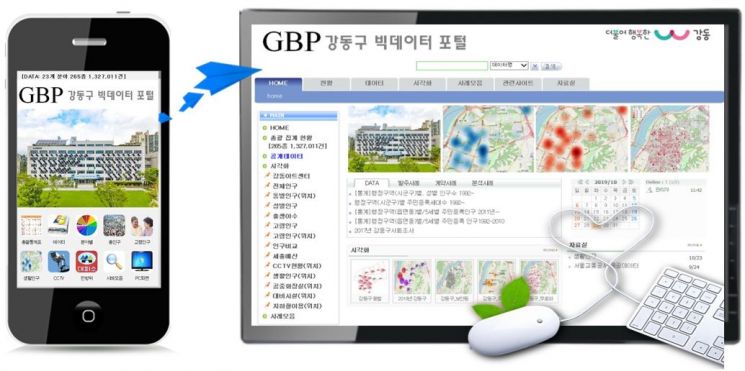
[Asia Economy Reporter Jongil Park] Gangdong-gu (Mayor Lee Jeong-hoon) has independently developed the 'GBP Gangdong-gu Big Data Portal' system, which enables integrated management of data scattered across various institutions?a common issue faced by all local governments.
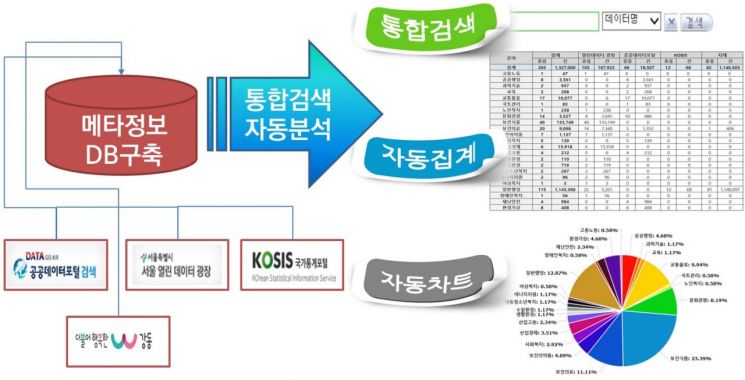
The 'GBP Gangdong-gu Big Data Portal' (hereafter, GBP) is a system that builds a meta-information database, allowing easy integrated search and automatic analysis within a single platform.
Starting this month, after a pilot operation period, it will be launched through the Gangdong-gu Office website. Representative public data available includes population statistics, CCTV status (location), daytime population (location), public restrooms (location), and subway usage (location).
This system was developed because public data produced by Gangdong-gu was separately managed by institutions such as Seoul City, the Ministry of the Interior and Safety, and Statistics Korea, resulting in significantly reduced data accessibility and work efficiency. Currently, Gangdong-gu’s public data comprises 265 types and 1,333,877 records.
Through this system development, all data produced by Gangdong-gu can be visualized as numerical and image data, shown through automatic aggregation and automatic charts. Information is provided at a glance to enhance understanding and convenience, and trends by year can also be viewed, enabling its use as an objective indicator to predict future changes.
Additionally, it is accessible via mobile devices, allowing easy access anytime and anywhere without location constraints.
Last year, to respond to the new era environment such as the 4th Industrial Revolution, the district reorganized its structure and established a Big Data Team. In particular, personnel were assigned through an internal recruitment process, successfully developing the GBP independently and deriving priority CCTV installation areas based on big data analysis.
This laid the foundation for a smart city and big data-driven scientific administration, demonstrating an administrative case ahead of other local governments.
By having specialized staff with GBP development experience directly develop the system, the district also achieved cost savings of hundreds of millions of won in development expenses.
Moreover, without separate project funds, the district analyzed priority CCTV installation areas using public big data with the help of Ministry of the Interior and Safety public big data youth interns and internal personnel, presenting objective grounds for decision-making different from previous methods. Based on these results, the district plans to install CCTV this year.
Reviewing the process, among areas requiring CCTV installation, the five most urgent locations were selected, and additional factors such as child protection zones and police station locations were considered to determine CCTV installation points. Assuming each CCTV can capture 360 degrees within a 50-meter radius, the district identified vulnerable surveillance areas based on CCTV status data and utilized data related to crime vulnerability, including CCTV crime complaints, commercial establishments (entertainment, lodging, finance), and floating population data.
Furthermore, areas with high crime intensity and frequency, commercial establishments (entertainment, lodging, finance), and regions with high nighttime and late-night floating populations were given higher scores, while weights were applied to areas with high female population density and single-family housing density to calculate the final index.
Thus, the paid floating population data was replaced with Seoul City public data on nighttime and late-night bus users, producing results without incurring additional budget.
This maximized cost-saving effects, and the district looks forward to further policy applications using big data analysis in the future.
Lee Jeong-hoon, Mayor of Gangdong-gu, stated, “Through the GBP system, data access has become easier, fulfilling residents’ right to know and improving data comprehension. We will continue to pursue administrative innovation that makes residents’ lives more convenient through independent big data analysis.”
© The Asia Business Daily(www.asiae.co.kr). All rights reserved.


















