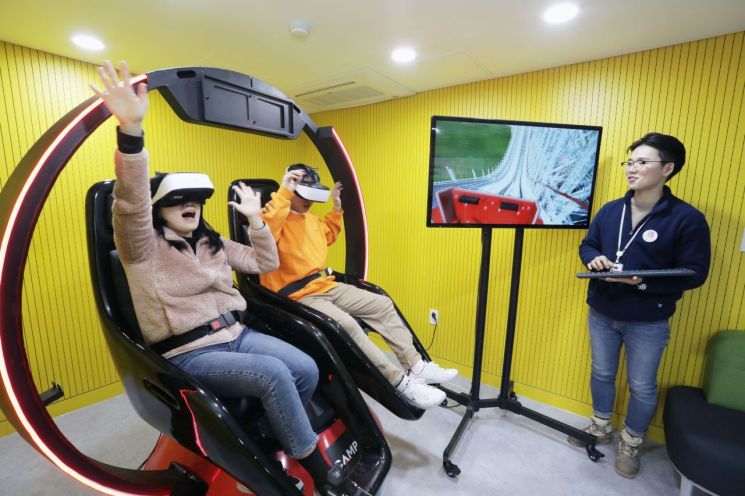
[Asia Economy Reporter Moon Chaeseok] An analysis has emerged that absurd regulations, such as classifying virtual reality (VR) films screened at the Cannes Film Festival as 'game content' and thus preventing their screening in Korean theaters, are not only hindering but also holding back the development of 5th generation (5G) killer content.
On the 5th, the Korea Institute for Industrial Economics and Trade (KIET) diagnosed this in its report titled "Changes and Implications in the Content Industry in the 5G Era," stating that active discovery of content in fields expected to grow, such as immersive and interactive content and cloud gaming, is necessary.
The report urged that since Korea lacks differentiated content and platforms suitable for the 5G environment, strategic support and regulatory reforms are needed to nurture initial market killer content.
The report anticipated that with the commercialization of 5G, production of augmented reality (AR), VR, and hologram content will be activated, and the market for individual media will also expand.
With faster data processing speeds, demand for ultra-high-definition video content is expected to increase, and short-form content will spread due to the activation of streaming services.
While the market is rapidly advancing, Korea's response is criticized as slow. Despite being the first in the world to commercialize 5G services, Korea has not established proper momentum for platform and content industries.
Excessive regulation was pointed out as a problem without fail. Researcher Park Ji-hye, who wrote the report, said, "The VR film 'White Rabbit,' produced in 2018, was screened at the Cannes Film Festival but was classified as game content domestically because it runs on PC, preventing its release in theaters," adding, "Korea's VR content classification standards do not align with overseas standards, causing restrictions on related industry development."
A solid business model has also not been established. While VR content experience venues are increasing, there is a shortage of content to enjoy. Most business models focus on one-time experience centers such as theme parks and experience zones. This is because 87.7% of domestic AR·VR companies are small businesses with sales under 1 billion KRW.
In the platform market, Korea has not produced global hit products like the US's YouTube or China's TikTok. The technology level related to immersive content was about 1.4 years behind the US as of 2017. China's technological capabilities have also risen to a level that cannot be ignored.
The report emphasized that the government must provide strategic support and regulatory reforms even now. It is necessary to build immersive content business models to seek continuous revenue generation, and the government should make proactive investments so that small content companies do not suffer from high production costs, lack of infrastructure, and uncertainties in distribution platforms.
Since overseas video platforms such as TikTok, YouTube, and Netflix dominate the domestic media market, differentiated strategies by companies for developing and nurturing native platforms must also be prepared.
Researcher Park said, "In the early stages of 5G service deployment, to nurture core domestic content, the technology gap with overseas companies must be bridged and related regulations reformed," urging, "Strategic government support and policy preparation for native platform development are necessary."
© The Asia Business Daily(www.asiae.co.kr). All rights reserved.
![Clutching a Stolen Dior Bag, Saying "I Hate Being Poor but Real"... The Grotesque Con of a "Human Knockoff" [Slate]](https://cwcontent.asiae.co.kr/asiaresize/183/2026021902243444107_1771435474.jpg)
















