Report by the Korea Institute of Finance: 'Current Status and Implications of Elderly Poverty Rate in South Korea'
Calculating elderly poverty rate in South Korea considering the characteristic of high real estate asset ownership among the elderly
Elderly poverty rate in 2018 was 31.0%... significantly higher than the OECD average
Rapid aging, disappearing income sources, lack of retirement preparation, and insufficient public pensions are causes of elderly poverty
Government employment policies focus on the elderly... side effects include youth exclusion and weakening consumption base
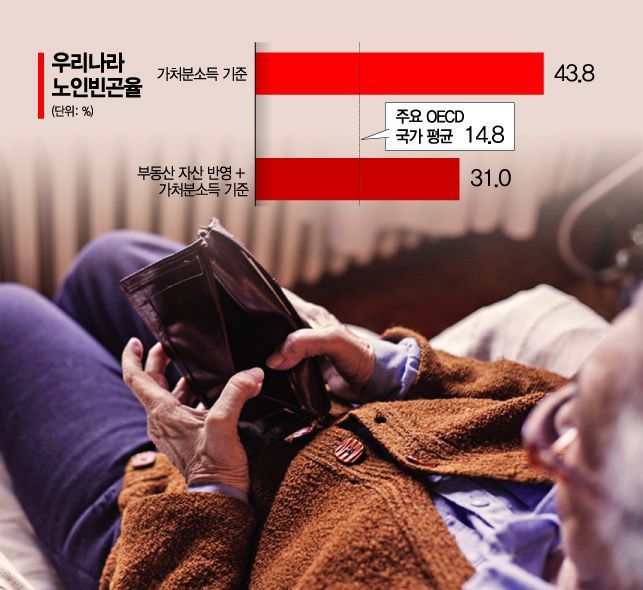
[Asia Economy Reporter Shim Nayoung] Even though many elderly people in South Korea own homes, 3 out of 10 are struggling with poverty. Even when reflecting real estate assets, South Korea’s elderly poverty rate is significantly higher than that of OECD member countries. The elderly poverty rate refers to the proportion of the elderly population whose disposable income is less than half of the median disposable income of the entire population.
The high elderly poverty rate in South Korea is largely due to excessive spending on children’s education and marriage expenses, while economic support from children is lacking, resulting in reduced private income for the elderly. Social welfare and pension systems have not kept pace with the rapidly progressing aging population. Conversely, there are concerns that recent government employment policies focusing on the elderly have relatively excluded the youth.
◆ Elderly poverty rate much higher than OECD average = On the 3rd, the Korea Institute of Finance released a report titled 'Current Status and Implications of Elderly Poverty Rate in South Korea,' which calculated the elderly poverty rate considering that South Koreans aged 65 and older hold more real estate assets than elderly populations in other countries. The report stated that the rate was 31.0% as of 2018. This was calculated by adding the 'annual disposable income' to the 'annual net asset availability,' which is the elderly’s real estate assets evenly distributed over their life expectancy.
Meanwhile, when calculating the elderly poverty rate based solely on 'annual disposable income,' it was 43.8% as of 2017. The poverty rate for those aged 51 to 65, a group concentrated around retirement age, exceeded the OECD average, and the poverty rate sharply increased to 40% among those aged 65 to 75. Considering the overall elderly poverty rate of 43.8% for those aged 65 and older, it is estimated that the poverty rate for those aged 75 and above reaches around 50%.
Senior Research Fellow Jang Min, who authored the report, explained, "In South Korea, the proportion of tangible asset holdings among those aged 60 and above accounts for 80% of total assets, which is much higher than the 20% in the United States or 60% in Japan. When real estate assets are converted into cash flow to adjust income, the elderly poverty rate significantly decreases, but it remains higher than the OECD average of 14.8% (based on disposable income)."
He also pointed out that in other countries, older age groups are also presumed to hold larger real estate or financial assets, which may mean South Korea’s elderly poverty rate is relatively higher.
◆ Declining labor productivity and slowing consumption = A high elderly poverty rate leads to decreased labor productivity and slowed consumption, which become factors hindering national growth. It was also diagnosed that the income conditions of the elderly are unstable and that youth have been relatively excluded from government employment policies.
Researcher Jang stated, "Even recently, those aged 60 and above have been driving employment growth. However, if impoverished elderly enter the labor market mainly in low-wage sectors, their increased labor supply is likely to reduce overall labor productivity." He noted that employment policies focusing on impoverished elderly have concentrated related jobs in public work and service sectors, while the number of manufacturing jobs, which are the main employment sectors for youth and prime working-age groups, has continuously declined.
The report suggested that to improve the elderly poverty rate, public and private pension enrollment rates using earned income should be increased in the long term, and social security programs should be strengthened. It also proposed considering measures such as extending the retirement age and gradually delaying the start of National Pension payments, as the current working-age population is likely to experience a sharp income decline after retirement.
© The Asia Business Daily(www.asiae.co.kr). All rights reserved.
![Clutching a Stolen Dior Bag, Saying "I Hate Being Poor but Real"... The Grotesque Con of a "Human Knockoff" [Slate]](https://cwcontent.asiae.co.kr/asiaresize/183/2026021902243444107_1771435474.jpg)

















