2019 National Customer Satisfaction Survey
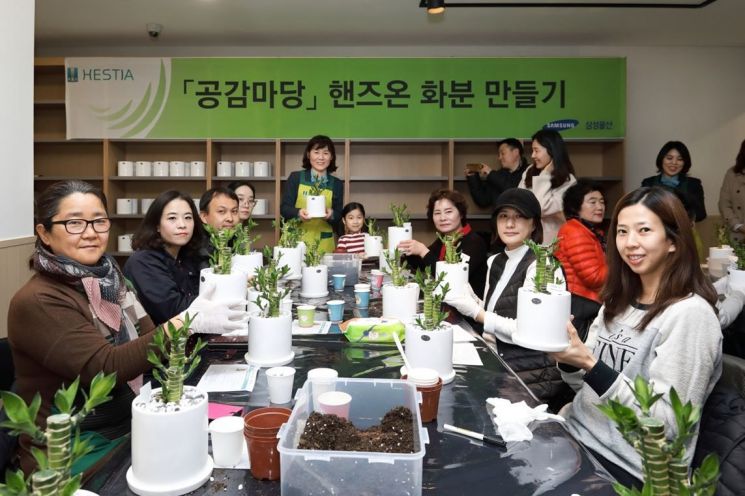 Samsung C&T Ramian is the first in the apartment industry to introduce the service brand 'Ramian Hestia,' providing differentiated customer services to residents.
Despite challenging economic conditions last year, domestic companies' 'customer-centric' management shone, leading to an increase in customer satisfaction, according to a survey. The Korea Productivity Center (Chairman Noh Gyu-seong) announced on the 3rd that the National Customer Satisfaction Index (NCSI), surveyed across 78 industries, 329 companies, universities, and public institutions, scored 76.7 points, up 0.2 points (0.3%) from 76.5 points in 2018. This is the highest score since the NCSI survey began in 1998. The survey was jointly organized by the Korea Productivity Center and the University of Michigan, USA, and sponsored by the Ministry of Trade, Industry and Energy.
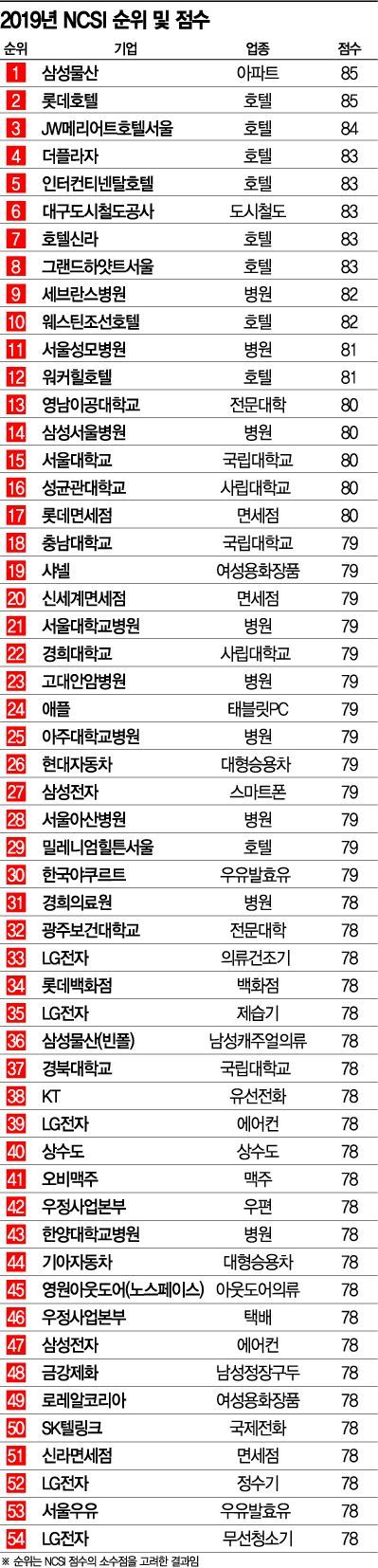
Among all surveyed companies, Samsung C&T in the apartment sector and Lotte Hotel in the hotel service sector received the highest rating of 85 points. The customer satisfaction 'Top 10' included seven hotels along with Daegu Metropolitan Transit Corporation and Severance Hospital. By economic sector, customer satisfaction increased in 9 out of 14 sectors where year-on-year comparison was possible. By industry, 27 out of 76 industries saw higher customer satisfaction compared to the previous year, a decrease from 40 industries the year before. The Korea Productivity Center explained, "There were 10 industries where the company ranked first changed, and 11 industries showed a tie for first place, confirming how fierce the competition was to capture customers' hearts."
Looking at economic sectors, 9 out of 14 sectors improved compared to the previous year, 1 sector remained stagnant, and 4 sectors declined. The sector with the highest improvement rate was 'Water supply, sewage, waste management, and raw material recycling,' which rose 2.6% (2.0 points) year-on-year. Following were 'Non-durable goods manufacturing,' 'Public administration, defense, and social security administration,' and 'Health and social welfare services,' each increasing by 0.8% compared to the previous year. Notably, in non-durable goods manufacturing, tobacco rose 2.7% (2 points) year-on-year. The Korea Productivity Center analyzed, "The diversification of tobacco for electronic cigarettes and the release of lighter, smaller electronic cigarette devices have significantly addressed smokers' needs and inconveniences that had been raised."
Customer satisfaction scores for fermented milk, beer, outdoor clothing, and men's dress shoes also rose by 1.3% compared to the previous year. The increase in customer satisfaction for fermented milk is attributed to the launch of various products such as 'grain topping yogurt' and 'milk containing grains,' meeting consumer needs in line with growing interest in convenient meal replacements. Additionally, the introduction of various functional probiotic products actively responded to consumers' heightened health sensitivity due to environmental changes like fine dust, which was also a key factor.
In the case of outdoor clothing, efforts to shift the focus to lifestyle products encompassing consumers' daily lives, combined with the technical expertise accumulated as an outdoor brand centered on functionality and activity, positively influenced customers' perception of quality. For men's dress shoes, stable product management aligned with casual trends and quality improvement efforts through strengthening the premium handmade shoe lineup were identified as positive influences on customer satisfaction.
On the other hand, the economic sectors where NCSI scores declined were 'Electricity, gas, steam, and air conditioning supply,' 'Wholesale and retail trade,' 'Finance and insurance,' and 'Accommodation and food services.' High customer satisfaction means a higher proportion of customers are likely to remain satisfied and loyal to companies within that sector. It was analyzed that in most industries, as customer satisfaction increases, customer retention rates also rise. The Korea Productivity Center emphasized, "An increase in customer retention rates leads to a higher proportion of premium customers, which is significant for companies as it enhances the long-term growth potential of the respective industry."
© The Asia Business Daily(www.asiae.co.kr). All rights reserved.


















