First Leader of Integration in 40 Years to Be Chosen
Citizen Jury and Regional Touring Primaries Introduced
Final Candidate Expected to Be Decided in Mid-April
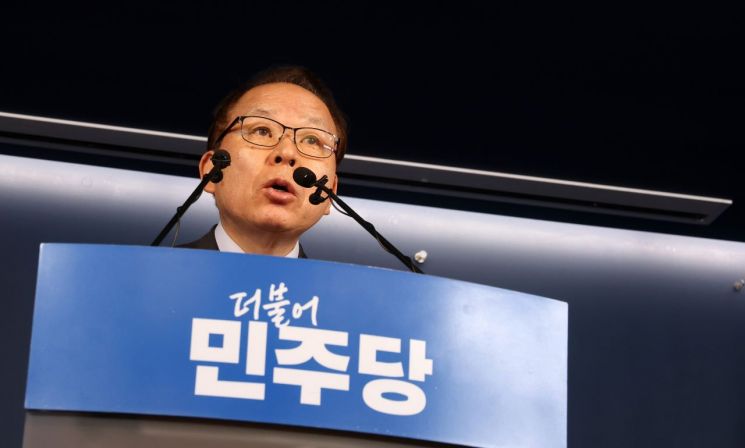 Democratic Party of Korea Nomination Committee Chairman Lee Isu announces the results of the candidate screening at the party headquarters in Yeouido, Seoul, on the 2nd. Photo by Yonhap News
The Democratic Party of Korea has tentatively finalized three main frameworks for selecting the inaugural candidate for the Jeonnam-Gwangju Special Mayor in the upcoming June local elections: narrowing down to a five-person main race after an eight-person preliminary primary, introducing a citizen jury system for candidate selection, and holding regional touring primaries.
This approach is interpreted as an effort to reflect the "spirit of integration" in the primary process, considering the symbolic significance of the Gwangju-Jeonnam integration, which is taking place for the first time in 40 years.
On March 2, the Democratic Party’s Candidate Management Committee announced this primary plan at a press conference at the National Assembly and officially proposed it to the party leadership.
The committee determined that all eight applicants for nomination were qualified and decided to allow them all to participate in the preliminary primary without a cutoff.
In the Gwangju region, Kang Gijeong, Min Hyungbae, Lee Byeonghun, and Jeong Junho are the candidates, while in the Jeonnam region, Kim Yeongrok, Shin Jeonghun, Lee Gaeho, and Joo Cheolhyeon have been listed. With incumbent metropolitan mayors, multiple-term lawmakers, and former ministers all entering the race at once, the primary is being described as "presidential-level."
Although specific details of the preliminary primary method have not been made public, local political circles believe that either a 100% party member vote or the existing standard of "50% party member vote and 50% public opinion poll" is likely. Through joint speeches and debates by region, the candidates will be narrowed down to five, and in the main primary, the citizen jury system and touring voting are expected to be implemented together.
The jury system involves ordinary citizens participating to evaluate each candidate's policy competence and vision for integration. This is intended to go beyond a simple popularity contest and to verify leadership befitting the integrated special city. A preferential voting system, which aims to reduce wasted votes, is also reportedly being considered.
The calculations surrounding the primary rules are becoming increasingly complex.
Gwangju (with a population of about 1.2 million) and Jeonnam (about 1.56 million) differ not only in the size of their electorates but also in the number of party members with voting rights (Gwangju: 130,000; Jeonnam: 180,000). There have been ongoing concerns that if a simple summing method is applied, it may favor candidates from a particular region. This is why the need to apply regional weighting is also being raised.
Regarding the jury system, concerns have been raised about potential conflicts due to opaqueness in the composition process, while the touring primary is also feared to increase costs and encourage organizational mobilization competition.
Meanwhile, the final candidate for Jeonnam-Gwangju Special Mayor is expected to be determined in mid-April.
© The Asia Business Daily(www.asiae.co.kr). All rights reserved.












