As international oil prices have surged due to an attack on Iran by the United States and Israel, there is a growing possibility that Russia, which is at war with Ukraine, will benefit as a result. Industry experts believe that if the Strait of Hormuz, a key shipping route for Middle Eastern oil, were to be completely blocked, countries friendly to Russia-such as China and India-would further increase their imports of Russian oil.
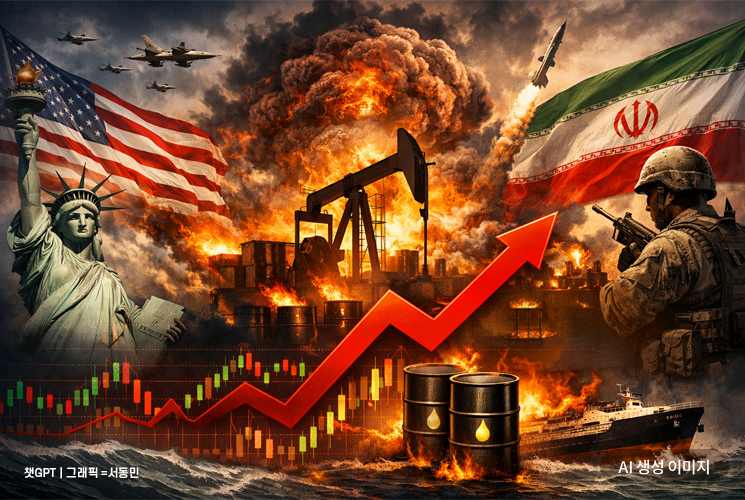
On March 2, the first trading day after the airstrike (local time), international oil prices for West Texas Intermediate (WTI) crude for April delivery were trading at around $72 per barrel (approximately 105,192 won), which is about 8% higher than the previous trading day of February 27.
International oil prices once exceeded $130 per barrel in February 2022 following the outbreak of the war in Ukraine. Prices fell steadily, dropping below $100 in August of the same year. However, as geopolitical uncertainties have increased this year, oil prices have started to rise again.
According to Politico Europe, Kirill Dmitriev, head of Russia’s National Wealth Fund and economic envoy to President Vladimir Putin, expressed optimism on X (formerly Twitter) on February 28, when the U.S. and Israel carried out airstrikes on Iran, stating, "Oil prices will soon exceed $100 per barrel."
Vladimir Solovyov, a host on Russian state TV, described the Iranian airstrike as "a huge benefit to our budget," and argued, "If Trump (the U.S. President) attacks Iranian oil fields, we will become one of the few remaining oil producers."
Market analysts believe that, depending on three factors-complete closure of the Strait of Hormuz, a halt in Iranian oil supply, and whether Middle Eastern oil facilities are attacked-international oil prices could soar well above $100 per barrel.
Iran has repeatedly threatened to blockade the Strait of Hormuz whenever tensions with the United States and Israel have escalated. However, except for temporary restrictions on ship operations for reasons such as military exercises, Iran has never declared a full blockade.
Russia, which relies on oil exports for a significant portion of its war funding, has shifted to selling oil at discounted prices to India and China after sanctions such as price caps and other restrictions blocked sales to Europe and other Western markets. According to a report by the U.S. Energy Information Administration (EIA), in 2024, India imported 34% and China 26% of Russia’s crude oil exports.
Russia had already benefited from higher oil exports in January, following U.S. military intervention in Venezuela. As the United States attempted to seize control of Venezuela’s oil facilities, there were predictions that China, Venezuela’s largest oil customer, would further increase its imports of Russian oil.
China, the world’s largest importer of crude oil, remains heavily dependent on Middle Eastern oil, including from Iran. About one-third of China’s oil imports pass through the Strait of Hormuz. The Associated Press reported that since China buys most of Iran’s oil exports, which total 1.6 million barrels a day, the country may have to seek alternative suppliers. This is expected to push energy prices even higher.
Since the outbreak of the war in Ukraine, Europe has almost completely halted imports of Russian oil, but could face a renewed energy crisis. This is because instability in the Middle East is also causing natural gas prices to spike. On March 2, natural gas for April delivery traded on the Dutch TTF exchange jumped by more than 26% at one point, surpassing 40 euros per megawatt-hour (MWh), or approximately 68,635 won.
The Strait of Hormuz is not only crucial for oil but also accounts for about 20% of global liquefied natural gas (LNG) shipments. Europe has increased imports of U.S. and Qatari natural gas to compensate for the loss of Russian supplies. According to Ole Valbye, a commodities analyst at Sweden’s SEB bank, "About 8-10% of Europe’s LNG imports are indirectly linked to shipments passing through the Strait of Hormuz." He predicted that if gas supplies from the Middle East are disrupted, Asian countries would also seek to secure U.S. LNG, causing European gas prices to soar.
© The Asia Business Daily(www.asiae.co.kr). All rights reserved.












