Geopolitical Risks Rise with U.S. Airstrike on Iran
Investments Also Flow to Male Pattern Hair Loss Treatment Developers
As the domestic stock market surged sharply in a short period, funds have increasingly flowed into inverse exchange-traded funds (ETFs) that bet on a decline in Korean stock prices.
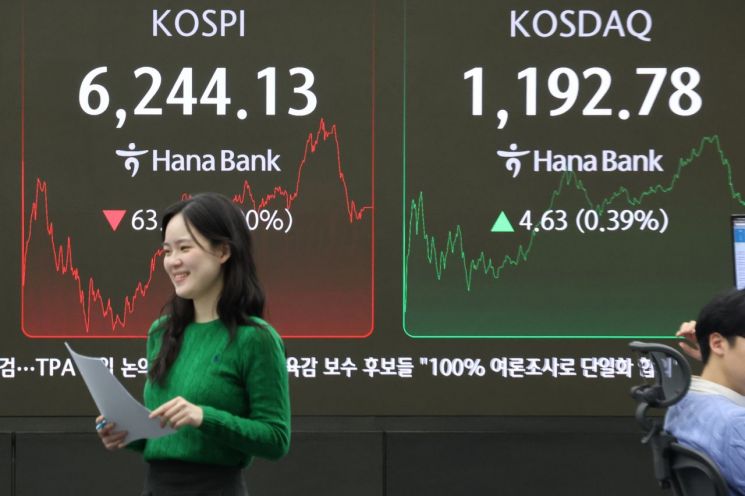
According to Korea Investment & Securities on March 2, high-net-worth individuals with an average balance of more than 1 billion won who invest through the company made net purchases totaling 9.9 billion won of "KODEX 200 Futures Inverse 2X" between February 20 and 26. This was the largest amount among all domestic listed stocks and ETFs. This ETF seeks to deliver twice the inverse performance of the KOSPI 200 futures index, generating profits when domestic stock prices fall. Since the KOSPI index soared by as much as 44.89% in just two months this year, it is interpreted that wealthy investors are betting on the possibility of a short-term correction.
It was not only high-net-worth individuals who invested in "KODEX 200 Futures Inverse 2X." According to the Korea Exchange, this ETF attracted 170.9 billion won in inflows last week, ranking fifth among all domestic ETFs in terms of net capital inflow. Over the past month, 528.1 billion won has flowed into this ETF. "KODEX Inverse," which tracks the KOSPI index inversely, has also attracted more than 450 billion won so far this year.
The "KODEX 200 Futures Inverse 2X" returned -16.78% last week, and all major inverse ETFs betting against the domestic stock market recorded negative returns last week. However, there are predictions that the situation could change starting from March 3, when the market reopens after the U.S. airstrike on Iran. This is because the Korean stock market tends to react sensitively when global liquidity moves out of risk assets.
The second-largest net purchase among high-net-worth investors was Inventage Lab, a bio company (approximately 9 billion won). This company is developing a candidate substance for the treatment of male-pattern hair loss. Recently, it received approval for a Phase 2 clinical trial of its candidate in Australia and also operates a technology platform that converts intravenous (IV) injections into subcutaneous (SC) injections.
Significant amounts of high-net-worth investor funds also went into LS (5.6 billion won) and Peptron (5.6 billion won). Holding company SK, which has SK hynix as its grandchild company (approximately 5.5 billion won), and Korea Financial Group, which oversees Korea Investment & Securities (approximately 5.2 billion won), also saw large net purchases. These companies are expected to benefit from the third amendment to the Commercial Act, which focuses on the mandatory cancellation of treasury shares.
Meanwhile, among the top 1% of investors in terms of returns using Mirae Asset Securities, POSCO Holdings was the most actively purchased between February 20 and 27. This is analyzed as being due to expectations of performance improvement across all divisions of POSCO Holdings. SK Eterynics, Hyundai Motor, and Harim Holdings followed in terms of net purchases.
© The Asia Business Daily(www.asiae.co.kr). All rights reserved.












