Emergency Response Maintained Amid Possibility of Prolonged Crisis, Including Possible Hormuz Blockade
Power Public Enterprises and Korea Energy Economics Institute Review Supply and Overseas Project Safety
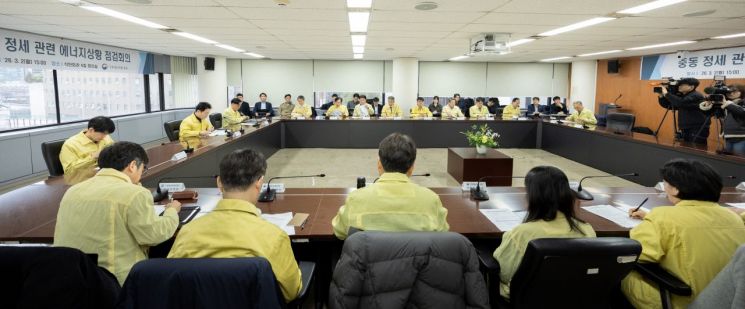 The Ministry of Climate, Energy and Environment held an energy situation review meeting on the 2nd at the Korea Mine Reclamation Corporation Gyeongin Branch in Jongno-gu, Seoul, chaired by Vice Minister Ho-hyun Lee, to assess the impact on domestic electric power public corporations and review response plans in relation to the Middle East situation. Ministry of Climate, Energy and Environment,
Lee Hohyun, the Second Vice Minister of the Ministry of Climate, Energy and Environment, stated on March 2 that the short-term impact of instability in the Middle East on the domestic electricity market would be limited.
On this day, Vice Minister Lee held an "Energy Situation Review Meeting" with the Korea Power Exchange, Korea Electric Power Corporation, Korea Hydro & Nuclear Power, the five major power generation companies, and the Korea Energy Economics Institute in attendance. The meeting was convened to review the current electricity supply and demand status, the impact of the Middle East situation, and the response plans of electric power public enterprises. This meeting was organized in response to heightened uncertainty in the Middle East following the U.S.-Israel airstrike on Iran on February 28.
Vice Minister Lee emphasized, "The current situation in the Middle East is extremely serious," adding, "In these uncertain times, the Ministry of Climate, Energy and Environment and electric power public enterprises must work together to minimize the impact on the energy industry and ensure a stable electricity supply."
According to the Ministry, there has been no direct impact of the Middle East situation on the domestic power supply so far. The analysis suggests that, due to seasonal factors such as decreased power demand in the spring and the fact that increases in oil prices are typically reflected in LNG prices for the electricity market with a time lag of three to six months, short-term shocks are not expected to be significant.
It was also confirmed that there is no direct supply disruption regarding bituminous coal and directly imported LNG purchased by the power generation public enterprises, as there are no supplies sourced from the Middle East.
However, the government has decided to prepare for the possibility of a prolonged crisis. In particular, assuming scenarios such as a blockade of the Strait of Hormuz leading to a sharp rise in oil prices or disruptions in gas imports, the government will strengthen monitoring of the Middle East region together with the electric power public enterprises and maintain an emergency response system.
Upon reviewing major projects currently being pursued by Korea Electric Power Corporation and its power generation subsidiaries in the Middle East, it was found that there has been no direct impact so far.
The Ministry of Climate, Energy and Environment plans to operate an Energy Emergency Response Team together with electric power public enterprises to continuously monitor related impacts and respond swiftly to any changes in the situation.
© The Asia Business Daily(www.asiae.co.kr). All rights reserved.












