2,655 Violations Detected on 3,139 Departures from Incheon During Lunar New Year Holiday
94.2% Involved Attempt to Check Portable Batteries as Hold Baggage
During this year's Lunar New Year holiday period, it was found that, on average, one passenger per departing flight from Incheon International Airport violated regulations on carrying portable batteries.
According to Incheon International Airport Corporation on March 2, the total number of violations of portable battery regulations detected at Incheon International Airport from February 13 to 18-the day before the Lunar New Year holiday through the end of the holiday-was tallied at 2,655 cases.
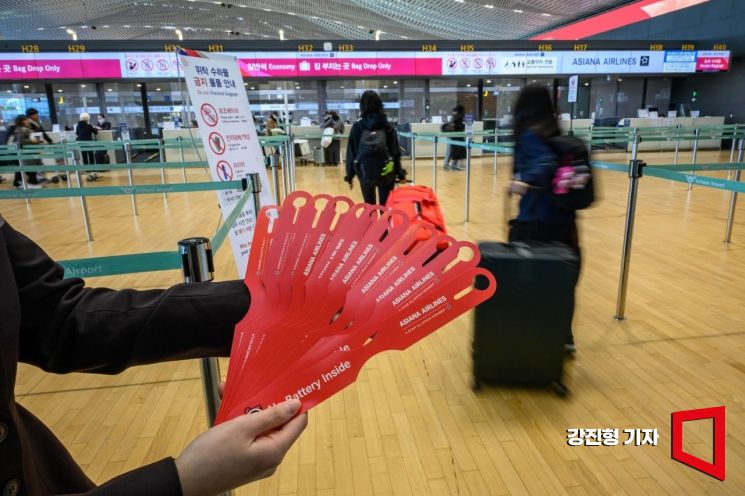 On January 14, when Asiana Airlines started operations at Incheon Airport Terminal 2, an employee at the Asiana Airlines check-in counter at Incheon International Airport Terminal 2 was handing out 'NO BATTERY' tags.
Given that a total of 3,139 passenger flights departed from Incheon Airport during this period, this means there was an average of 0.85 violations per flight, or violations occurred on 8 to 9 out of every 10 flights.
By type, the vast majority-2,502 cases (94.2%)-involved passengers attempting to check in portable batteries as checked baggage. The reason for restricting this is that if a fire occurs in a portable battery stored in the cargo hold during flight, initial suppression is virtually impossible and this could lead directly to a major disaster. There were 153 cases (5.8%) where passengers carried batteries but violated carry-on regulations regarding capacity or quantity.
The Ministry of Land, Infrastructure and Transport implemented a strengthened standard for the safety management system of lithium-ion portable batteries in March last year, following a fire incident on an Air Busan passenger aircraft at Gimhae Airport in January 2023. As a result, portable batteries cannot be checked in as hold baggage. Even when carried onboard, restrictions such as a maximum of five batteries per person with a capacity of up to 100Wh must be observed. For batteries between 100Wh and 160Wh, up to two are allowed, but airline approval is required.
In cases where portable batteries are found in checked baggage in violation of the regulations, the airline will either call the passenger to carry the batteries onboard personally or dispose of them. If the batteries are carried onboard but the passenger did not comply with capacity or quantity restrictions, the batteries will be either disposed of or the passenger will be sent back to the departure area so that a companion can carry them.
Recently, as incidents of onboard fires caused by lithium-ion cells embedded in portable batteries have continued to occur, airlines both in Korea and abroad have been tightening regulations on carrying portable batteries in the cabin. Accordingly, as of around February 23, all 11 domestic airlines have instituted a complete ban on charging electronic devices such as mobile phones and laptops with portable batteries inside the aircraft cabin.
© The Asia Business Daily(www.asiae.co.kr). All rights reserved.












