Report from the Korea Transport Institute Journal
Cost Reduction When Applying Basic Pension Eligibility Criteria
Greater Savings Than Raising Age to 70 or 75... Sustainable Over the Long Term
An analysis has found that restructuring the current subway fare exemption system for those aged 65 and over based on income criteria would result in greater cost savings than simply raising the age for free rides.
On March 2, Yonhap News cited a report titled "Improvement Measures for the Subway Free Ride System in an Aging Society," published in the journal "Transportation Research" by the Korea Transport Institute, to deliver these findings.
According to the report, if the current system of providing 100% free rides to all individuals aged 65 and over is maintained on the Seoul subway (Lines 1 to 9), the estimated cost of these free rides is projected to reach 379.7 billion won in 2030. With the increasing elderly population, this cost is expected to rise to 437 billion won by 2035 and 501.9 billion won by 2040.
These figures were calculated by applying the standard fare at the time of the study (1,400 won) to the estimated number of elderly passengers, based on population projections by age group and statistics on senior preferential tickets from 2019 to 2024. If future fare increases are factored in, the actual financial burden could be even higher.
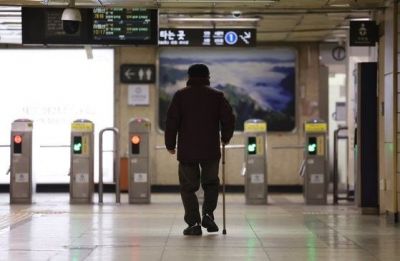
The report also simulated scenarios where the minimum age for free rides would be raised to 70, 75, or 80. If the age is increased to 70, the cost of free rides in 2030 would decrease to 267.5 billion won, down by 29.6%. Raising it to 75 would reduce the cost to 164.1 billion won, a 56.8% decrease, and adjusting it to 80 would lower the cost to 91.9 billion won, a 75.8% reduction. However, the analysis noted that as time goes on and the aging population intensifies, the cost-saving effect gradually diminishes. In particular, raising the age to 80 could pose significant challenges in terms of social acceptance and welfare considerations.
In contrast, the cost-saving effect was even greater when applying the basic pension eligibility criteria-granting full exemptions only to the bottom 70% of elderly people by income and requiring the top 30% to pay the full fare. In this scenario, the cost of free rides in 2030 would be estimated at 107.6 billion won, a 71.7% reduction compared to maintaining the current system. By 2035, the cost would decrease to 102.7 billion won (76.5% reduction), and by 2040, to 92.5 billion won (81.6% reduction), indicating that this method would be more effective over the long term than simply raising the age threshold.
The approach of granting full exemptions only to recipients of the National Basic Livelihood Security Program, while requiring all other elderly individuals to pay 50% of the fare, would result in a 37.1% to 40.2% reduction in costs between 2030 and 2040, making it less effective than applying the basic pension eligibility criteria.
The report also introduced overseas examples. In Paris, free public transportation is provided to seniors aged 65 and over whose income is below a certain threshold. In Japan, low-income individuals aged 70 and over are eligible for discounted unlimited transit passes. In both cases, benefits are differentiated according to income level.
© The Asia Business Daily(www.asiae.co.kr). All rights reserved.












