With People Power Party Boycotting, Jeonnam-Gwangju Integration Act Passes with 159 Votes in Favor out of 175 Present
Child Allowance Eligibility Gradually Extended to Age 13
The special act and the amendment to the Local Autonomy Act for the administrative integration of Jeonnam and Gwangju regions passed the National Assembly plenary session on March 1, 2026. Lawmakers from the People Power Party boycotted the session in protest against the unilateral passage of the bills by the ruling party. However, the People Power Party decided to end the previously scheduled unlimited debate (filibuster), bringing the plenary session to a close after six days and five nights.
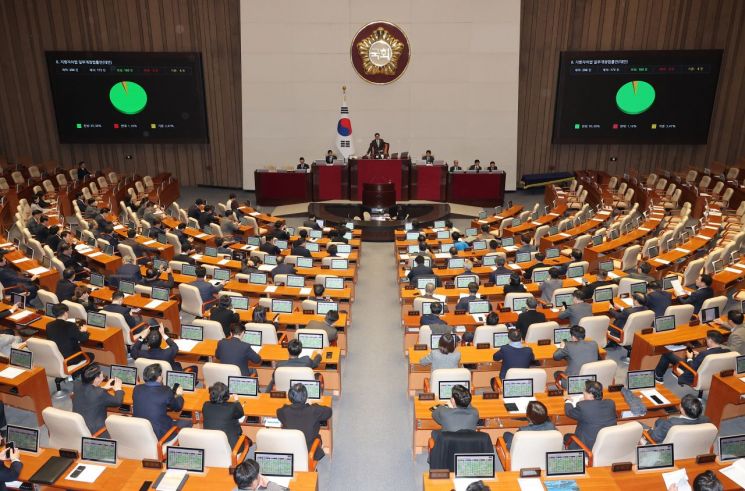
During the session, the National Assembly voted on the "Special Act on the Establishment of the Jeonnam-Gwangju Integrated Metropolitan City" and the amendment to the Local Autonomy Act. The special act passed with 159 votes in favor, 2 against, and 14 abstentions out of 175 lawmakers present. The amendment to the Local Autonomy Act passed with 165 votes in favor, 2 against, and 6 abstentions out of 173 lawmakers present.
The special act grants the Jeonnam-Gwangju Integrated Metropolitan City a status equivalent to that of Seoul Metropolitan City and includes provisions for special cases related to national financial support and educational autonomy. The act also covers the creation and management of a balanced development fund within the integrated city, as well as local tax reductions for development projects. It also specifies that there will be four deputy mayors in the integrated city.
Although a plenary session was held on February 24, the session continued overnight as the People Power Party requested a filibuster in opposition to the ruling party’s push for the passage of three judicial reform bills (the distortion of justice law, the appeal for retrial law, and increasing the number of Supreme Court justices). The plenary session was initially expected to continue until March 3 with the filibuster in progress, but on March 1, the People Power Party ended the filibuster, demanding the passage of a special act for the administrative integration of Daegu and North Gyeongsang Province.
Song Eon-seok, floor leader of the People Power Party, stated, "The administrative integration of Daegu and North Gyeongsang Province is supported by the Daegu Metropolitan Government, the North Gyeongsang Provincial Government, the Daegu City Council, and the North Gyeongsang Provincial Council. Therefore, I urge the Democratic Party to stop making excuses and process the integration bill." Regarding Chu Mi-ae, the chair of the Legislation and Judiciary Committee of the National Assembly (Democratic Party member), who holds the key to the passage of the Daegu-Gyeongbuk integration bill and has declared that the committee cannot be convened due to the filibuster, Song commented, "Chair Chu said the committee cannot be convened because of the filibuster, so today we decided to end the filibuster. However, there is still no news about the committee being convened."
Before the special act was passed during the plenary session, the amendment to the National Referendum Act, which guarantees referendum voting rights for overseas citizens, was also passed. The previous day, the Democratic Party had removed a clause from the proposed amendment before the plenary session that would have imposed imprisonment for up to 10 years or fines of 5 million to 30 million won on those who continually spread false information regarding advance voting, referendums, and ballot counting. This clause had been opposed by opposition parties and others.
The amendment to the Child Allowance Act also passed the plenary session. The amendment stipulates that the eligibility age for the child allowance will be gradually raised from the current under 8 years old to under 13 years old by 2030. It also provides an additional monthly payment of 5,000 won for children living outside the metropolitan area. For 49 cities, counties, and districts designated as "priority areas" among regions with population decline, such as Gapyeong-gun in Gyeonggi Province, children will receive an extra 10,000 won per month. For 40 areas designated as "special areas," such as Yanggu-gun in Gangwon Province, children will receive an additional 20,000 won per month. The bill was originally expected to be put to a vote after a planned eight-day, seven-night filibuster, but was processed on March 1, as the People Power Party announced the suspension of the filibuster.
© The Asia Business Daily(www.asiae.co.kr). All rights reserved.












