Legislative Gap Closed After 11 Years: Constitutional Referendum on June 3 Now Possible
Controversial "Penalty for Spreading False Information" Provision Removed
The amendment to the National Referendum Act, which forms the essential legal foundation for constitutional revision, passed the plenary session of the National Assembly on March 1. With the guarantee of overseas Koreans' voting rights-which had been neglected for more than 10 years since the Constitutional Court's decision of unconstitutionality-discussions among political circles to hold a national referendum on constitutional amendment alongside the local elections on June 3 are expected to gain significant momentum.
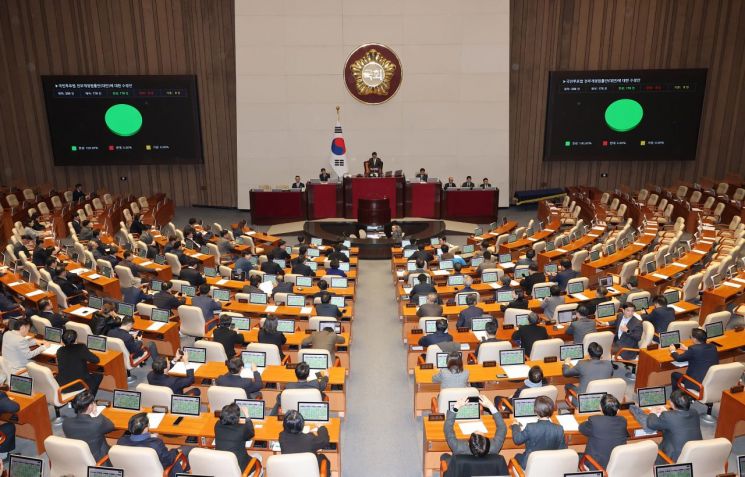
On this day, the National Assembly held a plenary session and approved the amendment to the National Referendum Act with unanimous consent from all 176 lawmakers present. The core of this amendment is the resolution of the issue concerning the restriction of overseas Koreans' voting rights, which the Constitutional Court had declared unconstitutional in 2014. Until now, the participation of overseas Koreans in voting had been blocked, making it virtually impossible to conduct a national referendum. However, with this legislative change, administrative obstacles to discussions on constitutional revision have been removed.
National Assembly Speaker Woo Wonshik had continuously and strongly urged for the passage of this bill, stating, "Let us hold the June 3 local elections and the constitutional amendment referendum simultaneously."
The provision in the original draft-imposing criminal penalties such as imprisonment of up to 10 years for spreading false information related to the National Election Commission-was deleted from the final version. The Democratic Party of Korea decided to remove this provision after accepting criticism that it constituted legislative overreach, which was discussed and agreed upon at a general assembly of lawmakers held just before the plenary session. The deleted provision had stipulated strong penalties for spreading false information related to early voting or ballot counting.
The People Power Party responded to the Democratic Party's push for passage by launching a filibuster, starting with Assemblyman Park Deokheum, but abruptly ended the effort after 19 hours. This was because Song Eonseok, floor leader of the People Power Party, decided to halt the debate, demanding that the Legislation and Judiciary Committee address the Special Act on Administrative Integration for the Daegu-Gyeongbuk (TK) region. The move is interpreted as a 'strategic choice' to abandon opposition to the National Referendum Act in order to prioritize the passage of the TK Integration Act, a long-standing regional demand.
© The Asia Business Daily(www.asiae.co.kr). All rights reserved.












