More EVs Equipped with High-Capacity Batteries over 80kWh
Decline in EVs with 60?80kWh Batteries
Expansion of North American ESS Market... Opportunity for K-Batteries to Replace Chinese Competitors
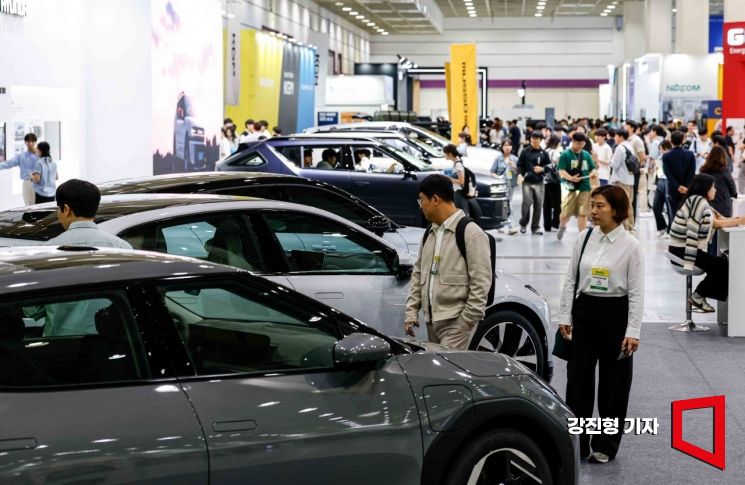 On June 4, visitors attending 'EV Trend Korea' held at COEX in Gangnam-gu, Seoul, are seen viewing various electric vehicles displayed at the venue. 2025.6.4. Photo by Kang Jinhyung
With the expansion of the electric vehicle (EV) market, it has been analyzed that the market itself is becoming increasingly polarized. There is a growing proportion of vehicles equipped with large batteries suitable for long-distance driving, as well as an increase in affordable EVs designed specifically for commuting. In contrast, the market share for mid-range EVs with ambiguous driving ranges is gradually declining.
According to SNE Research, a secondary battery market research firm, on March 2, the proportion of EVs equipped with batteries of at least 80 kilowatt-hours (kWh) increased from 35.5% in 2024 to 40.5% last year. The share of EVs with batteries exceeding 100kWh also rose from 11.6% to 12.4% over the same period.
The demand for EVs capable of long-distance driving on a single charge is growing among consumers, leading to an increase in the number of vehicles equipped with high-capacity batteries. Typically, an EV with an 80kWh battery can travel 400 to 500 kilometers on a single charge.
Interestingly, the market for short-range EVs with battery capacities of 40-60kWh or less has also expanded. The share of EVs in this category grew from 21% in 2024 to 24% last year. This reflects demand from consumers seeking affordable EVs for commuting, as well as new purchases of EVs in emerging markets.
On the other hand, the share of EVs with 60-80kWh batteries-previously the largest segment-declined significantly from 41.7% in 2024 to 33.2% last year.
In relation to this trend, at the 'K-Battery, Next Frontier' webinar hosted by SNE Research on February 27, SNE Research Executive Director Seo Jeongkyu explained, "The EV market also appears to be gradually dividing into large-capacity and short-range segments."
SNE Research forecasts continued difficulties in the North American EV market, which is the main market for domestic battery companies, following a 0.5% contraction last year. The company expects these challenges to persist until 2027, with the North American EV market only recovering to growth rates in the 10% range in 2028.
In contrast, the North American ESS (Energy Storage System) market is expected to recover its growth momentum from 2026. SNE Research stated, "The North American ESS battery market declined in 2025 due to high tariffs on Chinese batteries. However, as K-battery companies convert their North American EV production lines to ESS use and continue to invest, sales are expected to increase from 2026 onward."
Chinese batteries, which had dominated the North American ESS market, are expected to rapidly lose their foothold after 2028 due to high tariffs and U.S. government regulations. K-batteries are anticipated to take their place.
SNE Research projects that the market share of Korean batteries in the North American ESS market will increase from 23% in 2025 to 64% this year. However, as prismatic lithium iron phosphate (LFP) batteries hold an overwhelmingly high share in the North American ESS battery market, K-battery companies will need to respond quickly to this trend.
According to SNE Research, the share of LFP batteries in the North American ESS market is expected to rise from 95% in 2026 to 99% by 2035. The proportion of prismatic batteries is also projected to increase from 95% to 98% over the same period.
© The Asia Business Daily(www.asiae.co.kr). All rights reserved.












